 Sanjay Verma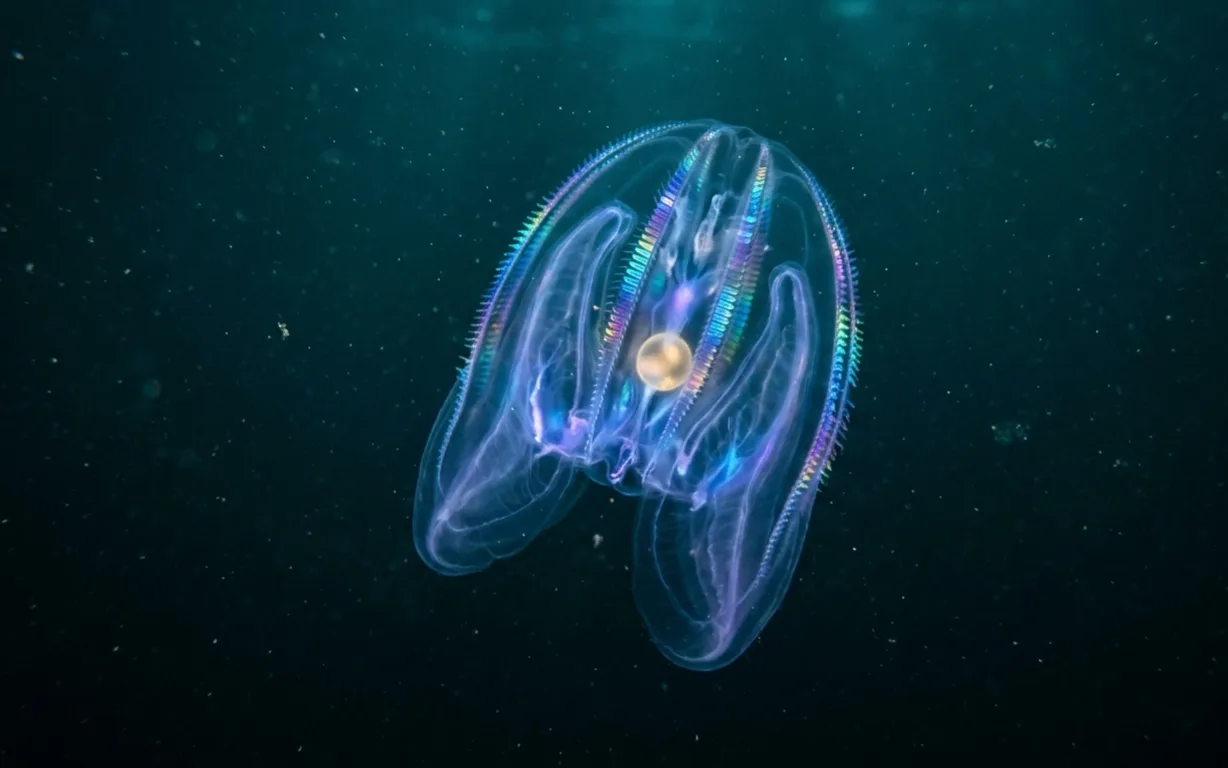
In This Article
- The 100-Year-Old Discovery That Started It All
- What Made This Tiny Sea Creature Worth Studying
- How Did Scientists Prove the Comb Jelly Has an Organizer?
- The Chemical Signals Behind the Body Blueprint
- What This Means for the Story of All Animal Life
Take a tiny piece of tissue from one comb jelly embryo, stick it onto another, and watch a second fully working mouth grow from scratch. That is exactly what scientists just did — and it tells us something profound about how every animal on Earth, including you, gets its body shape. Published in Nature in 2026, the study shows that the embryonic organizer, a signal long thought to be the special trick of more advanced animals, was already present in one of the oldest animal groups alive today.
The 100-Year-Old Discovery That Started It All
Back in 1924, two German scientists named Hilde Mangold and Hans Spemann did something remarkable with frog embryos. They cut out a tiny patch of tissue called the blastopore lip, the small region where the embryo first starts to fold inward during early development, and transplanted it into a different embryo. The result was astonishing: a second full body axis grew. The host embryo had two complete sets of body structures.
That experiment proved one of biology's biggest ideas: certain cells in a young embryo act as a master controller. They tell every nearby cell what to become, whether that is part of a head, a gut, or a tail. Scientists called this the embryonic organizer. It earned Spemann the Nobel Prize.
For decades, scientists confirmed this organizer existed in frogs, fish, zebrafish, and even sea anemones. But a huge question remained unanswered: how old is it, really? Was it something that evolved multiple times, or did every living animal inherit it from the same ancient ancestor? To answer that, researchers needed to find it in the oldest type of animal still alive. And that answer surprised even the researchers behind the study.
What Made This Tiny Sea Creature Worth Studying
Comb jellies, known to scientists as ctenophores, look like soft, glowing jellyfish drifting through the ocean. They are not jellies at all, but their own separate group entirely. What makes them special is their position on the family tree of life: they sit at the very base, branching off before every other type of animal, including sponges, worms, insects, and vertebrates like us.
That makes comb jellies a living window into the earliest chapter of animal life. If they have the embryonic organizer, it means the organizer existed in the very first multicellular animals. If they do not, then the organizer evolved independently in different animal groups, which would tell a very different story.
The species chosen for the study was Mnemiopsis leidyi, a small comb jelly common in coastal Atlantic waters. Its embryo develops quickly and is transparent, making it ideal for watching exactly what happens under the microscope when tiny tissue transplants are made. [INTERNAL LINK: what are ctenophores]
How Did Scientists Prove the Comb Jelly Has an Organizer?
The team at Friedrich Schiller University Jena, led by Stanislav Kremnyov and Andreas Hejnol, took a page directly from the 1924 Spemann-Mangold playbook. They cut tiny pieces of tissue from the blastopore lip region of a comb jelly embryo at the gastrula stage, which is when the embryo begins to form its basic layers, and transplanted those pieces into host embryos.
In 41.8% of the 67 transplantations, the host embryo grew a completely new pharynx, the tube-like throat structure, complete with a working mouth opening. Both the original and the new mouth could catch and eat food. Both connected to the same shared digestive system. The embryo had, in effect, been given two fronts.
"Transplanting only the blastopore lip of a comb jelly embryo can induce ectopic development of the fully formed axial structures."
— Kremnyov et al., Friedrich Schiller University Jena · Nature, 2026To confirm the new structures were not just copies of the transplanted tissue, the team used coloured dyes to track exactly which cells came from the donor and which came from the host. The new pharynx contained a mix of both. The transplanted cells had recruited the host's own cells and directed them to build new structures. That is the textbook definition of an organizer at work.
They then pushed the experiment further: they took comb jelly blastopore lip tissue and transplanted it into embryos of a completely different animal, the sea anemone Nematostella vectensis. Despite these two animals being separated by hundreds of millions of years of evolution, the comb jelly tissue triggered the anemone's cells to start forming a second body axis. The organizer signal crossed the species boundary entirely.
The Chemical Signals Behind the Body Blueprint
Knowing the organizer exists is one thing. Understanding how it works is another. The researchers traced the signal to two chemical pathways: beta-catenin, a molecule that acts inside cells, and TGFβ (transforming growth factor beta), a family of proteins that cells release to communicate with their neighbours.
When the team blocked beta-catenin signalling in comb jelly embryos using a chemical inhibitor, the normal pharynx failed to develop properly. When they blocked TGFβ, the same thing happened. Both signals were essential. Neither alone was enough.
The team even injected the specific TGFβ proteins produced near the comb jelly's blastopore directly into embryos and watched 57% of them develop branching pharynxes or extra mouths. The proteins alone were enough to trigger the body-building program. These same proteins, when injected into sea anemone embryos, caused the anemone cells to start forming a second axis too.
What This Means for the Story of All Animal Life
Before the first animals existed, life on Earth was entirely single-celled. Single-celled organisms grow by dividing in time, one cell becomes two, two become four, always following a clock. When the first multicellular animals appeared, something entirely new was required: cells needed to grow in space, knowing their position, whether to become the front or the back, the outside or the inside.
The embryonic organizer is what made that possible. It was the invention that allowed a blob of identical cells to become a body with a head and a tail. And this study places that invention right at the beginning of animal life, not later in the evolution of more complex groups.
- Deepest origin confirmed: The embryonic organizer dates back to the common ancestor of all living animals, over 700 million years ago.
- Cross-species signal works: Comb jelly organizer tissue can direct body formation in sea anemone embryos, proving the molecular language is shared across the entire animal kingdom.
- TGFβ is the key messenger: The proteins released at the comb jelly's blastopore carry the inductive signal, and the same proteins trigger body-axis formation in a completely different animal species.
The study does carry limitations worth noting. The cross-species transplantation only worked in one direction, comb jelly tissue into sea anemone embryos, because comb jelly cells do not stick well to sea anemone tissue in the reverse experiment. Researchers also acknowledge that confirming the full set of molecular details in comb jellies will require further work, given the considerable evolutionary distance from other well-studied animals. What the data confirms is the organisational principle and the core signalling logic, not every downstream gene in the network.
"The emergence of this signalling pathway probably played a key part in the origin of the embryonic organizer during the transition to complex multicellularity." — Kremnyov et al., Nature, 2026.
There is something almost vertiginous about what this implies. When you were a few days old as an embryo, a small group of your cells was issuing instructions that determined the shape of your entire body. That same conversation, using the same chemical words, was happening 700 million years ago in the very first creatures that ever had a body to speak of. The blueprint is that old. And a glowing, drifting sea creature that most people have never heard of just helped us prove it.
📄 Source & Citation
Primary Source: Kremnyov S, Lebedeva T, Genikhovich G, & Hejnol A. (2026). A blastoporal organizer in a ctenophore. Nature. https://doi.org/10.1038/s41586-026-10643-z
Authors & Affiliations: Stanislav Kremnyov and Andreas Hejnol (Institute of Zoology and Evolutionary Research, Friedrich Schiller University Jena, Germany); Grigory Genikhovich (Department of Neurosciences and Developmental Biology, University of Vienna, Austria)
Data & Code: Available via the paper's supplementary materials and extended data at the Nature DOI link above.
Key Themes: Embryonic Organizer · Ctenophore Biology · Animal Evolution · TGFβ Signalling · Multicellularity Origin
Supporting References:
[1] Spemann H & Mangold H. (1924). Über induktion von embryonalanlagen durch implantation artfremder organisatoren. Arch. Für Mikrosk. Anat. Entwicklungsmechanik, 100:599–638.
[2] Kraus Y et al. (2016). Pre-bilaterian origin of the blastoporal axial organizer. Nature Communications, 7:11694.
[3] Schultz DT et al. (2023). Ancient gene linkages support ctenophores as sister to other animals. Nature, 618:110–117.
No comments yet. Be the first to share your thoughts.
Leave a Comment