 Sanjay Verma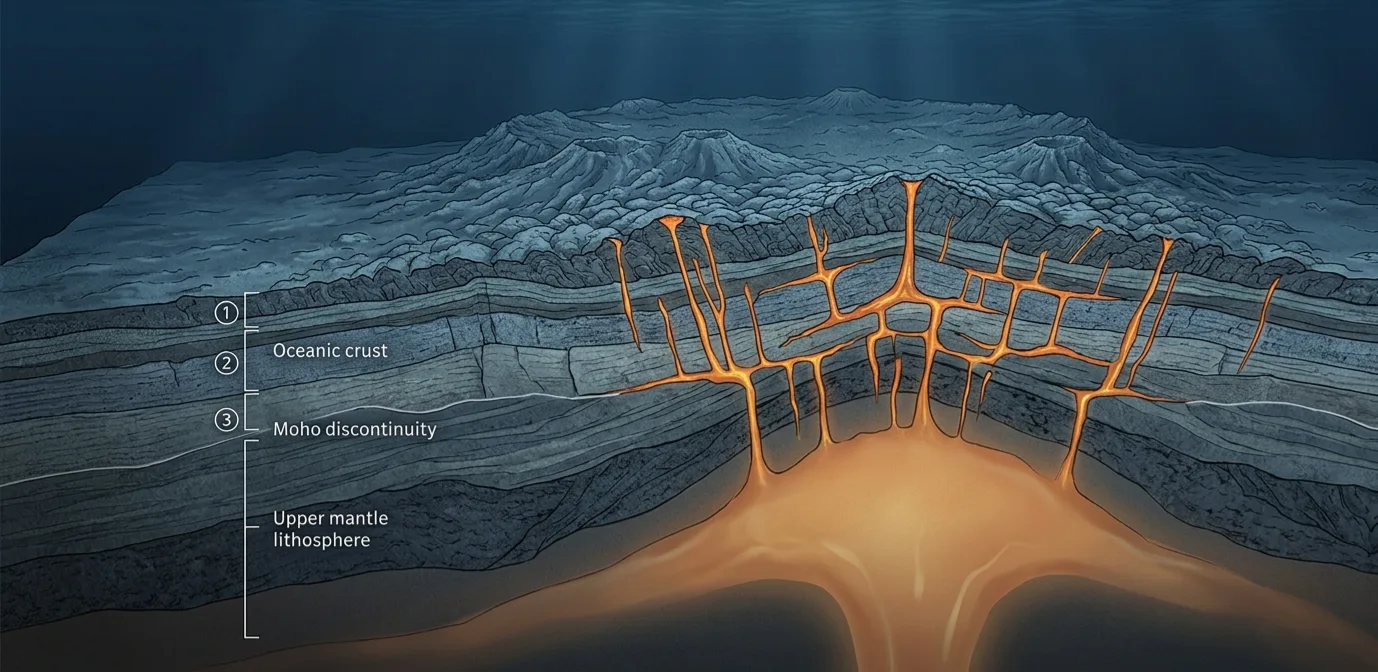
In This Article
- What Makes the Ontong Java Plateau So Strange
- Why Scientists Couldn't See Inside the Plateau Before
- How Did Scientists Find Frozen Magma Channels Inside the Seafloor?
- What This Discovery Means Beyond a Remote Pacific Plateau
- The Questions That Still Need Answering
Somewhere under the western Pacific Ocean sits a slab of ancient volcanic rock so massive it could swallow the entire island of Great Britain eight times over. It is called the Ontong Java Plateau, and for decades nobody knew exactly how magma reached the surface to build it. Now, a team of Japanese scientists has found something remarkable frozen inside the seafloor's crust: narrow vertical scars, left behind by molten rock forcing its way upward. The discovery, published in Geophysical Research Letters, finally reveals the plumbing that built Earth's biggest underwater plateau.
What Makes the Ontong Java Plateau So Strange
Picture an enormous underwater tabletop bigger than the country of France, built almost entirely during one geological instant. That is the Ontong Java Plateau, the largest large igneous province on Earth, formed by a burst of volcanism around 110 to 120 million years ago. Most volcanic islands sink slowly back into the ocean after they form, worn down by their own weight. The Ontong Java Plateau barely sank at all, a clue that the usual explanation for giant eruptions could not be the whole story.
Why Scientists Couldn't See Inside the Plateau Before
Earlier work used slow, low-frequency sound waves to map the plateau's structure. Those waves are good at spotting big features, such as the fact that the lithosphere, the rigid outer shell of rock beneath the ocean floor, is about 40 kilometers thicker under Ontong Java than in the surrounding seabed, according to a 2021 study in Communications Earth & Environment. But low-frequency waves are blunt tools. They could never pick out cracks only a few kilometers wide. So the new team switched to fast, high-frequency seismic waves instead, sharp enough to catch fine detail most surveys miss.
How Did Scientists Find Frozen Magma Channels Inside the Seafloor?
The team studied two special types of high-frequency seismic signals called Po and So waves, which skim long distances through the ocean's rocky lid after an earthquake. Beneath Ontong Java, the So wave arrived weaker and later than expected, losing far more energy than waves crossing normal seafloor nearby in the northwest Pacific. Computer simulations showed that a smooth, evenly layered lithosphere alone could not reproduce that pattern. Only a model with narrow, vertical streaks of altered rock, cutting through the normal horizontal layers like scratches through wood grain, matched the real data. Those streaks are fossil dike swarms, the leftover cracks that once carried magma from deep in the mantle toward the surface.
"A hybrid structure comprising dike swarms superimposed on the laminar structure."
— Azusa Shito et al., Okayama University of Science · Geophysical Research Letters, 2025What This Discovery Means Beyond a Remote Pacific Plateau
These fossil magma channels are not just a curiosity. They show that the melt reaching the surface at Ontong Java travelled from far deeper in the Earth than a shallow pool of trapped magma could explain, backing the idea of a genuine deep mantle plume, the kind of rising heat column first described in classic work on large igneous provinces published in Reviews of Geophysics. The rock also came back chemically altered. Partial melting had stripped iron out of the surrounding mantle, and the study suggests some of that iron was later pushed back in as magma forced its way through the same lithosphere, softening the rock and slowing the seismic waves that cross it even today.
The Questions That Still Need Answering
The study relied on a flat, two-dimensional computer model, because the scattered network of seafloor sensors across this remote plateau could not support anything more detailed. That means the exact density and spacing of the dike swarms across the whole plateau remains a rough sketch, not a precise map. Researchers at the Japan Agency for Marine-Earth Science and Technology plan to build three-dimensional models next, work that should reveal whether the magma channels clustered most densely at the plateau's thickened center, where sharp boundaries between rock layers were first mapped by a 2009 study in Science.
- Fossil magma channels — Vertical dike swarms frozen inside the seafloor mark the exact path molten rock once took to reach the surface.
- Slower, softer rock — The lithosphere under the Ontong Java Plateau carries seismic waves roughly 4 percent slower, hinting at deep chemical change.
- A deeper origin confirmed — The pattern backs a genuine mantle plume rising from great depth, not a shallow trapped pool of magma.
Every planet keeps a record of its violent beginnings, written not in fire but in the quiet architecture of stone. The Ontong Java Plateau is proof that even the ground beneath an ocean remembers exactly how it was made.
The findings give researchers a clearer picture of how magma physically reworked ancient ocean floor from below, leaving behind a chemical fingerprint that has outlasted the volcanic activity that created it. — Shito et al., Geophysical Research Letters, 2025.
📄 Source & Citation
Primary Source: Shito, A., Suetsugu, D., Ishikawa, A., Yoshikawa, M., Isse, T., Shiobara, H., et al. (2025). Dike swarms in the oceanic lithosphere beneath the Ontong Java Plateau. Geophysical Research Letters, 52, e2025GL115219. https://doi.org/10.1029/2025GL115219
Authors & Affiliations: Azusa Shito (Okayama University of Science) with Daisuke Suetsugu, Akira Ishikawa, Masako Yoshikawa, and colleagues from the Japan Agency for Marine-Earth Science and Technology, the University of Tokyo, Kobe University, and Hiroshima University.
Data & Code: Waveform data available via the Ocean Hemisphere Project Data Management Center (ohpdmc.eri.u-tokyo.ac.jp); global earthquake catalog via USGS; global CMT catalog via globalcmt.org.
Key Themes: Ontong Java Plateau · Mantle plume · Dike swarms · Oceanic lithosphere · High-frequency seismic waves
Supporting References:
[1] Isse, T. et al. (2021). Seismic evidence for a thermochemical mantle plume underplating the lithosphere of the Ontong Java Plateau. Communications Earth & Environment, 2(1):98.
[2] Coffin, M. F., & Eldholm, O. (1994). Large igneous provinces: crustal structure, dimensions, and external consequences. Reviews of Geophysics, 32(1):1–36.
[3] Kawakatsu, H. et al. (2009). Seismic evidence for sharp lithosphere-asthenosphere boundaries of oceanic plates. Science, 324(5926):499–502.
No comments yet. Be the first to share your thoughts.
Leave a Comment