 Sanjay Verma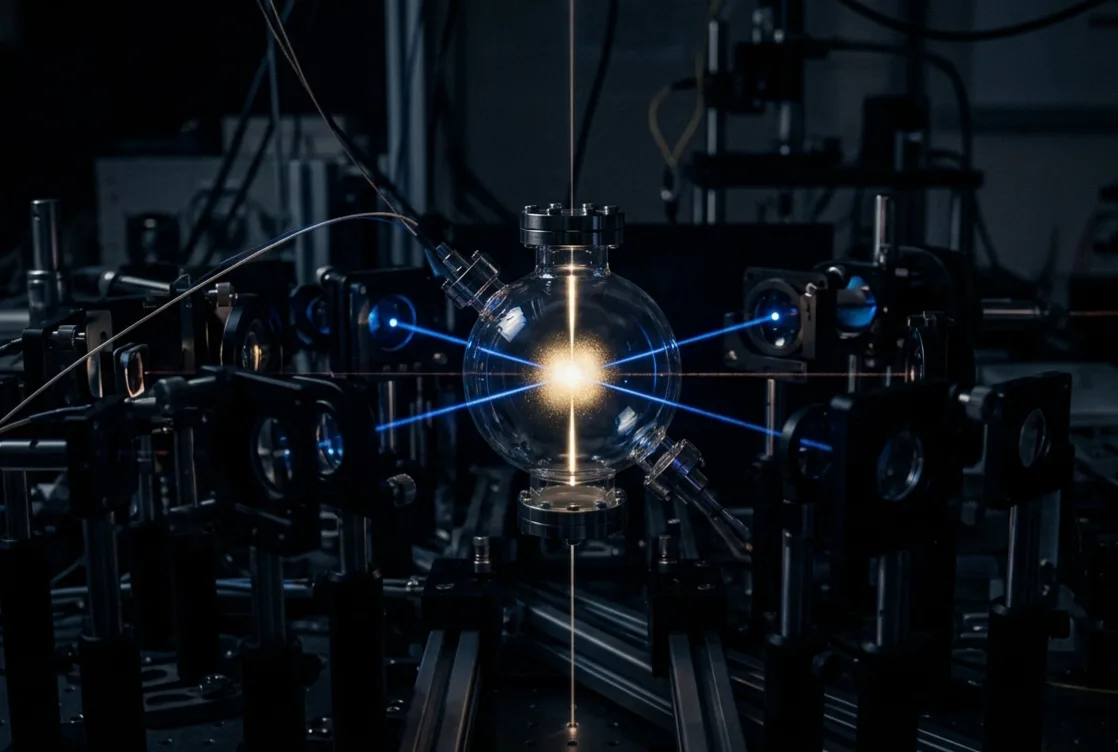
In This Article
- What Physicists Mean by the Problem of Time
- Why Earlier Ideas Never Really Solved It
- How Did Scientists Build a Universe Out of Cold Atoms?
- What This Discovery Could Unlock Beyond the Lab
- What Questions Are Still Open
Picture a cloud of atoms so cold it sits just billionths of a degree above absolute zero, split by a wall of light into two hidden little worlds. That is the strange stage where physicists have now tested the problem of time, a question that has puzzled quantum gravity researchers for decades. If the universe itself has no built-in clock, how can anything happening inside it ever be placed in order? A new experiment offers a real, testable answer, not just more theory.
What Physicists Mean by the Problem of Time
Ordinary clocks work because something outside the system counts the ticks. But the equation that tries to describe the whole universe at once, known as the Wheeler-DeWitt equation, leaves out time completely. There is no outside observer to hold a stopwatch on the cosmos, so the total wave function simply sits still, frozen, with nothing marking before or after.
That contradiction, a universe that looks timeless on paper but clearly changes around us, is what physicists call the problem of time. It stayed a purely mathematical puzzle for sixty years, because nobody could build a miniature universe and actually watch what happens inside it.
Why Earlier Ideas Never Really Solved It
Theorists have floated fixes since the 1980s. Some suggested picking one variable inside a model and calling it the clock, letting everything else be measured against it. Others leaned on entropy, the physical measure of disorder, hoping it would always tick upward and give time a direction.
The trouble was testing any of it. These ideas lived inside abstract minisuperspace models of the cosmos, built from a handful of simplified variables, with no laboratory bench to check them against. A promising idea and a proven one are not the same thing, and for decades this one stayed firmly in the first category. So what would it actually take to put it to the test?
How Did Scientists Build a Universe Out of Cold Atoms?
Giovanni Barontini's team at the University of Birmingham cooled about 24,000 rubidium atoms into a single quantum cloud called a Bose-Einstein condensate, a state where atoms stop behaving as separate particles and start moving as one.
A thin wall of light, only about 8 micrometers across, split the cloud into two halves: a "bright" side that researchers could watch, and a "dark" side left alone. Atoms drifted back and forth across that wall for 120 milliseconds, growing from a big bang moment to a maximum size, then shrinking back down to a big crunch. Instead of timing this with a lab clock, the team tracked how much entropy moved between the two sides and used that flow itself as the clock.
"The results establish a controlled experimental setting in which relational-time constructions can be quantitatively tested."
— Giovanni Barontini, University of Birmingham · Physical Review Research, 2026What This Discovery Could Unlock Beyond the Lab
This is not just a curiosity for theoretical physicists. The same trick, using entropy exchange as an internal clock, could help researchers build simple analogs for testing ideas about time reversal, black holes, or how order and disorder trade places inside a sealed system.
Barontini's team already showed that turning up the height of the light barrier changes everything. With a low barrier, the mini-universe cycles endlessly between big bang and big crunch, exchanging entropy freely. Raise the barrier high enough, and the cycling stops entirely. The system settles into a kind of "heat death," a stationary state where the internal clock simply stops running, because no entropy is left to exchange. What happens right at that tipping point turned out to be the most telling part of all.
What Questions Are Still Open
This mini-universe is a quantum simulator, not a shortcut to solving quantum gravity itself. The atom cloud obeys ordinary quantum mechanics, not the full equations of general relativity, so the experiment cannot settle what time really is in the actual cosmos.
Barontini's paper is candid about that limit, and it also lists concrete next steps: testing whether different internal clocks inside the same system agree with each other, checking whether the big bang and big crunch moments hide a true singularity or a smooth bounce, and pushing the same method toward analog black holes. Each of those experiments is buildable with tools cold-atom labs already own.
- Entropy as a clock — The experiment measured time by tracking how disorder moved between two halves of an atom cloud, with no outside clock involved.
- A tunable mini-universe — Raising the height of the light barrier let researchers switch between an endlessly cycling cosmos and one that reaches a permanent heat death.
- A testbed, not a final answer — The setup can now be reused to check other ideas about internal time, black hole analogs, and the arrow of time under real lab conditions.
Every clock people have ever built, sundials, pendulums, atomic fountains, works the same basic way: it watches one part of the world to keep track of another. Barontini's tiny cloud of atoms does the identical trick, just stripped down to its rawest form. Something changes because something else was willing to lose a little order for it. That may be the simplest description anyone has ever managed to test of what time actually is.
Taken together, the measurements show that inside a sealed system, the flow of entropy can stand in for an outside clock without physicists losing track of what came first, giving quantum-gravity researchers their first real experimental bench for an idea that had only ever lived on paper. Summary of findings, Physical Review Research, 2026.
📄 Source & Citation
Primary Source: Barontini, G. (2026). Testing the problem of time with cold atoms. Physical Review Research, 8(2), L022047. https://doi.org/10.1103/1h9j-df4k
Authors & Affiliations: Giovanni Barontini, School of Physics and Astronomy, University of Birmingham, United Kingdom.
Data & Code: The experimental data are openly available via Zenodo, referenced in the paper's data-availability statement.
Key Themes: Problem of time · Wheeler-DeWitt equation · entropic time · Bose-Einstein condensates · arrow of time
Supporting References:
[1] DeWitt, B. S. (1967). Quantum theory of gravity. I. The canonical theory. Physical Review, 160:1113.
[2] Hartle, J. B. & Hawking, S. W. (1983). Wave function of the Universe. Physical Review D, 28:2960.
[3] Connes, A. & Rovelli, C. (1994). Von Neumann algebra automorphisms and time-thermodynamics relation in generally covariant quantum theories. Classical and Quantum Gravity, 11:2899.
No comments yet. Be the first to share your thoughts.
Leave a Comment