 Krishan Gopal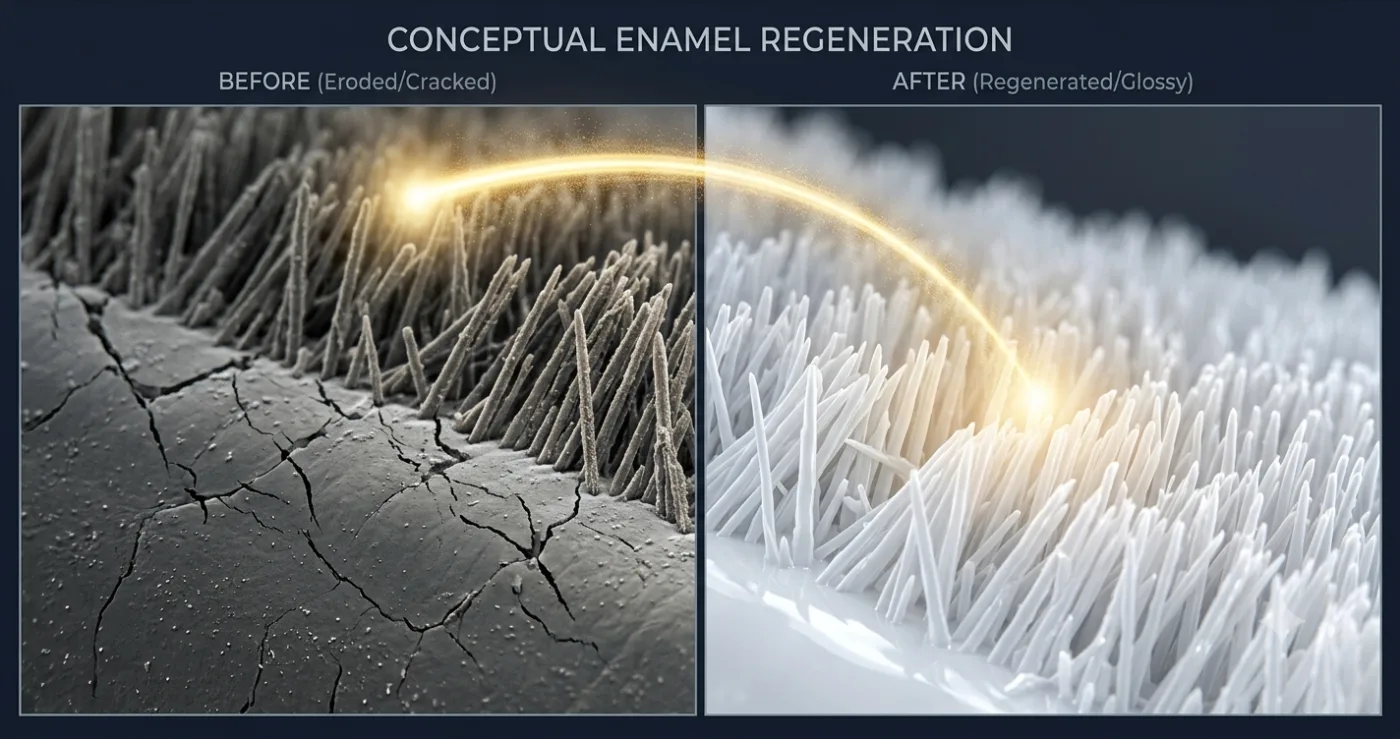
In This Article
- The Problem With Losing Tooth Enamel
- Why Earlier Attempts to Rebuild Enamel Fell Short
- How Does This Protein Coating Regrow Real Enamel?
- What This Means for Treating Sensitive Teeth and Cavities
- What Scientists Still Need to Prove
Picture a wound that never heals, not because your body will not try, but because it never learned how in the first place. That is exactly what happens to tooth enamel. Once it wears away from acid, grinding, or decay, it does not grow back, because the cells that built it switched off before you were even born. Now, a research team has found a way to regrow tooth enamel using a lab-made protein coating that copies the natural process that built it the first time, and the results, published in Nature Communications, restored real mineral crystal, not a filler or a patch.
The Problem With Losing Tooth Enamel
Enamel is the hardest material your body makes, tougher than bone, built from tightly packed mineral rods lined up like microscopic rebar. It has one fatal flaw: the cells that lay it down die off once a tooth pushes through the gum. After that, enamel cannot repair itself. It can only wear thinner, from acidic drinks, tooth grinding, or bacteria that feed on sugar and release acid as waste.
Left untreated, that one-way street adds up fast. Nearly half the world deals with some form of enamel loss or erosion, and the annual global bill for treating it runs close to $544 billion. So what does it actually take to reverse damage that biology itself gave up on repairing?
Why Earlier Attempts to Rebuild Enamel Fell Short
Dentists have long patched worn enamel with fillings, resins, and varnishes, but none of those materials are real enamel. They sit on top of the tooth rather than bonding into it, so they wear differently and can peel or crack over time. Lab attempts using acids, lasers, or peptide gels managed to grow thin mineral layers, but usually only on the outer flat surface, and often took over half an hour to apply while using solvents unsuitable for a live mouth.
How Does This Protein Coating Regrow Real Enamel?
The team, led by researchers at the University of Nottingham, built a synthetic protein called an elastin-like recombinamer, or ELR for short. Mixed with calcium ions and left to dry on a tooth for just a few minutes, the ELR molecules fold themselves into tiny fibres that mimic the amelogenin scaffold from before birth. Soak that coated tooth in a fluid rich in calcium, phosphate, and fluoride, and needle-shaped mineral crystals start growing straight out of the coating within two hours, maturing into full apatite crystals by day ten.
The regrown mineral did not just sit on top of the tooth. Electron microscope images showed the new crystals fusing directly onto the tooth's own crystal lattice, with no visible seam between old and new.
— Findings reported in Hasan et al., Nature Communications, 2025That seamless fusion, known as epitaxial growth, is the detail that separates this from a filling. The new crystals grew in the correct orientation whether the surface was smooth outer enamel, ridged inner enamel, or bare dentine with no enamel left at all, something no earlier method had managed across every layer of the tooth at once.
What This Means for Treating Sensitive Teeth and Cavities
For someone with worn enamel or a sensitive tooth, the regrown layer is not just cosmetic. After acid had stripped enamel down to a stiffness of about 37 gigapascals, the ELR treatment brought it back to roughly 76 gigapascals, close to the 81 gigapascals of untouched natural enamel. The regrown surface also survived a simulated year of toothbrushing and years of chewing and grinding without visibly breaking down.
What Scientists Still Need to Prove
Every test so far happened on extracted human teeth in a lab, not inside a living mouth. Saliva, chewing forces, temperature swings, and years of daily use are harder to fully recreate on a bench. The ELR coating itself also slowly degrades during the mineralising process, and researchers still need to confirm how the treatment behaves over months or years in real patients rather than days in a dish.
- Real repair, not a patch — the new mineral bonds directly into the tooth's existing crystal structure instead of sitting on top of it.
- Works on any damage level — the same coating regrew enamel on lightly worn teeth and on teeth stripped down to bare dentine.
- Clinical trials are next — human trials, not lab dishes, will decide whether this reaches a dentist's chair.
The scientists behind the work say the approach could eventually offer dentists a practical way to treat enamel erosion and the sharp, sudden pain of dental hypersensitivity, not just cover it up. — Hasan et al., Nature Communications, 2025.
Teeth remain one of the few parts of the body that never learned to heal themselves. What this research points to is not a miracle cure sitting on a pharmacy shelf tomorrow, but proof that the trick our bodies used just once, quietly, before we were even born, can be borrowed and repeated on demand.
📄 Source & Citation
Primary Source: Hasan, A., Chuvilin, A., Van Teijlingen, A., et al. (2025). Biomimetic supramolecular protein matrix restores structure and properties of human dental enamel. Nature Communications, 16, 9434. https://doi.org/10.1038/s41467-025-64982-y
Authors & Affiliations: Abshar Hasan and Alvaro Mata (University of Nottingham), with collaborators at the University of Strathclyde, King's College London, University of California San Francisco, and Radboud University Medical Centre, among others.
Data & Code: Source data for all figures is openly available at https://doi.org/10.17639/nott.7600.
Key Themes: Tooth enamel regeneration · Biomimetic materials · Elastin-like recombinamers · Dental biomineralization · Enamel erosion treatment
Supporting References:
[1] Righolt, A. J., Jevdjevic, M., Marcenes, W. & Listl, S. (2018). Global-, regional-, and country-level economic impacts of dental diseases in 2015. Journal of Dental Research, 97(5):501-507.
[2] Beniash, E. et al. (2019). The hidden structure of human enamel. Nature Communications, 10:4383.
[3] Bai, Y. et al. (2020). Protein nanoribbons template enamel mineralization. Proceedings of the National Academy of Sciences, 117:19201-19208.
No comments yet. Be the first to share your thoughts.
Leave a Comment