 Dr. Raj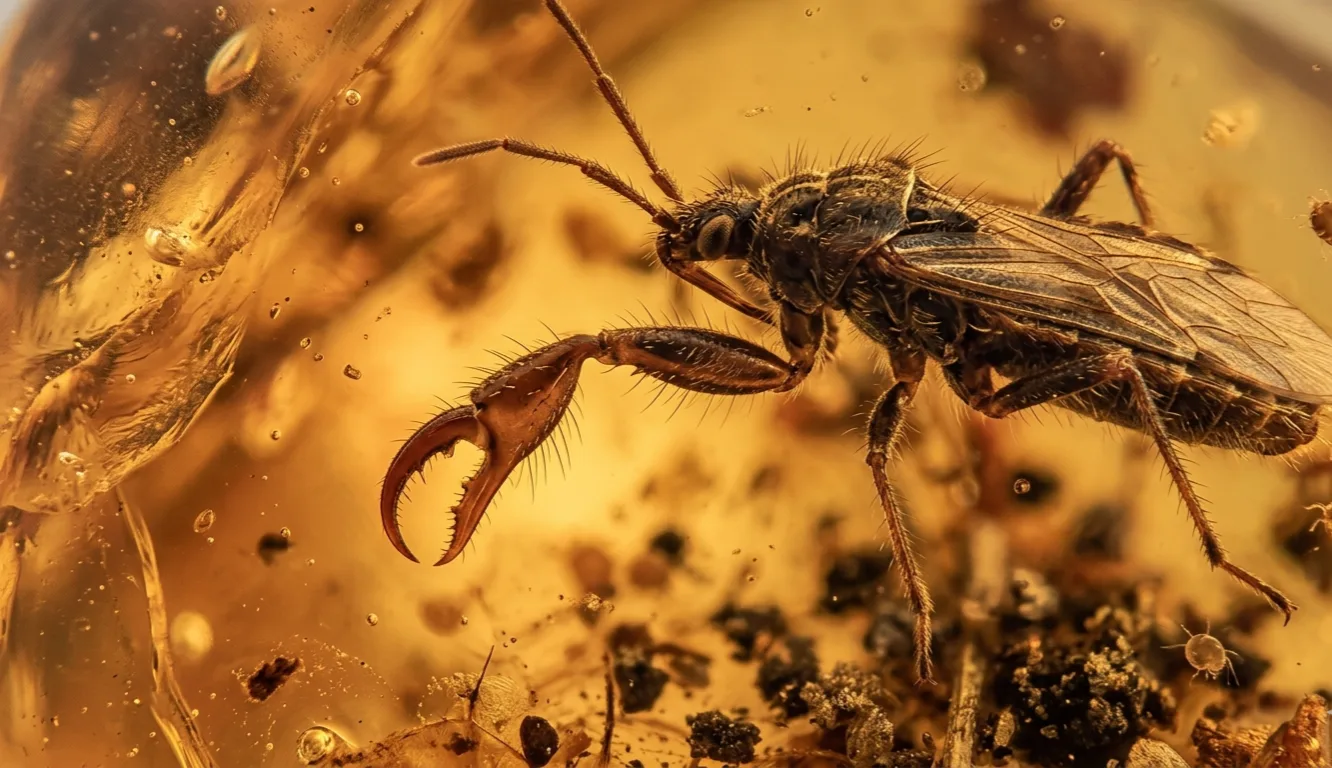
In This Article
- Frozen in Amber for 100 Million Years
- Why Insect Claws Are Almost Never Like a Crab's
- How Did a Bug Grow a True Pincer Claw?
- What the Shape of One Claw Tells Us About All of Evolution
- The Questions Researchers Still Cannot Answer
Somewhere in the forests of what is now Myanmar, about 100 million years ago, a tiny predatory bug walked through warm resin dripping from a tree. It never walked out. That bug, no bigger than a grain of rice, has just handed scientists something they had never seen in any fossil insect before: a true pincer claw, built exactly like a crab's, preserved in spectacular detail inside a piece of ancient golden amber. The insect in amber has been named Carcinonepa libererrantes, and it forces biologists to rethink how many times nature has independently invented the same deadly weapon.
Frozen in Amber for 100 Million Years
Picture a droplet of tree resin, sticky as honey, falling slowly down a trunk in a hot Cretaceous forest. A small bug touches it and cannot pull free. More resin covers it. Over millions of years, the resin hardens into amber, locking everything inside like a natural glass case.
This is exactly how the specimen ended up at Ludwig-Maximilians-Universitat Munchen in Germany, where palaeobiologist Carolin Haug and her team examined it under powerful microscopes and an X-ray CT scanner. The amber piece came from the Hukawng Valley in Kachin State, Myanmar, a site famous for producing some of the most detailed insect fossils on Earth. The amber here dates to roughly 100 million years ago, during the Late Cretaceous period, when dinosaurs still ruled the land above.
The bug was not alone inside its amber tomb. Mites, springtails, a pseudoscorpion, and two beetles shared the same resin drop. But only one creature among them had something extraordinary on its front legs.
Why Insect Claws Are Almost Never Like a Crab's
Think of how a penknife closes. The blade folds back against the handle. That is how almost every grasping leg in the insect world works. The lower part of the leg folds backwards against the upper part. Praying mantises work this way. So do most predatory water bugs, hunting spiders, and countless others. Scientists call this a sub-chelate arrangement, but plain English works just as well: a jackknife leg.
A crab's claw works completely differently. Both fingers close towards each other, one fixed and one moving, like scissors or a pair of tongs. Scientists call this a chelate appendage, from the Greek word for claw. Before this amber fossil, only three living groups of insects had ever evolved this design: certain thrips (tiny plant-feeding insects), a family of parasitic wasps called Dryinidae, and a small group of predatory true bugs called Carcinocorini.
No fossil insect had ever been found with one. Until now.
How Did a Bug Grow a True Pincer Claw?
The answer surprised even the researchers behind the study. The femur, which is the upper part of the foreleg (think of it as the bug's "thigh"), grew a rigid outward finger. That fixed finger and the long, curved lower leg closed against each other at an angle of just under 90 degrees. That small detail matters enormously: anything closing at less than 90 degrees counts as a true chelate claw. Anything more is still just a jackknife.
To confirm the claw was genuinely unique, the team ran a shape analysis across all 2,107 specimens, comparing the outline of the upper part of every grasping structure in their dataset. The fossil's femur sat completely alone in the results. No modern insect, no crab, no mantis shrimp, nothing else in the dataset had the same shape.
"The exact morphology of the chela of Carcinonepa libererrantes seems unique, as further emphasized by the fact that the shape of the femur is different from all other known proximal parts of chelae."
— Haug et al., Ludwig-Maximilians-Universitat Munchen · Insects, 2026The researchers used micro-CT scanning, which is like an X-ray but taken from hundreds of angles to build a full 3D image, to look inside the amber without touching it. The scans confirmed that the short beak on the head of the fossil identifies it as a true bug, most likely a member of the group Nepomorpha, the true water bugs. Based on its overall shape and some features of its legs, the team thinks it may belong specifically to Gelastocoridae, a family of small, warty-looking terrestrial predators known today as toad bugs.
The fossil also appears to have been a juvenile, not yet fully grown. Its trunk shows only three clearly separated sections rather than four, a pattern seen in young Nepomorpha before they reach adulthood.
What the Shape of One Claw Tells Us About All of Evolution
Here is the part that goes beyond one fossil. Evolution is often described as if it stumbles randomly through a dark room. But certain designs keep appearing, in completely unrelated animals, separated by millions of years. Eyes evolved dozens of times. Wings evolved at least four times in separate animal groups. And now pincer claws, it turns out, evolved at least four separate times in insects alone.
Scientists call this convergent evolution: different lineages arriving at the same design because that design simply works. What makes the new fossil especially interesting is the path it took to get there. In the true bugs of the group Carcinocorini, the fixed finger of the pincer grew from the tibia, which is the lower leg. In Carcinonepa libererrantes, it grew from the femur, the upper leg. Different parts, same result.
The Questions Researchers Still Cannot Answer
This fossil is remarkable, but incomplete. Large portions of the body are too degraded to examine closely, even under CT scanning. The researchers cannot confirm the exact antenna structure or surface texture of the wing covers, both of which would allow a more precise family identification. The possibility that it belongs to Gelastocoridae rather than another Nepomorpha group remains a strong probability, not a certainty.
There is also a deeper open question. If pincer claws are this useful, and evolution has invented them at least four times in insects alone, why are they still so rare? The jackknife leg dominates across tens of thousands of insect species. Whether the pincer design carries hidden costs, or whether it simply requires a very specific starting shape to evolve, remains genuinely unknown. The published paper in Insects openly names this as territory for future work.
Seven other fossil bugs from the same amber collection were also reported in the same study. All of them belong to a different group, Enicocephalomorpha, and all have legs that almost but not quite reach the pincer threshold. The diversity of grasping strategies visible in a single amber deposit suggests the Cretaceous forest was a place of intense predatory pressure and equally intense invention.
- First fossil pincer-clawed insect — Carcinonepa libererrantes is the first known fossil from any insect group to carry a true chelate, crab-style claw, closing a 100-million-year gap in the record.
- Evolution recycles the same solutions — The pincer design evolved independently in at least four insect lineages, each time using different leg parts, confirming that convergent evolution is not rare coincidence but a predictable outcome of shared pressures.
- The shape is genuinely unique — Out of 2,107 grasping structures compared across insects and crustaceans, not one matched the exact femur shape of this fossil, making it a one-of-a-kind data point in the history of animal weapons.
"This find is only the fourth case of an independent or convergent evolution of such a structure. A quantitative morphological comparison of over 2000 grasping structures reveals that the proximal part of the chela has a unique shape in the fossil, unparalleled in the fossil and modern fauna." — Haug et al., Insects, 2026.
A small bug that walked into a drop of resin and never left has spent 100 million years waiting to show us something. It turns out that nature, when faced with the same problem across deep time, keeps writing the same answer. Not because it has to. Because that answer works.
📄 Source & Citation
Primary Source: Haug C, Haug FI, Hornig MK, Braig F, Haug JT. (2026). A true bug with a true but unique chela in 100 million-year-old amber. Insects, 17(4), 431. https://doi.org/10.3390/insects17040431
Authors & Affiliations: Carolin Haug (Ludwig-Maximilians-Universitat Munchen; GeoBio-Center LMU), Fenja I. Haug (LMU Munich), Marie K. Hornig (University Medical Center Rostock), Florian Braig (University of Oulu, Finland), Joachim T. Haug (LMU Munich; GeoBio-Center LMU)
Data & Code: All data available in the published paper and supplementary materials at the MDPI source link above. Shape analysis data in Supplementary Files S1–S6. Specimens deposited at LMU Munich (PED collection).
Key Themes: Amber Palaeontology · Convergent Evolution · Insect Morphology · Cretaceous Biodiversity · Predator Adaptations
Supporting References:
[1] Weirauch C, Forero D, Jacobs DH. (2011). On the evolution of raptorial legs — an insect example. Cladistics, 27:138–149.
[2] Baranov V et al. (2022). The first adult mantis lacewing from Baltic amber. Fossil Record, 25:11–24.
[3] Luque J et al. (2021). Crab in amber reveals early colonization of nonmarine environments during the Cretaceous. Science Advances, 7:eabj5689.
No comments yet. Be the first to share your thoughts.
Leave a Comment