Astronomers confirm a Saturn-mass rogue planet using microlensing. Learn how this starless world was found and what it reveals about galaxy wanderers.
Astronomers have confirmed the discovery of a rogue planet with Saturn’s mass, drifting alone through interstellar space. Published in Science, this finding offers the first direct measurement of a free-floating world, moving it from candidate to confirmed planet.
How Scientists Detected the Invisible Planet
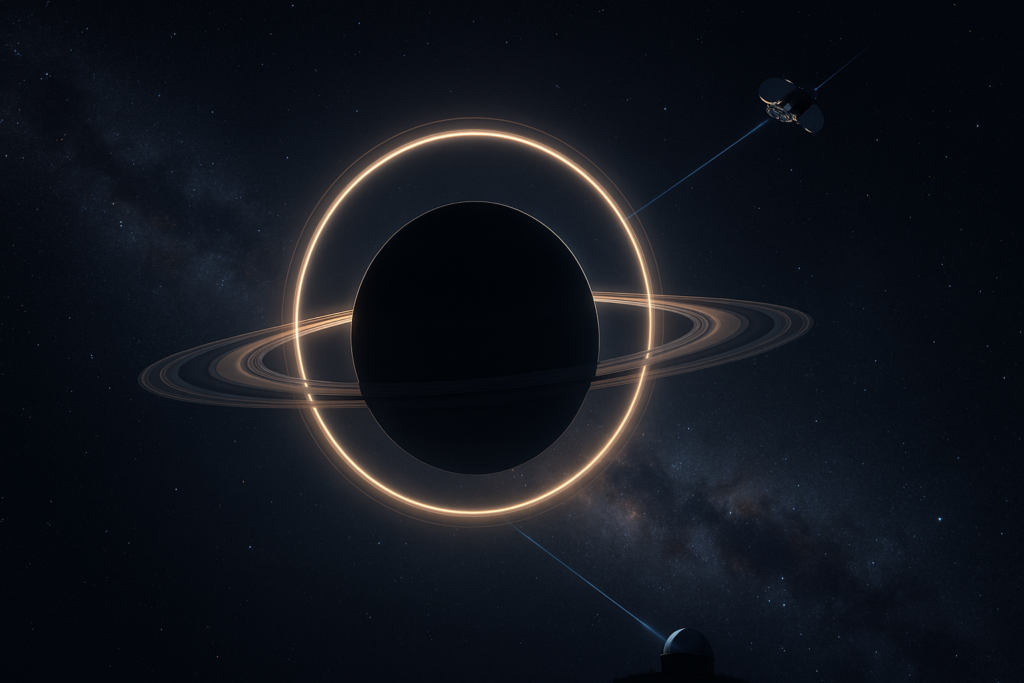
Researchers used gravitational microlensing to spot this dark wanderer. As the planet passed in front of a distant star, its gravity magnified the star’s light like a lens.
The key was using two viewpoints: Earth-based observatories and the European Space Agency’s Gaia spacecraft. This parallax method broke the usual mass-distance ambiguity, allowing precise measurement.
Key Facts About the Rogue Planet
- Mass: Roughly 22% of Jupiter’s mass—nearly identical to Saturn.
- Status: A true planet, not a brown dwarf (failed star).
- Distance: About 9,800 light-years away.
- Significance: Proves planets can be ejected from their star systems to wander alone.
Why a Saturn-Mass Planet Matters
A planet of this mass likely formed in a protoplanetary disk around a young star. It was probably ejected by gravitational clashes with other giant planets. This supports theories that planet scattering is common during solar system evolution.
You can read the official research paper in the journal Science here.
The Future of Rogue Planet Discovery
This detection is just the start. NASA’s Nancy Grace Roman Space Telescope, launching in 2027, will perform a vast microlensing survey. It could find hundreds of rogue planets, possibly even Earth-mass ones. Learn more on NASA’s Roman Telescope page.
Ground networks like OGLE and KMTNet will continue providing 24/7 coverage to catch these brief events.
Are Rogue Planets Common?
Estimates vary, but some studies suggest billions could exist in our galaxy. This direct measurement helps refine those models. As more are found, we’ll learn if ejection is typical or rare in planet formation.
For now, this Saturn-sized loner confirms that some galactic drifters are true planets—born near a star, but now roaming forever dark.