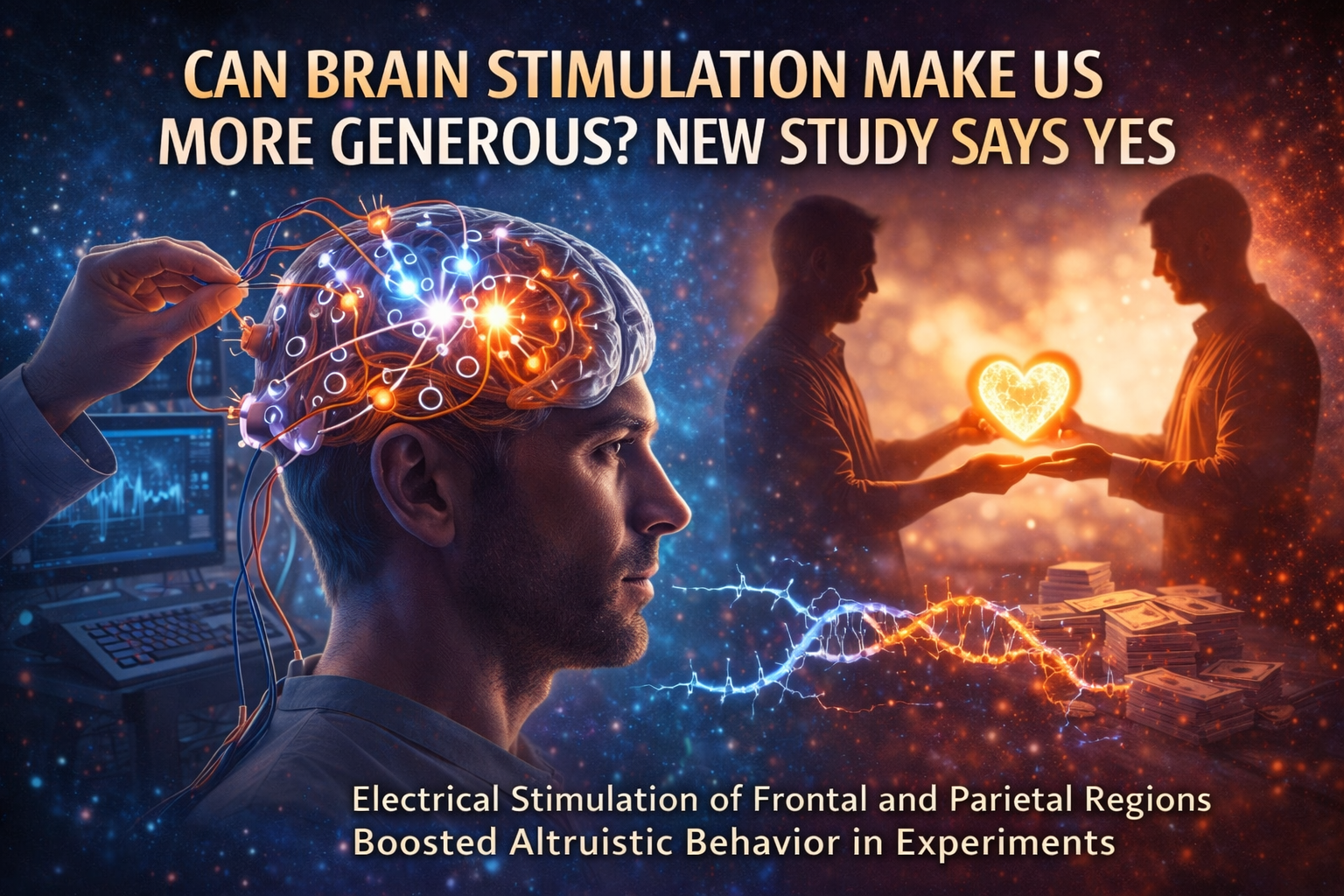
Synchronized electrical pulses to frontal and parietal regions increased altruistic behavior in laboratory experiments, raising profound questions about the neural basis of morality
February 15, 2026
Is generosity a matter of moral character—or simply a question of how well different parts of your brain communicate with each other? A groundbreaking study published this week suggests the answer may be more biological than philosophical.
Researchers at the University of Zurich and East China Normal University have demonstrated that by gently stimulating two specific brain regions and synchronizing their activity, they can measurably increase people’s willingness to share resources with others, even when doing so comes at a personal cost.
The findings, published February 10 in the open-access journal PLOS Biology, offer the first causal evidence that coordinated brain activity directly influences altruistic decision-making. The discovery raises intriguing possibilities for understanding—and potentially treating—conditions that affect social behavior, while also prompting difficult ethical questions about manipulating the neural basis of moral choices.
The Generosity Experiment
The research team recruited 44 healthy adults to play the “dictator game,” a classic economic exercise used to measure altruistic behavior. In this task, one person decides how to split money between themselves and an anonymous partner who has no say in the division.
Participants made 540 such decisions over the course of the experiment. But unlike typical behavioral studies, these choices were made while researchers applied transcranial alternating current stimulation, or tACS—a non-invasive technique that delivers weak electrical currents through electrodes placed on the scalp.
The electrodes targeted two critical regions: the frontal lobe, involved in decision-making and evaluating outcomes, and the parietal lobe, which processes information about others’ perspectives and social context. The electrical current alternated at 72 cycles per second, a frequency within the gamma range that previous research has linked to altruistic decisions.
“What’s new here is evidence of cause and effect,” explained lead author Jie Hu of East China Normal University. “When we altered communication in a specific brain network using targeted, non-invasive stimulation, people’s sharing decisions changed in a consistent way—shifting how they balanced their own interests against others’.”
When Synchrony Breeds Generosity
The results were striking. When gamma-band synchrony between the frontal and parietal areas was enhanced, participants demonstrated a measurable increase in generous behavior. They allocated larger portions of money to their anonymous partners, even when such choices meant personal financial sacrifice.
The effect wasn’t dramatic—participants didn’t transform from misers to philanthropists. But the shift was consistent and statistically significant. More importantly, it appeared strongest in situations where participants had less money than their partner, suggesting the stimulation particularly influenced behavior when inequality was most pronounced.
“We were struck by how boosting coordination between two brain areas led to more altruistic choices,” said co-author Marius Moisa of the University of Zurich. “When we increased synchrony between frontal and parietal regions, participants were more likely to help others, even when it came at a personal cost.”
To understand the mechanism behind this shift, the researchers employed computational modeling to decode how the stimulation influenced cognitive evaluation. The analysis suggested that enhanced gamma coupling effectively increased the weight participants gave to their partner’s outcomes relative to their own.
This wasn’t a change in impulsivity or risk tolerance. Instead, the stimulation appeared to finely tune the moral calculus underlying social decisions—the internal weighing of self-interest against concern for others.
A Window Into the Social Brain
The findings add crucial pieces to the puzzle of how the brain orchestrates social decisions. While social norms, upbringing, and culture clearly influence altruistic behavior, the study provides evidence that intrinsic brain mechanisms also play a critical role.
Previous research has largely relied on observing brain activity while people make social choices, identifying correlations between neural patterns and generous behavior. But correlation doesn’t prove causation. By experimentally manipulating brain activity and observing behavioral changes, this study establishes a direct causal link.
“We identified a pattern of communication between brain regions that is tied to altruistic choices,” said co-author Christian Ruff of the University of Zurich. “This improves our basic understanding of how the brain supports social decisions, and it sets the stage for future research on cooperation—especially in situations where success depends on people working together.”
The research suggests that the harmony of activity between key brain areas serves as a driving force behind altruistic choices. When these regions communicate efficiently through synchronized gamma oscillations, the brain appears better equipped to consider others’ welfare in decision-making processes.
The Subtlety of Influence
Importantly, participants remained completely free to choose how to split the money. The stimulation didn’t force specific decisions or override conscious choice. Instead, it subtly nudged the relative weight people placed on others’ welfare compared to their unstimulated baseline.
Most participants described the stimulation as mild and reported they didn’t feel it directly influenced their decisions, suggesting the behavioral changes occurred subconsciously—below the threshold of awareness but within the realm of genuine choice.
The temporary nature of the effect also merits attention. A single stimulation session produced measurable but transient changes. Researchers noted that lasting behavioral modification would likely require repeated sessions, similar to how physical exercise requires consistency to produce lasting results.
Implications and Unanswered Questions
The discovery has potential applications for understanding and treating conditions that affect social cognition. Disorders such as autism spectrum disorder and psychopathy often involve atypical social decision-making. Understanding the neural mechanisms underlying these differences could inform therapeutic approaches.
However, the researchers emphasize that their findings don’t yet support real-world or clinical applications. The effect observed in the laboratory was modest, and much remains unknown about how such interventions might work in natural social environments or in patient populations.
The study also raises significant ethical considerations. If techniques became more powerful or precise, difficult questions would follow: Who decides when brain stimulation should be used to influence social behavior? Should such interventions be limited to voluntary settings? Could they be misused in the name of promoting cooperation or social cohesion?
“The effects were not huge, but they’re consistent,” Ruff noted, offering both promise and appropriate caution about future possibilities.
Limitations and Future Directions
The research team acknowledges important limitations. They did not directly record brain activity during the trials, relying instead on computational models to infer the neural effects of stimulation. Future studies should combine brain stimulation with neuroimaging techniques like fMRI or EEG to directly observe changes in neural activity and confirm the hypothesized mechanisms.
The study also focused exclusively on healthy adults in a controlled laboratory setting using a simplified economic game. Real-world altruism involves far more complex social situations, emotional factors, and moral considerations. Whether and how these findings translate to genuine prosocial behavior outside the laboratory remains an open question.
Additionally, the researchers manipulated inequality in their experiment, testing whether stimulation affected generosity differently depending on relative advantage. While they found the strongest effects when participants had less than their partner, more research is needed to understand how factors like relationship closeness, cultural background, and individual personality traits might modulate the impact of brain stimulation on social decisions.
A Neurobiological Foundation for Morality
Perhaps the most profound implication of the research is philosophical: it suggests that what we experience as moral deliberation—the weighing of our interests against others’, the feeling of compassion that drives helping behavior—has concrete neurobiological substrates that can be experimentally manipulated.
“Social decisions are not only shaped by our upbringing or culture,” noted previous research on brain mechanisms of generosity. “They are in fact also strongly anchored in the mechanisms of our brain.”
This doesn’t diminish the importance of moral education, cultural values, or personal responsibility. But it does suggest that the capacity for altruism, like other aspects of human cognition and behavior, emerges from the coordinated activity of brain networks that can be influenced by biological factors.
For now, the study remains a controlled proof of concept—a demonstration that coordinated brain activity involved in social decision-making can be influenced in measurable ways, and that doing so can nudge people toward slightly more generous choices in a laboratory setting.
The effect is subtle. But it offers a revealing window into how the brain negotiates the eternal tension between self-interest and generosity, and how that delicate balance might be shaped by the rhythms of neural communication pulsing through our frontal and parietal cortices as we navigate the social world.
As neuroscience continues to unravel the biological foundations of human behavior, studies like this remind us that even our most cherished moral qualities—compassion, generosity, selflessness—are not purely abstract virtues but are grounded in the physical machinery of the brain, woven into the very fabric of our neural architecture.