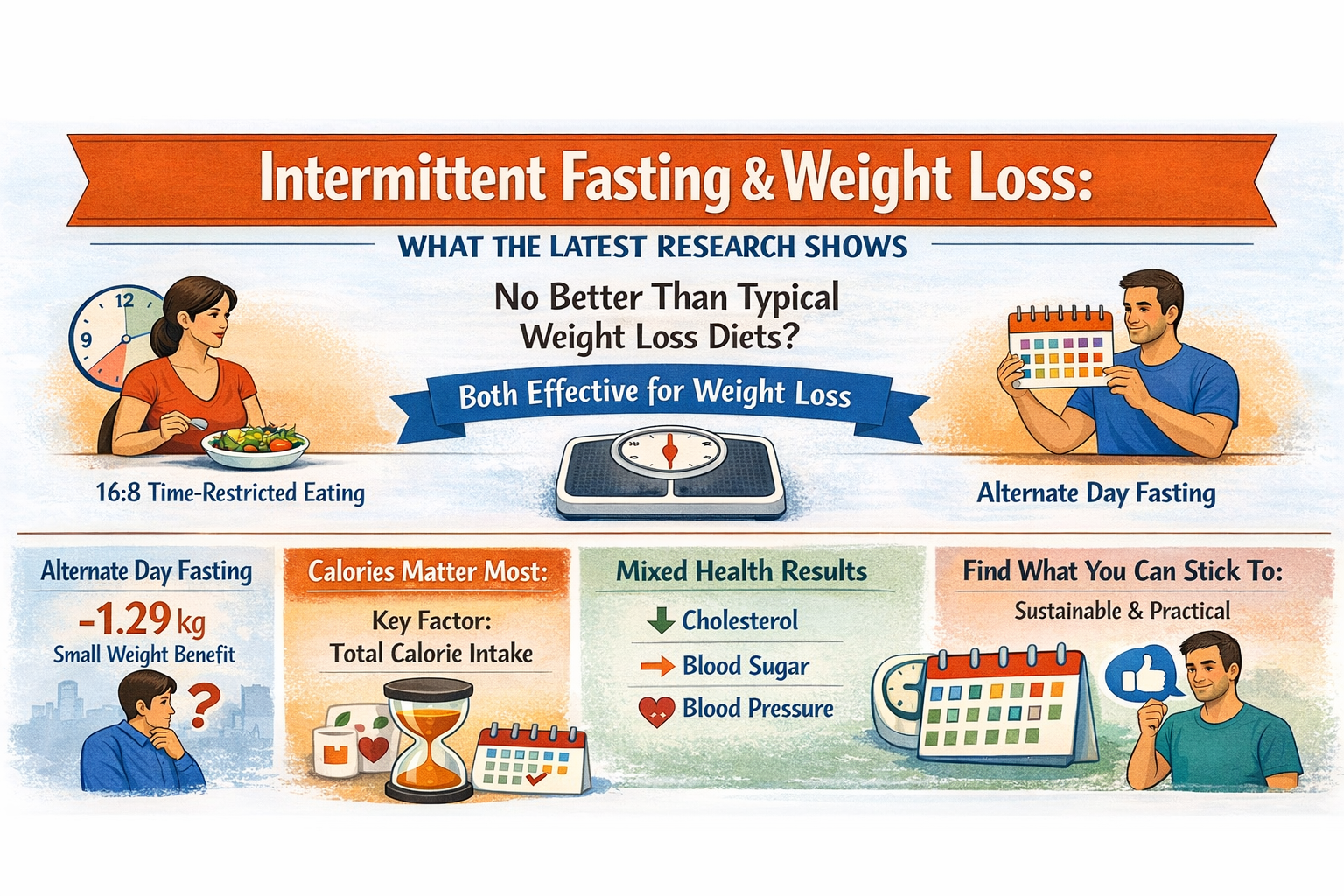
The recent BMJ study headline “Intermittent fasting no better than typical weight loss diets” has sparked considerable discussion, but the full picture is more nuanced than this suggests. Based on the comprehensive network meta-analysis published in The BMJ in June 2025 analyzing 99 randomized clinical trials involving 6,582 adults PubMedEurekAlert!, here’s what the evidence actually reveals.
The Main Finding: Comparable Effectiveness, Not Failure
The research confirms that intermittent fasting diets appear to have similar benefits to traditional calorie-restricted diets for weight loss EurekAlert!. This doesn’t mean intermittent fasting doesn’t work—it means it works about as well as conventional calorie restriction. The key insight is that both approaches are effective weight loss strategies, just through different mechanisms.
What the Numbers Actually Show
When examining the data more carefully, the study revealed several important findings:
Alternate Day Fasting Shows Promise: Alternate day fasting was the only intermittent fasting strategy to show a small benefit in body weight reduction compared with continuous energy restriction, with a mean difference of -1.29 kg EurekAlert!ScienceDaily. It also demonstrated small reductions compared to both time restricted eating and whole day fasting ScienceDaily.
Clinical Significance Threshold: However, researchers noted these differences did not reach the minimally important clinical threshold of at least 2 kg weight loss for individuals with obesity ScienceDaily. This is an important distinction—statistically significant doesn’t always mean clinically meaningful.
Other Metabolic Benefits: Beyond weight, alternate day fasting was linked to lower levels of total and bad cholesterol compared with time restricted eating EurekAlert!, suggesting some forms of intermittent fasting may offer cardiovascular benefits beyond just weight loss.
The Reality: Calories Still Matter Most
Perhaps the most important takeaway comes from parallel research examining how intermittent fasting actually works. A January 2026 study found something revealing: when calorie intake stayed the same, an eight-hour eating window did not improve insulin sensitivity or cardiovascular markers ScienceDaily. This supports what many experts have been saying—the benefits of intermittent fasting largely come from reducing total calorie intake, not from some metabolic magic of meal timing alone.
Another large-scale study reinforced this: the frequency and size of meals was a stronger determinant of weight loss or gain than the time between first and last meal ScienceDaily. In other words, what you eat and how much you eat matters more than when you eat.
Different Forms, Different Results
Not all intermittent fasting is created equal. The research examined three main approaches:
Time-Restricted Eating (16:8): This popular method, where you eat within an 8-hour window, showed weight loss benefits but the evidence suggests these benefits come primarily from eating fewer calories overall during the restricted window.
Alternate Day Fasting: Fasting every other day showed the most promise in the BMJ analysis, though the differences were modest. Studies suggest alternate day fasting may produce better results in terms of weight loss and improved lipid profile, though this evidence was characterized by low or very low certainty PubMed Central.
5:2 Diet (Whole Day Fasting): This approach of eating normally five days and restricting calories two days per week showed similar effectiveness to other methods.
The Individual Response Factor
Meta-analyses of multiple studies reveal substantial variation in individual responses. One systematic review of 15 randomized controlled trials found intermittent fasting significantly reduced body weight by an average of 3.73 kg and BMI by 1.04 kg/m² PubMed Central, while also improving cholesterol levels. However, there was considerable variation between individuals and study designs.
An interesting caveat emerged: short-term intermittent fasting of 12 weeks or less may have resulted in a temporary elevation of triglycerides, whereas long-term intervention optimized lipid metabolism benefits PubMed Central. This suggests timing and duration matter for metabolic health outcomes.
The Sustainability Question
One of the biggest challenges with any diet is long-term adherence. Experts noted the decline in adherence in most studies, indicating that like all dietary regimens, intermittent fasting may be difficult to maintain long-term Science Media Centre. The “best” diet is ultimately the one you can stick with.
Studies found that the 16:8 time-restricted eating approach is relatively simple and easier to sustain, with participants exhibiting high compliance and rare adverse events PubMed Central. This practical advantage shouldn’t be dismissed—if intermittent fasting helps someone consistently reduce calorie intake when other methods haven’t worked, it’s valuable regardless of whether it has special metabolic properties.
What About Metabolic Health Beyond Weight?
The research shows mixed results for cardiometabolic benefits beyond weight loss:
Blood Pressure: Intermittent fasting significantly reduced diastolic blood pressure but had no significant effect on systolic blood pressure PubMed Central.
Blood Sugar Control: No benefit was found for blood sugar levels in diet strategy comparisons ScienceDaily, though a study of type 2 diabetes patients found all intermittent fasting strategies showed better effects in controlling glucose levels compared to standard diet PubMed Central.
Cholesterol: Results varied by fasting method and duration, with some showing improvements in cholesterol profiles while others showed no significant changes.
Expert Interpretations
Leading researchers emphasized the practical implications. As one expert noted, eating less leads to weight loss, irrespective of how you do it Science Media Centre. Another researcher pointed out that any structured intervention could show benefits derived not only from the dietary pattern but also from professional support, planning, and nutritional education Science Media Centre.
Importantly, researchers stated that the focus should be on fostering sustainable changes over time, and that intermittent fasting does not aim to replace other dietary strategies but to integrate and complement them BMJ Group.
The Bottom Line
The headline “no better than typical weight loss diets” is technically accurate but potentially misleading. A more complete interpretation would be:
- Intermittent fasting is effective for weight loss—just not dramatically more effective than traditional calorie restriction when total calories are matched.
- The mechanism matters less than adherence—if intermittent fasting helps you reduce calorie intake more consistently than eating smaller meals throughout the day, it’s the right choice for you.
- Different methods show different results—alternate day fasting showed slightly better outcomes than time-restricted eating, though differences were modest.
- Longer-term studies are needed—most trials lasted only 12 weeks, and researchers emphasized that longer duration trials are needed to further substantiate findings EurekAlert!.
- Individual variation is significant—what works best varies by person, lifestyle, and health status.
Rather than viewing this research as debunking intermittent fasting, it’s more accurate to see it as clarifying how it works: primarily through calorie reduction rather than special metabolic effects. This doesn’t diminish its value—it just means we should be realistic about why and for whom it’s likely to be effective. The “best” diet remains the one you can maintain long-term while meeting your nutritional needs.