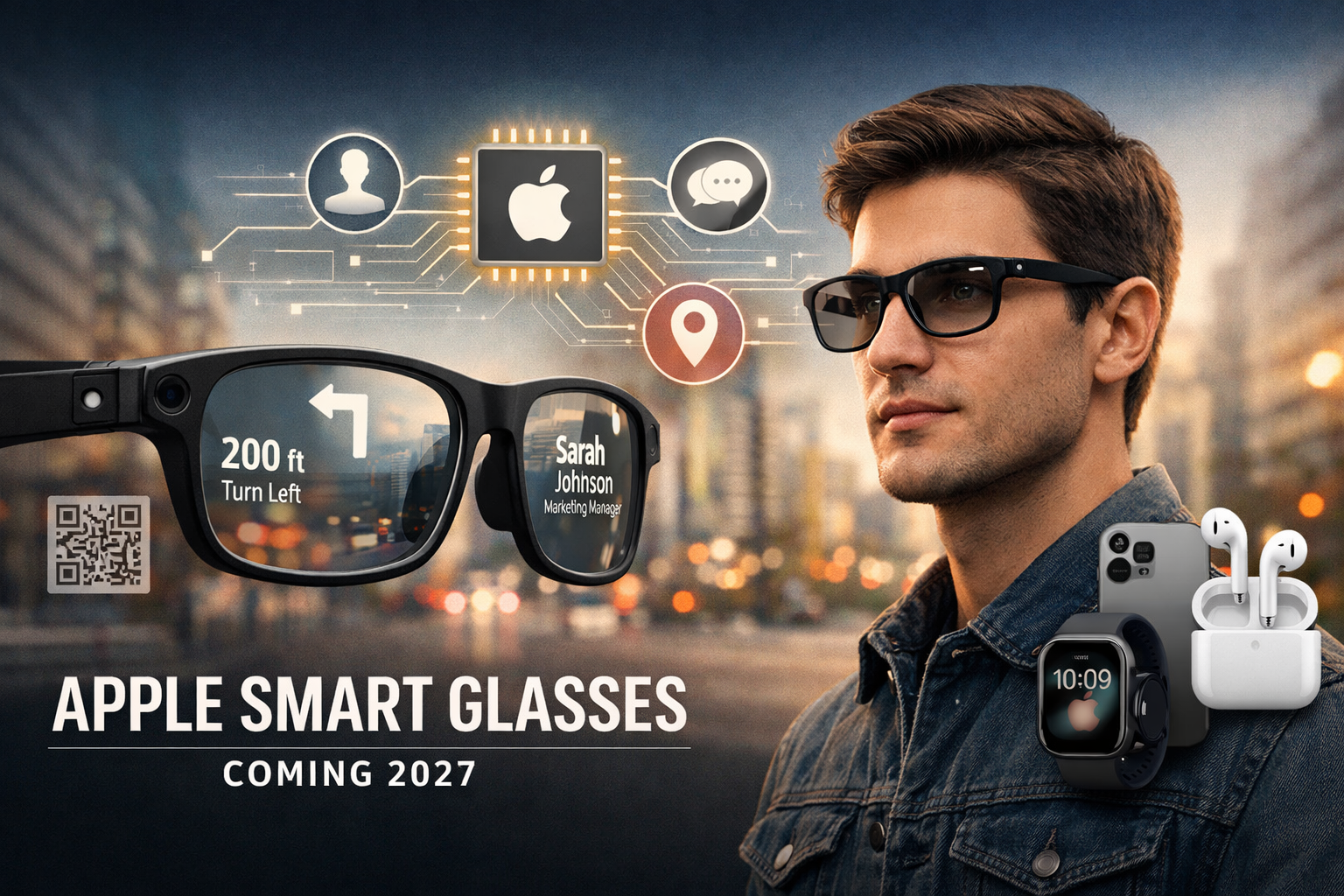
Apple is developing lightweight smart glasses centered on artificial intelligence and environmental awareness rather than immersive displays, according to multiple media reports. Production could begin in late 2026, with a consumer launch expected in 2027.
Apple is preparing to enter the smart-glasses market with a new product designed around “context-first” artificial intelligence, shifting away from screen-heavy headsets toward everyday wearability, according to reporting by Bloomberg and other outlets. The glasses are expected to rely on cameras and on-device AI to interpret a user’s surroundings, offering assistance without requiring large displays or constant phone interaction.
The move would mark Apple’s first major step into consumer smart glasses, following years of limited adoption across the industry. Unlike immersive headsets such as Vision Pro, Apple’s reported approach focuses on all-day comfort, battery efficiency, and discreet design—features seen as essential for mainstream acceptance.
Shift Away From Display-Heavy Headsets
Apple has reportedly slowed work on a lower-cost successor to Vision Pro in order to redirect engineering resources toward lightweight glasses, according to supply-chain and industry sources cited by Bloomberg. Vision Pro is expected to remain a professional and enterprise-focused product, while glasses would target daily consumer use.
Industry analysts note that earlier attempts at smart glasses struggled with social acceptance, battery life, and heat management. More recent products—particularly camera-equipped glasses designed to look like standard eyewear—have shown stronger demand, suggesting growing consumer comfort with the form factor.
Custom Chip Designed for Low-Power AI
Central to Apple’s reported plans is a custom, low-power processor optimized for continuous sensor input and on-device AI inference. Bloomberg reports the chip draws on the architecture of Apple Watch processors, which are designed for brief bursts of performance followed by extended low-power operation.
The processor is expected to support multiple cameras and visual-analysis tasks while minimizing heat and energy use. Manufacturing is anticipated to involve TSMC, Apple’s long-time chip partner, with mass production potentially beginning in late 2026.
This approach reflects Apple’s broader strategy of handling sensitive AI tasks on device rather than in the cloud, a design choice intended to reduce latency and address privacy concerns.
Competitive Landscape Shaped by Meta
Apple’s entry would come as the smart-glasses category gains momentum. Glasses developed through a partnership between Meta and Ray-Ban have sold more than two million units globally, according to industry estimates, demonstrating demand for camera-enabled glasses that resemble traditional eyewear.
Analysts say Meta’s early success has helped validate the category, lowering the barrier for new entrants. Rather than introducing a novel concept, Apple would be entering a market that has already demonstrated consumer interest and manufacturing scalability.
Two Models Under Consideration
Reports suggest Apple is exploring two versions of its smart glasses:
- A non-AR model without displays, focused on photography, voice interaction, and AI-powered context awareness.
- A display-equipped model that could offer limited visual overlays for navigation and notifications, potentially arriving later.
The non-AR version is expected to launch first, allowing Apple to compete directly with existing camera-equipped glasses while keeping pricing within reach of mainstream consumers.
Ecosystem and Retail Advantages
Apple’s broader ecosystem—linking iPhone, Apple Watch, AirPods, and on-device AI—could allow smart glasses to function as part of a distributed system rather than a standalone device. For example, audio capture, visual recognition, and health signals could be processed collaboratively across devices.
Apple’s global retail network may also play a role in adoption. In-store fittings, prescription-lens support, and hands-on demos could reduce consumer hesitation, a challenge that hindered earlier smart-glasses launches.
What to Watch Next
Key indicators for a 2027 launch include confirmation of chip production timelines, increased developer support for visual-intelligence features, and supply-chain reports pointing to trial manufacturing in 2026. Any significant delays in silicon production or software readiness could push the release into 2028.
If Apple proceeds as expected, its entry could accelerate growth across the smart-glasses market by normalizing the idea of AI-enabled eyewear for everyday use. While volumes are likely to be modest at first compared with iPhone launches, analysts say even a limited rollout could influence the direction of wearables over the next decade.
For consumers and developers alike, the shift signals that smart glasses are moving from experimental devices toward practical accessories—an evolution that may define the next phase of personal computing.