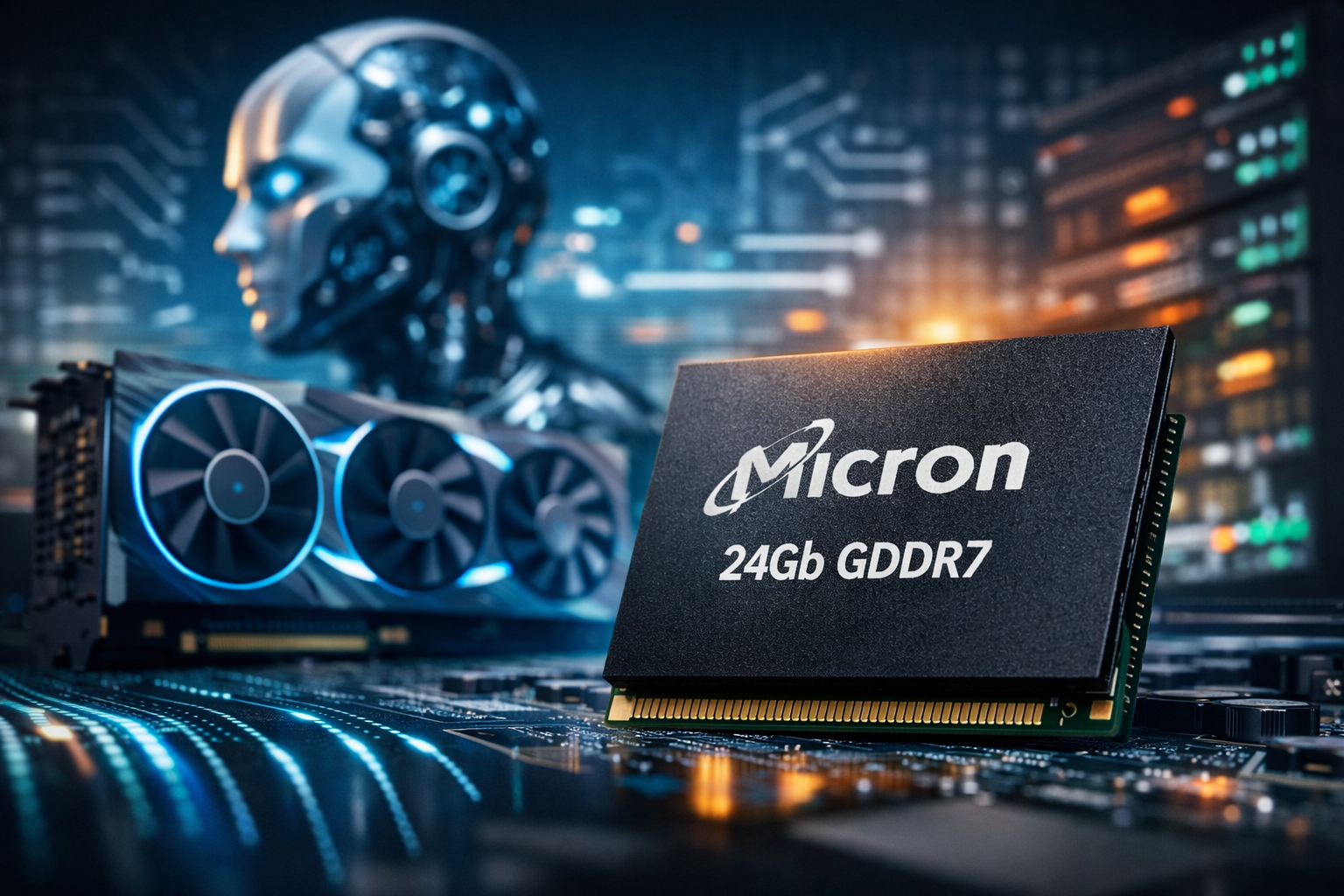
Micron Technology has confirmed 24-gigabit (Gb) GDDR7 memory modules capable of operating at 36 gigabits per second (Gbps), targeting upcoming discrete graphics cards for both gaming and artificial intelligence workloads. The announcement follows similar moves by Samsung, which began mass production of 24Gb GDDR7 modules in November 2025.
What Micron’s 24Gb GDDR7 Offers
According to Micron’s published blog post, the new GDDR7 modules deliver higher memory density and bandwidth compared to existing GDDR7 products. The 24Gb density is not entirely new to market — Micron’s 3GB modules are already deployed in products such as the 96GB NVIDIA RTX PRO 6000 Blackwell workstation GPU and the RTX 5090 Laptop, which uses 24GB of VRAM across a 256-bit memory bus.
The forthcoming 36 Gbps variants represent a speed increase over currently shipping GDDR7 solutions and are expected to be adopted by GPU manufacturers in new or refreshed products by late 2026 or the first half of 2027, subject to supply conditions.
Memory Bandwidth Configurations
Micron’s documentation outlines the theoretical peak memory bandwidth achievable at 36 Gbps across various bus widths:
| Bus Width | Bandwidth | Total Capacity |
|---|---|---|
| 128-bit | 576 GB/s | 12 GB |
| 192-bit | 864 GB/s | 18 GB |
| 256-bit | 1,152 GB/s | 24 GB |
| 320-bit | 1,440 GB/s | 30 GB |
| 384-bit | 1,728 GB/s | 36 GB |
| 512-bit | 2,304 GB/s | 48 GB |
Gaming and AI Workload Benefits
Micron states the higher-density, higher-bandwidth memory is designed to address both consumer graphics and on-device AI processing demands.
For gaming applications, Micron indicates the technology reduces texture pop-in and asset swapping, supports larger frame buffers for high-resolution displays, and enables more detailed environments with fewer loading transitions.
For AI and productivity applications, the company highlights faster on-device inference, lower-latency performance across hybrid CPU-GPU-NPU workflows, higher throughput for neural graphics and generative AI models, and improved power efficiency attributed to architectural refinements and reduced operating voltages.
Competitive Landscape and Supply Outlook
Samsung has previously disclosed plans for 32Gb GDDR7 densities and speeds of up to 42.5 Gbps, and has reportedly sampled 36 Gbps chips to partners. Micron has also disclosed densities beyond 24Gb and speeds exceeding 36 Gbps, though no firm timeline for those products has been announced.
Current DRAM supply constraints may affect the pace at which these higher-specification modules reach volume production and GPU integration. NVIDIA’s next-generation Rubin GPU architecture is also expected to utilize faster and denser GDDR7 memory, according to previously disclosed roadmap information.