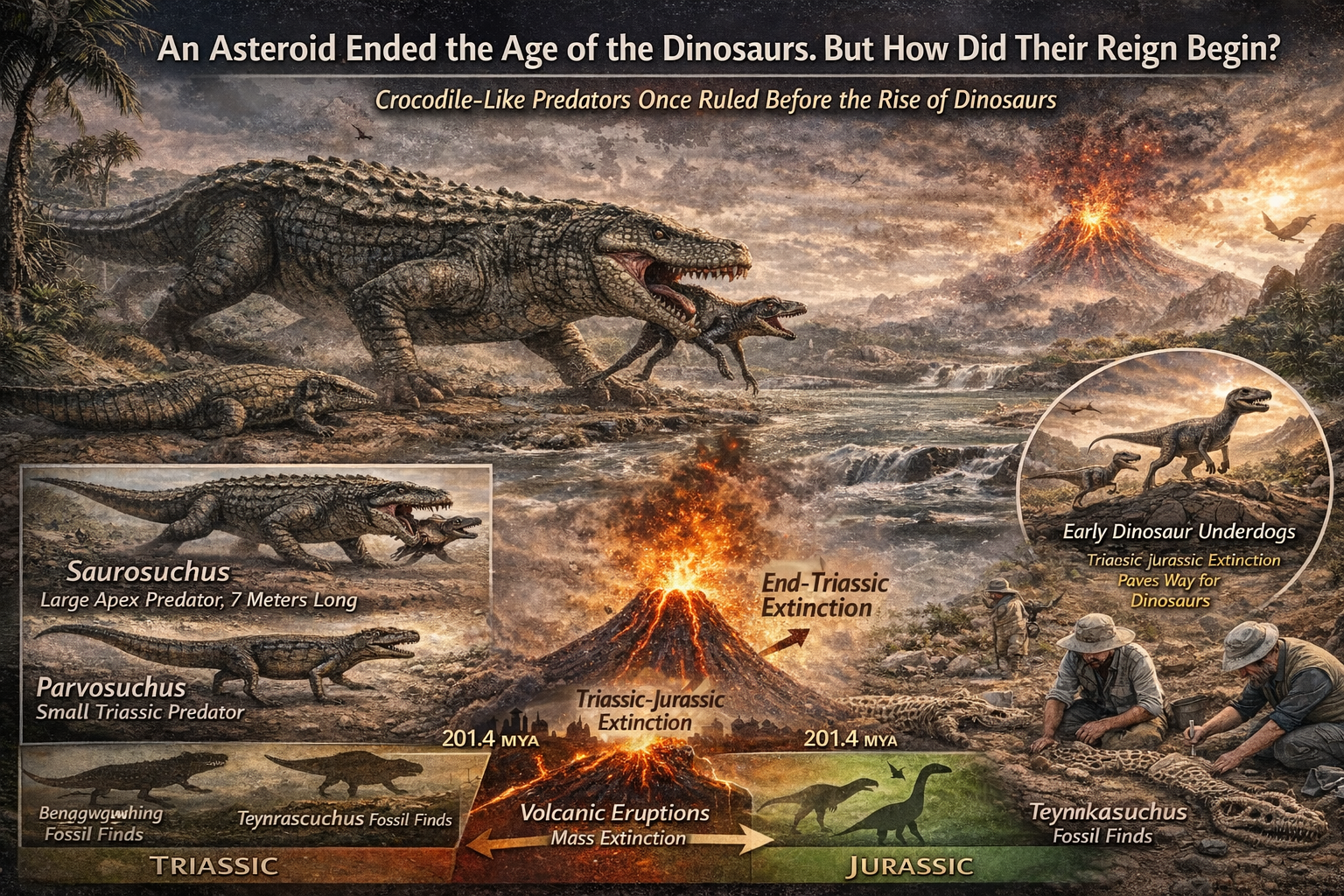
New fossil discoveries reveal that crocodile-like predators ruled the Earth before dinosaurs took over—and their downfall paved the way for the “Age of Dinosaurs”
While everyone knows that an asteroid wiped out the dinosaurs 66 million years ago, far fewer people understand how dinosaurs came to rule the planet in the first place. The answer lies in a dramatic story of volcanic catastrophe, ecological upheaval, and the mysterious reptiles that dominated Earth before dinosaurs ever rose to prominence.
For decades, paleontologists have puzzled over a fundamental question: Why did dinosaurs become the dominant land animals for 135 million years? Recent fossil discoveries from Argentina, Brazil, and Nevada are revealing a surprising answer—dinosaurs didn’t triumph through superiority alone. They inherited the Earth after their main competitors were wiped out in a mass extinction event.
The Unexpected Rulers of the Triassic
Long before Tyrannosaurus rex stalked its prey or massive sauropods shook the ground, a different group of reptiles commanded the ancient world. These were the pseudosuchians—the “false crocodiles”—distant relatives of today’s alligators and crocodiles that bore little resemblance to their slow-moving, swamp-dwelling descendants.
“While a lot of the public’s fascination with the Triassic focuses on the origin of dinosaurs, it’s really the pseudosuchians that were doing interesting things at the beginning of the Mesozoic,” explains Dr. Nate Smith, Director and Curator of the Dinosaur Institute at the Natural History Museum of Los Angeles County.
These ancient reptiles were remarkably diverse. Some were massive quadrupedal apex predators reaching seven meters in length, like the fearsome Saurosuchus. Others, such as the heavily armored aetosaurs, were herbivores resembling prehistoric tanks. Still others walked upright on two legs, and some even had dinosaur-like beaks.
Unlike modern crocodiles that sprawl with legs splayed to the sides, pseudosuchians walked upright with legs directly beneath their bodies—allowing them to move efficiently and chase down prey. They thrived in the hot, dry climate of the Triassic Period, when all of Earth’s landmasses were joined into the supercontinent Pangaea.
When Dinosaurs Were Underdogs
During most of the Triassic period, dinosaurs weren’t the dominant species, nor were they the most diverse animals or the most abundant, according to paleontologist Dr. Steve Brusatte. The first true dinosaurs appeared roughly 240 to 235 million years ago in what is now Argentina—small, bipedal creatures that “darted across the variable landscape,” as one researcher describes them.
These early dinosaurs, including Eoraptor and Herrerasaurus, were relatively minor players in ecosystems dominated by pseudosuchians. They weren’t at the top of the food chain and occupied ecological niches on the margins of Triassic life.
Recent high-precision dating of the Chañares Formation in Argentina suggests that the transition from dinosaur ancestors to diverse dinosaurian communities occurred rapidly within about 5 million years. However, even after this initial diversification, dinosaurs remained secondary to the pseudosuchian rulers of the land.
The Extinction That Changed Everything
The turning point came 201.4 million years ago, at the boundary between the Triassic and Jurassic periods. Massive volcanic eruptions from the Central Atlantic Magmatic Province spewed enormous amounts of lava and toxic gases, including carbon dioxide, sulfur, and mercury, into the atmosphere.
This catastrophic event—triggered by the breakup of Pangaea—created intense global warming and ocean acidification. The end-Triassic extinction resulted in the demise of some 76 percent of all marine and terrestrial species, making it one of the five worst mass extinctions in Earth’s history.
The end-Triassic extinction caused the extinction of all pseudosuchians with the exception of crocodylomorphs—the ancestors of modern crocodiles. Giant predatory pseudosuchians, armored aetosaurs, and crocodile-like phytosaurs all vanished. Meanwhile, dinosaurs, pterosaurs, and early mammals survived relatively unscathed.
“The extinction event cleared the way for dinosaurs to dominate Earth for the next 135 million years, taking over ecological niches formerly occupied by other species,” notes research from MIT on the extinction’s aftermath.
Why Did Dinosaurs Survive?
Scientists are still debating why dinosaurs weathered the extinction while their pseudosuchian competitors perished. One leading theory suggests that cold periods induced by volcanic ash clouding the atmosphere might have favored warm-blooded animals, with dinosaurs, pterosaurs, and mammals being more capable of enduring these conditions than large pseudosuchians.
Others point to differences in physiology, diet, or simply luck. What’s clear is that the extinction fundamentally restructured terrestrial ecosystems. In the aftermath, dinosaurs experienced a major radiation, filling ecological niches vacated by the victims of the extinction.
Recent Fossil Discoveries
Several recent discoveries are filling in crucial details about this transitional period:
In November 2024, paleontologists in Brazil announced the discovery of Tainrakuasuchus bellator—a 2.4-meter-long armored predator that lived 240 million years ago, just before dinosaurs appeared. Dr. Rodrigo Temp Müller, who led the discovery team, notes that these finds provide evidence of “ecosystems that existed before the dawn of the dinosaur era.”
Another Brazilian discovery, Parvosuchus aurelioi, represents one of the smallest Triassic predators at just one meter long. Its blade-like teeth suggest it hunted small prey and scavenged, demonstrating the ecological complexity of pre-dinosaur ecosystems.
Meanwhile, in Nevada, researchers found Benggwigwishingasuchus eremicarminis—a pseudosuchian that lived along ancient coastlines. This discovery reveals that crocodile relatives inhabited coastal environments worldwide during the Middle Triassic, independently adapting to life along shores on multiple continents.
The True “Age of Dinosaurs”
The true “Age of Dinosaurs” occurred during the following Jurassic and Cretaceous periods, rather than the Triassic. It was only after the end-Triassic extinction that dinosaurs truly came into their own, diversifying into the giants we know today—from long-necked sauropods to fierce theropods to armored ankylosaurs.
The story reveals a humbling truth: dinosaurs didn’t dominate simply because they were superior. They inherited a world emptied of competitors by volcanic catastrophe. As Dr. Müller observes about the pseudosuchians: “Although early pseudosuchians received far less attention than dinosaurs in pop culture, these reptiles evolved a vast spectrum of forms before the rise of dinosaurs.”
The reign of dinosaurs—which would last until another catastrophic event 66 million years ago—began not with a triumph, but with survival in the face of planetary disaster. Understanding this transition helps scientists piece together how modern ecosystems evolved and how mass extinctions reshape the trajectory of life on Earth.
As researchers continue to unearth fossils from this critical period, each discovery adds another piece to the puzzle of how our planet transformed from a world ruled by crocodile-like predators to the domain of dinosaurs—setting the stage for the eventual rise of mammals, and ultimately, humans.