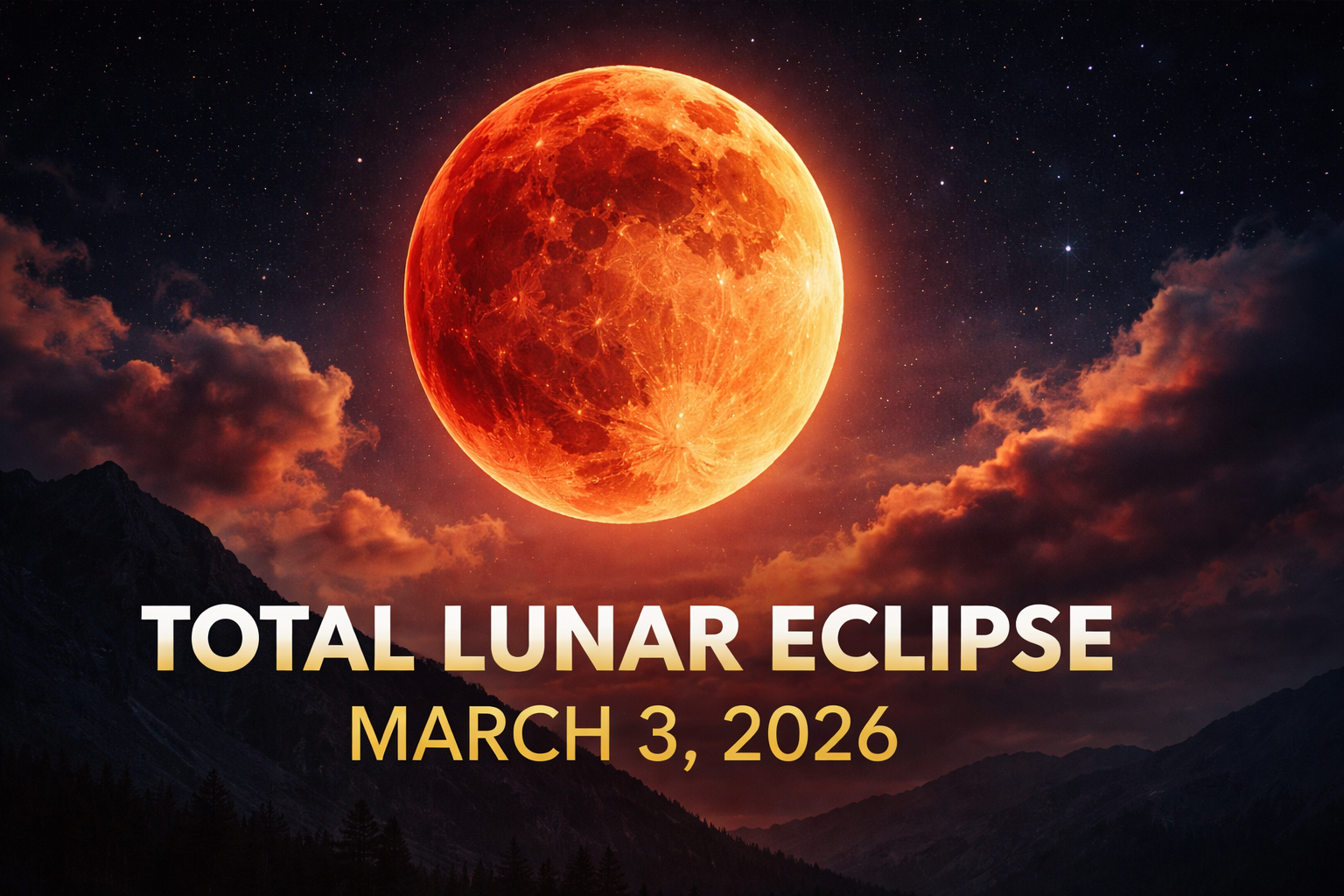
Skywatchers across parts of the world will witness a dramatic celestial spectacle on March 3, 2026, as the first total lunar eclipse of the year turns the Moon a deep copper-red, a phenomenon popularly known as a blood moon.
The eclipse will be safe to observe with the naked eye and will be best viewed from western North America, Australia, and the Pacific region, where observers will experience the full phase of totality.
What Is a Blood Moon?
A blood moon occurs during a total lunar eclipse, when Earth moves directly between the Sun and the Moon. As sunlight passes through Earth’s atmosphere, blue wavelengths scatter while red and orange light bends toward the Moon, giving it a striking reddish glow.
According to NASA, this precise alignment can only occur during a full Moon.
Where Will the Eclipse Be Visible?
- Best views: Western North America, Australia, Pacific region
- Totality visible: Eastern Asia and Australia (evening), Pacific (overnight), North & Central America (early morning)
- Partial eclipse: Central Asia, much of South America
- Not visible: Europe and Africa
In cities such as New York, the Moon will begin turning red, but the deepest phase of the eclipse will occur after moonset, limiting full visibility.
Eclipse Timing
- Totality begins: 6:04 a.m. EST
- Totality ends: 7:02 a.m. EST
- Duration: 58 minutes
- Global time: 11:04–12:02 GMT
How to Watch
No special equipment is required. Astronomers recommend:
- Viewing from a dark location
- Ensuring clear skies
- Using binoculars or a telescope for enhanced detail (optional)
Unlike solar eclipses, lunar eclipses are completely safe to view directly.