Bengaluru, India – In a dramatic cosmic event that unfolded 350 light-years away, the James Webb Space Telescope (JWST) has witnessed the sudden collapse of a protective wall in a young star’s disk, revealing a hidden reservoir of complex organic molecules considered key precursors to life’s chemistry.
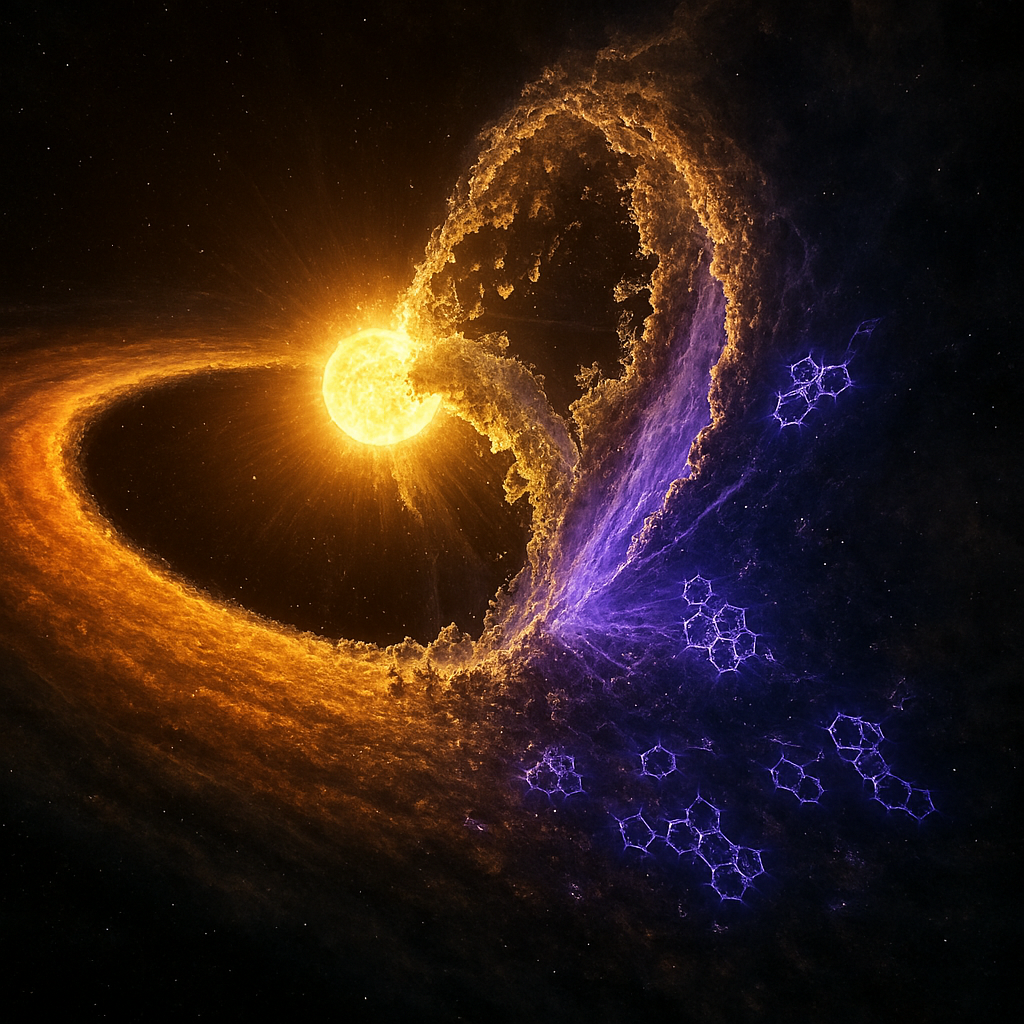
The star, T Chamaeleontis (T Cha), is a Sun-like infant quietly building planets. For years, a dense inner wall of its dusty disk shielded its outer reaches from the star’s ultraviolet (UV) light. But in 2022, during a violent growth spurt, part of that wall collapsed. As material from the disk plunged onto the star, the curtain of dust thinned, and a flood of UV light poured into the shadows.
This unexpected illumination caused previously hidden, flat, honeycomb-shaped molecules called polycyclic aromatic hydrocarbons (PAHs) to light up brilliantly in JWST’s powerful infrared eye. The discovery, led by researchers at the Indian Institute of Astrophysics (IIA), offers an unprecedented real-time view into how the chaotic environments around young stars can both hide and expose the very chemistry that could seed planets with life’s building blocks.
“It was like a cosmic stage light suddenly switching on,” said Dr. Arun Roy, a post-doctoral fellow at IIA and lead author of the study published in The Astronomical Journal. “The UV radiation streamed out, excited these PAH molecules in the cold outer disk, and made them glow. JWST caught that moment almost by accident.”
A Star with a Plan(etary) Gap
T Cha is no ordinary nursery. Its planet-forming disk features a vast, clean gap, likely carved by a newborn protoplanet as it sweeps up material. This gap makes the system a prime laboratory for studying how young planets shape their birth environments. The gap also separated the disk into a bright inner region and a colder outer one, with the inner rim acting as a protective barrier.
The Power of a Time Capsule
The team’s detective work didn’t stop with JWST. They turned back the clock by analyzing 20-year-old archival data from NASA’s Spitzer Space Telescope. To their surprise, they found faint but definite signatures of the same PAH molecules in Spitzer’s 2002 observations—a detection that had gone unnoticed until now.
This comparison proved crucial. While the PAHs shone 100 times brighter in JWST’s 2022 data due to the increased UV light, the relative intensities of their spectral fingerprints were nearly identical between the two epochs.
“This is the real kicker,” explained Dr. Roy. “The molecules themselves—their size, their structure, their charge—remained completely stable over two decades of cosmic time. They survived the turmoil of the disk, even as the disk structure itself changed dramatically around them.”
Why This Discovery Rewrites Understanding
- Overcoming the Veil: Detecting PAHs around low-mass, Sun-like stars has been notoriously difficult because their own disks often block the necessary UV light. This event demonstrates how common these molecules might be, simply waiting to be revealed by dynamic changes.
- Stability in Chaos: It shows that complex organic molecules can be remarkably resilient, persisting in the harsh, variable environment of a planet-forming disk for at least 20 years.
- A New Window on Disk Evolution: Astronomers can now study how sudden accretion events and planet-driven gaps directly affect the chemical environment where future planets will form.
The Astrobiological Connection
PAHs, composed of carbon and hydrogen arranged in interlocking rings, are widespread in the universe. They are considered one of the earliest and most robust steps on the chemical pathway that could eventually lead to the formation of more complex prebiotic molecules. Finding them in a Sun-like star’s planet-forming zone—and confirming their stability—bolsters the idea that the raw ingredients for life may be common in the nurseries of terrestrial planets.
“We are not just seeing static chemistry anymore,” said a co-author of the study. “With JWST, we are watching the story of planetary system formation unfold in real-time, complete with plot twists—like a wall falling down and revealing the treasure behind it.”
The research, funded by India’s Department of Science and Technology, utilized data from JWST’s Mid-Infrared Instrument (MIRI). The team continues to analyze the rich dataset to understand the precise properties of the PAHs and model the detailed structure of T Cha’s evolving disk.