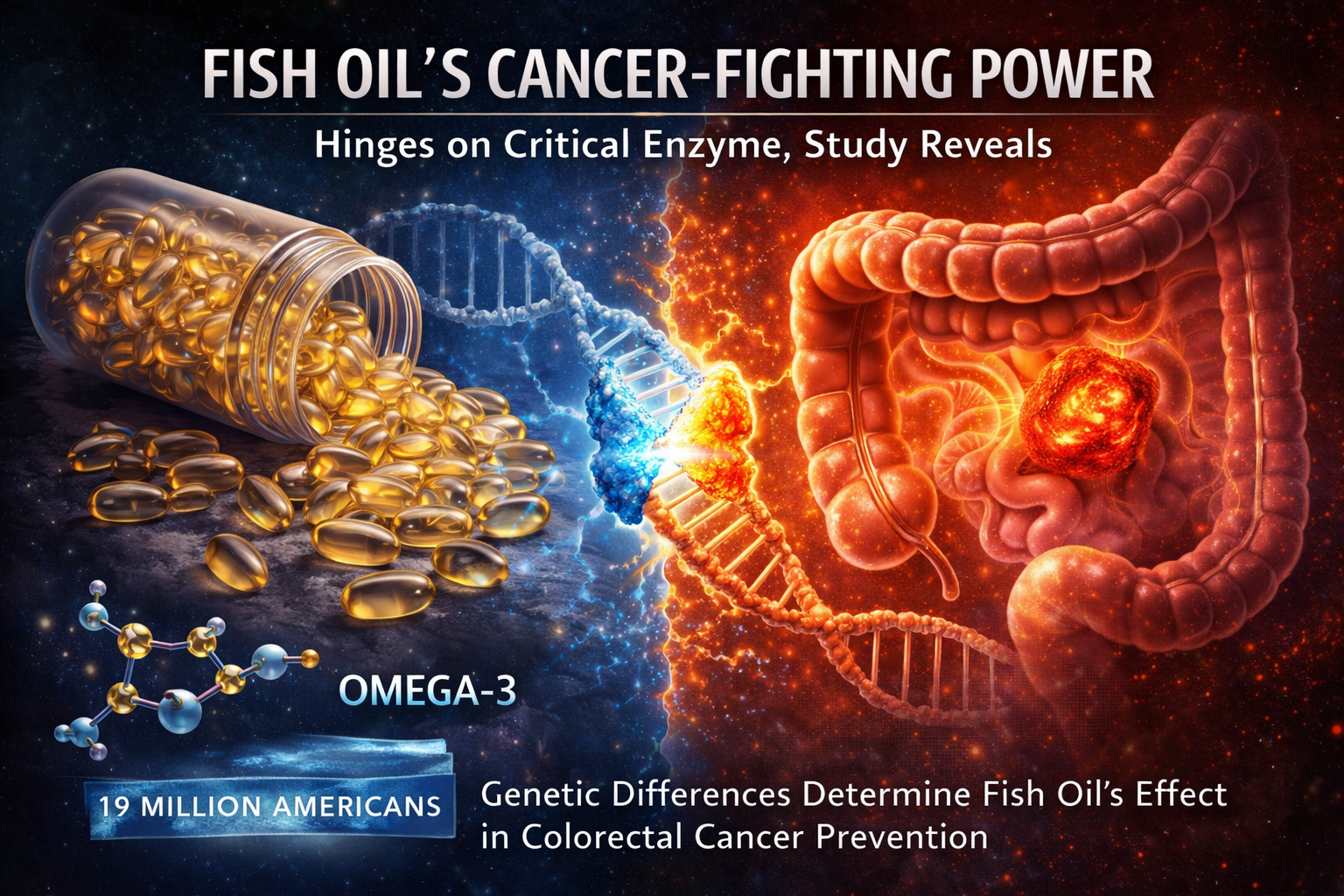
Groundbreaking research shows genetic differences determine whether omega-3 supplements help or harm in colorectal cancer prevention
February 15, 2026
For the 19 million Americans who take fish oil supplements daily, a new study delivers a sobering message: the popular pills may only work for some people, and in others, they could potentially do more harm than good.
Researchers at the University of Michigan and the University of Texas MD Anderson Cancer Center have discovered that an enzyme called 15-lipoxygenase-1, or ALOX15, plays a decisive role in whether omega-3 fatty acids can help prevent colorectal cancer. Without this enzyme, fish oil supplements not only lose their protective effects but may actually increase tumor growth.
The findings, published February 13 in the journal Cellular and Molecular Gastroenterology and Hepatology, challenge the one-size-fits-all approach to nutritional supplements and underscore the importance of personalized medicine in cancer prevention.
The Missing Piece of the Puzzle
Fish oil supplements, rich in the omega-3 fatty acids eicosapentaenoic acid (EPA) and docosahexaenoic acid (DHA), have long been promoted for their anti-inflammatory properties and potential to reduce the risk of chronic diseases. However, clinical studies examining their relationship to cancer have produced frustratingly inconsistent results—some showing protection, others showing no benefit, and a few even suggesting increased cancer risk.
“Large clinical studies focusing on the association between fish oil, EPA, DHA and cancer have largely been inconclusive,” the research team noted. This new study may finally explain why.
The key lies in how the body processes these omega-3 fatty acids. When consumed, EPA and DHA are normally converted into powerful anti-inflammatory molecules called resolvins. These compounds help dampen chronic inflammation, a well-established driver of cancer development. But this crucial conversion depends entirely on the presence of ALOX15.
A Surprising Discovery in Mice
The research team initially set out to compare mice fed fish oil-enriched diets with those on standard diets. The results were unexpected and concerning.
To their surprise, fish oil actually increased the number of colon tumors in mice exposed to chemicals that trigger inflammation and accelerate tumor formation. This counterintuitive finding prompted deeper investigation into what was going wrong.
The researchers then examined mice genetically engineered to lack ALOX15. In these animals, the absence of the enzyme led to a notable rise in colorectal tumors when fed fish oil—though the impact varied dramatically depending on which type of omega-3 fatty acid was used.
Mice fed EPA-rich diets developed significantly fewer tumors than those given DHA supplements. This distinction proved critical to understanding the mechanism at work.
Not All Fish Oil Is Created Equal
The study examined various formulations of omega-3 supplements, including free fatty acids, ethyl esters, and triglycerides. The researchers tested Lovaza, an FDA-approved prescription medication containing ethyl ester forms of EPA and DHA used to treat high triglyceride levels.
The results revealed stark differences. Lovaza and various EPA-based supplements—including ethyl ester and free fatty acid forms—reduced both the number and size of tumors, particularly in mice with active ALOX15. In contrast, DHA supplements failed to prevent tumor growth in mice lacking the enzyme. Only when ALOX15 was present did DHA show tumor-suppressing effects.
“Not all fish oil supplements are the same,” said Imad Shureiqi, professor of internal medicine at the University of Michigan and a member of the Rogel Cancer Center. “It is also important to ask whether the person who is taking the supplement has the required enzymes to metabolize these products to prevent chronic inflammation and subsequently cancer development.”
The ALOX15 Problem in Cancer
The discovery takes on added significance because ALOX15 is commonly lost or turned off in colorectal tumors. This creates a troubling scenario: patients at risk for or battling colorectal cancer may be the very people least likely to benefit from fish oil supplements—and potentially most likely to be harmed by them.
The enzyme facilitates the metabolic transformation that bridges dietary omega-3 intake with anti-inflammatory tumor suppression pathways. Without it, this crucial biochemical bridge collapses, leaving omega-3 fatty acids unable to exert their protective effects.
Implications for Cancer Prevention
The findings raise critical questions about current medical practice. Fish oil supplements are widely recommended for various health benefits, often without consideration of individual genetic or molecular profiles.
The researchers emphasize the need to screen for ALOX15 presence in cancer patients when developing prevention strategies using EPA and DHA supplements. Such screening could help identify which patients would truly benefit from fish oil supplementation and which might need alternative approaches.
“These findings suggest that having colon polyps without ALOX15 will make EPA and DHA less effective in stopping tumor growth,” Shureiqi explained. He recommends that people consult their physicians before taking fish oil supplements, particularly those with a family history of colorectal cancer or existing polyps.
Looking Toward Personalized Prevention
The research team isn’t stopping with these revelations. They’re now developing medications designed to boost ALOX15 levels in cancer cells. The goal is to restore the body’s ability to process EPA and DHA effectively, potentially strengthening efforts to prevent colon cancer.
If successful, such drugs could work synergistically with omega-3 supplementation, ensuring that fish oil delivers its intended benefits even in patients whose tumors have lost ALOX15 expression.
The Broader Message About Supplements
While the study was conducted primarily in mice and results may differ in humans, it delivers a powerful message about the limitations of blanket nutritional recommendations. Individual genetic makeup, enzyme expression profiles, and existing disease states can all significantly influence whether a supplement helps, does nothing, or potentially causes harm.
“The differential responses observed in the study underscore the nuanced interplay between supplement chemistry, host enzymatic milieu, and cancer biology,” researchers noted.
The findings align with a growing movement in medicine toward personalized approaches that account for individual biological differences rather than treating all patients the same way.
What This Means for Consumers
For now, the study suggests several practical takeaways:
First, fish oil supplements should not be viewed as universally beneficial, particularly for cancer prevention. Second, individuals considering fish oil for health reasons should discuss it with their healthcare providers, especially if they have risk factors for colorectal cancer. Third, the type of omega-3 supplement matters—EPA and DHA are not interchangeable.
As research continues to unravel the complex relationships between nutrition, genetics, and disease, one message is becoming increasingly clear: the era of one-size-fits-all supplement recommendations may be coming to an end, replaced by a more sophisticated understanding of how individual biology shapes our response to what we consume.
The study was supported by the National Cancer Institute, the Rogel Cancer Center, and the Cancer Prevention and Research Institute of Texas.