⚡ Quick Answer
Scientists estimate there are between 200 billion and 2 trillion galaxies in the observable universe. The Milky Way — our home galaxy — is about 100,000 light-years wide. The nearest large galaxy is Andromeda at 2.537 million light-years. As of 2025, the farthest confirmed galaxy is MoM-z14, over 13.5 billion light-years away.
📋 Table of Contents
- How Many Galaxies Are in the Universe?
- Types of Galaxies Explained
- Our Galaxy: The Milky Way
- Galaxy Names and Distances from Earth
- 2025 James Webb Telescope Discoveries
- Why We Measure in Light-Years
- Frequently Asked Questions
When you look up at the night sky and see thousands of stars, you are glimpsing only the tiniest fraction of what the universe holds. Every star you can see belongs to our galaxy, the Milky Way — and beyond it lie trillions more galaxies, each containing hundreds of billions of stars of their own. This guide covers everything students, curious minds, and science enthusiasts need to know about galaxies: how many there are, their names, how far they are from Earth, what types exist, and what the James Webb Space Telescope has revealed in 2025.
1. How Many Galaxies Are in the Universe?
2 Trillion
Estimated number of galaxies in the observable universe
The total number of galaxies in the observable universe sits between 200 billion and 2 trillion — a range so enormous it is almost impossible to comprehend. This wide estimate is not a failure of science; it reflects one of the most fundamental truths about astronomy: we can only observe a fraction of all that exists.
Today’s telescopes can detect galaxies up to roughly 46 billion light-years away — the boundary of the observable universe. But beyond that boundary, space continues. Most estimates suggest the unobservable universe could contain many more galaxies still, perhaps infinitely many. Even within the observable universe, approximately 90% of galaxies are too faint or distant for today’s instruments to detect.
“The James Webb Space Telescope continues to find far more bright early-universe galaxies than any theoretical model predicted — pushing our estimates of the galaxy count upward with every new observation.”
Galaxy counting is performed by selecting a small patch of deep sky — such as the famous Hubble Ultra Deep Field image — counting every galaxy visible in that patch, and then multiplying across the full sphere of sky. The 2 trillion figure comes from a landmark 2016 study that factored in galaxies that are too small and faint to currently detect, revising earlier estimates of 200 billion upward by tenfold.
2. Types of Galaxies Explained
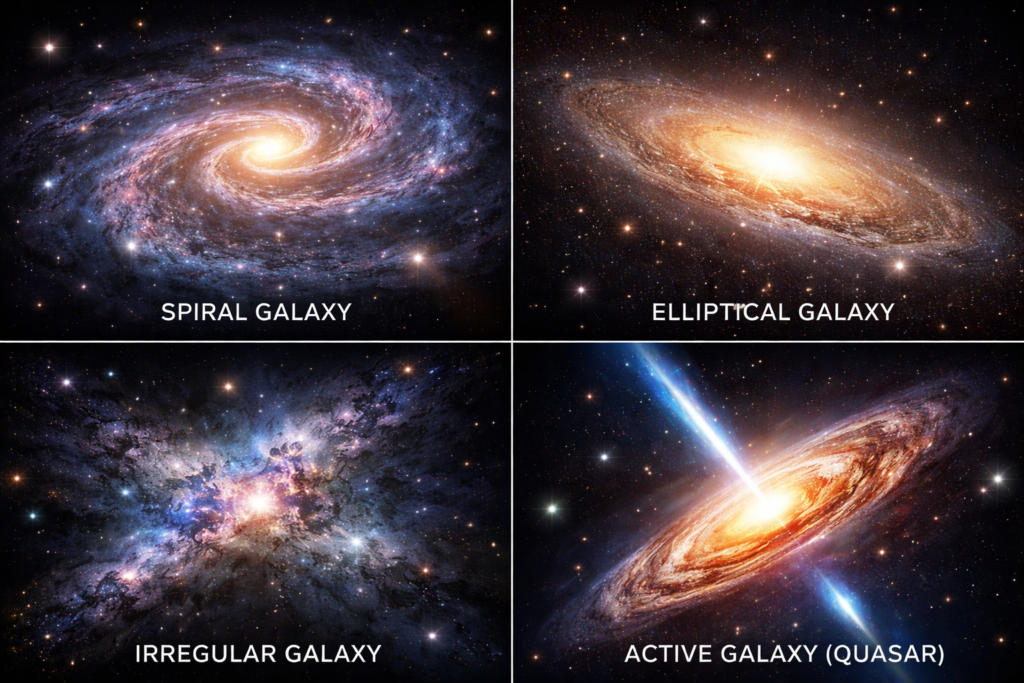
Galaxies are classified into four primary types based on their shape, structure, and internal activity. Understanding these types is essential to understanding how galaxies form, evolve, and eventually die.
🌀
Spiral Galaxies
Rotating pinwheel-shaped disks with a central bulge. Includes barred spirals (like the Milky Way). Rich in gas, dust, and active star formation. Make up ~60% of all galaxies we can observe.
🔵
Elliptical Galaxies
Round to oval in shape, older and less organized. Little gas or dust remains, so new star formation is minimal. Often form from collisions between spiral galaxies over billions of years.
🌌
Irregular Galaxies
Chaotic, asymmetric galaxies with no defined shape. Often result from gravitational collisions or tidal forces from nearby galaxies. The Magellanic Clouds are famous examples.
⚡
Active Galaxies (Quasars)
Powered by supermassive black holes consuming surrounding matter. Quasars are the most luminous objects in the universe, emitting thousands of times more energy than an entire galaxy of stars.
Spiral vs. Elliptical: Key Differences
Spiral galaxies like the Milky Way and Andromeda are home to ongoing star birth in their spiral arms, which glow blue from the light of young, hot stars. Elliptical galaxies, by contrast, appear yellow or red — the colors of older, cooler stars. Scientists believe most massive elliptical galaxies formed billions of years ago when two spiral galaxies collided and merged. This fate may eventually await the Milky Way itself when it collides with Andromeda in approximately 4.5 billion years.
The largest known galaxy is ESO 383-76 (also called Alcyoneus), measuring approximately 1,764,000 light-years in diameter — roughly 17 times wider than the Milky Way — located about 654 million light-years from Earth in the Centaurus constellation.
3. Our Galaxy: The Milky Way — Key Facts
The Milky Way is humanity’s home galaxy — a grand, barred spiral galaxy that has been forming stars for nearly as long as the universe has existed. Here are the most important facts you should know:
| Feature | Detail |
|---|---|
| Galaxy Type | Barred Spiral (SBbc) |
| Diameter | ~100,000 light-years (some estimates: up to 200,000) |
| Number of Stars | 100–400 billion stars |
| Age | ~13.6 billion years |
| Our Position | Orion Arm, ~26,000 light-years from galactic center |
| Galactic Year (orbit) | ~240 million Earth years |
| Central Black Hole | Sagittarius A* — 4 million solar masses |
| Nearest Large Neighbor | Andromeda Galaxy — 2.537 million light-years |
| Number of Satellite Galaxies | ~59 known dwarf galaxies orbit the Milky Way |
One of the most mind-bending facts about the Milky Way is our position within it. Earth sits along the Orion Arm — a minor spiral arm — roughly halfway between the galactic center and the outer edge. Because we are inside the galaxy looking outward, we see the Milky Way as a hazy band of light stretching across the night sky, not as the majestic spiral it truly is. To see it from the outside, you would need to travel approximately 2 million light-years away — which is exactly where Andromeda sits.
4. Galaxy Names and Distances from Earth (Complete Table)
The following table lists the most well-known and scientifically significant galaxies, ordered from closest to most distant. All distances are measured in light-years — the distance light travels in one year (approximately 9.46 trillion kilometers).
| Galaxy Name | Type | Distance from Earth | Notable Feature |
|---|---|---|---|
| Canis Major Dwarf | Irregular Dwarf | 25,000 light-years | Closest known galaxy to Earth (disputed) |
| Sagittarius Dwarf | Elliptical Dwarf | 70,000 light-years | Being absorbed by the Milky Way |
| Large Magellanic Cloud (LMC) | Irregular | ~160,000 light-years | Visible to naked eye; site of Supernova 1987A |
| Small Magellanic Cloud (SMC) | Irregular | ~200,000 light-years | Milky Way satellite; named after Ferdinand Magellan |
| Andromeda Galaxy (M31) | Barred Spiral | 2.537 million light-years | Nearest large galaxy; on collision course with Milky Way |
| Triangulum Galaxy (M33) | Spiral | ~2.73 million light-years | Third largest in the Local Group; farthest object visible to naked eye |
| Centaurus A (NGC 5128) | Elliptical (Active) | ~13 million light-years | Powerful radio galaxy; visible jets from central black hole |
| Whirlpool Galaxy (M51) | Spiral | ~23 million light-years | Classic spiral; first galaxy to have its spiral structure observed |
| Sombrero Galaxy (M104) | Spiral/Elliptical | ~31 million light-years | Distinctive dark dust lane gives sombrero appearance |
| Pinwheel Galaxy (M101) | Spiral | ~21 million light-years | Face-on spiral; contains over 1 trillion stars |
| Black Eye Galaxy (M64) | Spiral | ~24 million light-years | Named for its dark band of dust; unique counter-rotating inner disk |
| Cartwheel Galaxy | Ring | ~500 million light-years | Formed by a direct collision; ring of star formation visible |
| Markarian 231 | Active (Quasar) | ~600 million light-years | Nearest quasar to Earth; hosts a double black hole system |
| GN-z11 | Early Universe | ~13.4 billion light-years | Shocked astronomers with unexpected brightness and size |
| JADES-GS-z14-0 | Early Universe | ~13.5 billion light-years | Confirmed by JWST in 2024; former record holder |
| MoM-z14 | Early Universe | ~13.5+ billion light-years | 🏆 CURRENT RECORD (2025): Most distant confirmed galaxy ever observed |
⭐ Highlighted rows = earliest universe galaxies discovered by JWST. Distances represent light-travel time, not current positions.
5. 2025 James Webb Space Telescope Discoveries Rewriting History
🆕 Updated March 2025
The James Webb Space Telescope (JWST), launched in December 2021, has fundamentally transformed galaxy astronomy. Its ability to detect infrared light — wavelengths invisible to the human eye and to the Hubble telescope — allows it to peer through cosmic dust and see the universe as it existed just hundreds of millions of years after the Big Bang.
The Record-Breaking MoM-z14 Galaxy (2025)
In early 2025, astronomers confirmed MoM-z14 as the most distant spectroscopically confirmed galaxy ever observed, existing just 280 million years after the Big Bang — when the universe was barely 2% of its current age. Its light has traveled over 13.5 billion years to reach our telescopes, giving us a direct snapshot of the universe’s infancy.
What makes MoM-z14 extraordinary is not just its distance. It contains unusually high levels of nitrogen — a chemical signature that suggests massive stars formed and died with extraordinary speed in the early universe, far faster than models predicted. This has forced a rethink of how quickly the first galaxies could evolve.
The “Too Many Bright Galaxies” Problem
JWST has detected more than ten ultra-distant, unexpectedly bright galaxies in the early universe — galaxies that are 100 times more common than the standard model of cosmology (ΛCDM) predicted. This abundance of bright, well-structured early galaxies challenges the timeline we believed for how quickly matter could collapse into galaxies after the Big Bang.
Some scientists are now asking whether our models of dark matter, dark energy, or early star formation need to be revised. Others suggest that early galaxies simply converted gas into stars with remarkable efficiency, or that supermassive black holes played a larger role than expected in driving early galaxy growth.
The Earliest Galaxy Cluster Ever Seen
Using JWST in combination with NASA’s Chandra X-ray Observatory, astronomers identified what appears to be the most distant galaxy cluster ever observed — a group of galaxies assembling together just 1 billion years after the Big Bang. Galaxy clusters typically take far longer to form, making this discovery one of the most structurally surprising of the modern astronomical era.
6. Why Galaxy Distances Are Measured in Light-Years
A light-year is not a unit of time — it is a unit of distance. Specifically, it is the distance that light travels in one year through the vacuum of space: approximately 9.46 trillion kilometers (5.88 trillion miles).
Galaxies are so unimaginably far away that no human-scale unit of measurement could express their distances meaningfully. If you tried to write the distance to Andromeda in kilometers, you would need to write a 19-digit number. Light-years compress these distances into manageable numbers — Andromeda is simply 2.537 million light-years away.
“Looking into space is looking back in time. The light from Andromeda that reaches your eye tonight left that galaxy over 2.5 million years ago — before modern humans existed on Earth.”
This relationship between distance and time is the cornerstone of observational astronomy. When astronomers say they observe a galaxy 13 billion light-years away, they mean they are seeing that galaxy as it existed 13 billion years ago — not as it exists today. In this sense, the most distant galaxies discovered by JWST are not just far away: they are time machines, revealing what the first structures of the universe actually looked like during the cosmic dawn.
7. Frequently Asked Questions About Galaxies
❓ How many galaxies are in the observable universe?
Current scientific estimates place the total number of galaxies in the observable universe at between 200 billion and 2 trillion. The James Webb Space Telescope continues to discover more than previously predicted, and the true count may be even higher.
❓ What is the closest galaxy to Earth?
The Canis Major Dwarf Galaxy is considered the closest at about 25,000 light-years — though it is disputed and partially merged with the Milky Way. The most well-known close galaxy is the Large Magellanic Cloud at ~160,000 light-years, visible to the naked eye from the Southern Hemisphere.
❓ What is the farthest galaxy ever discovered?
As of 2025, MoM-z14 holds the record as the most distant spectroscopically confirmed galaxy, located over 13.5 billion light-years away. It was confirmed by the James Webb Space Telescope and existed just 280 million years after the Big Bang.
❓ How big is the Milky Way?
The Milky Way is approximately 100,000 light-years in diameter (some estimates extend to 200,000 light-years including its outer stellar halo). It contains between 100 billion and 400 billion stars and over 59 known satellite galaxies.
❓ What are the 3 main types of galaxies?
The three primary types are spiral galaxies (rotating disks with arms, like the Milky Way), elliptical galaxies (smooth, round, older), and irregular galaxies (no defined shape, often distorted by gravity). A fourth type — active galaxies including quasars — is also widely recognized.
❓ Will the Milky Way and Andromeda collide?
Yes — astronomers have confirmed that the Andromeda Galaxy is approaching the Milky Way at approximately 110 kilometers per second. In about 4.5 billion years, the two galaxies will collide and eventually merge into a single, larger elliptical galaxy. The Sun and Earth will likely survive, though displaced to a new region of the merged galaxy.
❓ How long does it take to travel to another galaxy?
Even at the speed of light (the fastest anything can travel), it would take 2.537 million years to reach Andromeda, our nearest large galaxy neighbor. With current spacecraft technology, the journey would take billions of times longer — intergalactic travel remains firmly in the realm of science fiction.
Summary: Key Galaxy Facts to Remember
The universe contains an estimated 200 billion to 2 trillion galaxies, organized into the cosmic web of groups, clusters, and superclusters. Galaxies come in four main types: spiral, elliptical, irregular, and active. Our home, the Milky Way, is a 100,000-light-year-wide barred spiral housing up to 400 billion stars. The nearest major galactic neighbor is the Andromeda Galaxy at 2.537 million light-years. The most distant confirmed galaxy as of 2025 is MoM-z14, over 13.5 billion light-years away — and the James Webb Space Telescope continues to push that frontier further with every new observation, constantly rewriting our understanding of when, how, and how quickly the universe’s first galaxies came into being.
Sources: NASA, ESA James Webb Space Telescope, Nature Astronomy, The Astrophysical Journal, Hubble Space Telescope archive. Last reviewed and updated: March 2025.
Tags: galaxy, how many galaxies, Milky Way, galaxy distances, types of galaxies, James Webb telescope, astronomy for students, space science 2025