World’s largest neutrino detector enhances capabilities with cutting-edge sensors buried deep beneath Antarctic ice
Published: February 17, 2026 | Science & Technology
After three intensive field seasons working in one of Earth’s most extreme environments, an international team of scientists has successfully completed the first major upgrade to the IceCube Neutrino Observatory since it began operations 15 years ago, significantly boosting humanity’s ability to detect and study the universe’s most elusive particles.
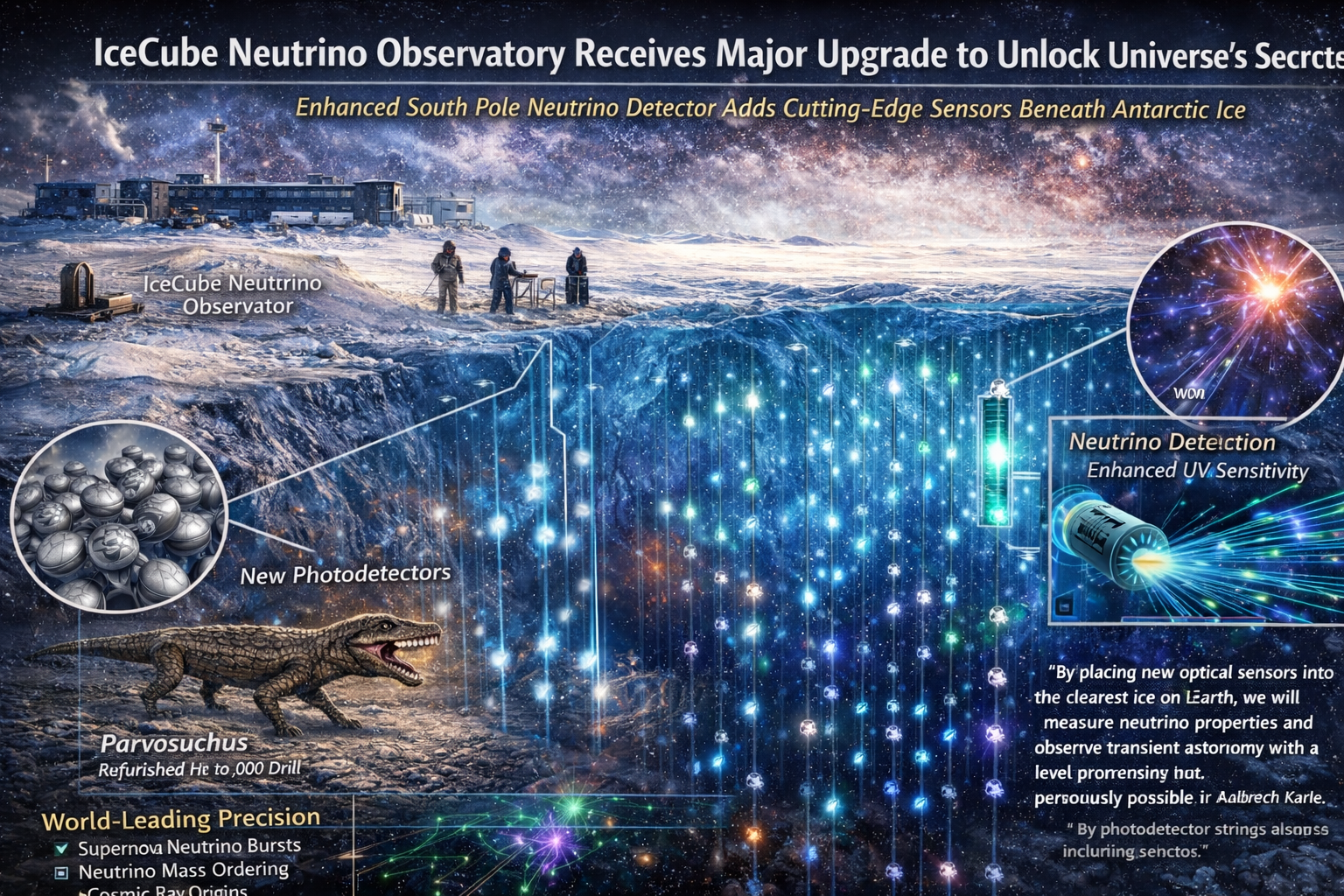
Between December 2025 and January 2026, researchers installed six new sensor strings nearly 8,000 feet beneath the Antarctic ice at the South Pole, adding over 650 modern photodetectors and calibration devices to the already massive detector. The upgrade represents a major engineering achievement and positions IceCube to make groundbreaking discoveries about neutrinos, cosmic rays, and the violent astrophysical events that produce them.
What is IceCube?
Located at the Amundsen-Scott South Pole Station, IceCube is the world’s largest neutrino detector, spanning a full cubic kilometer of pristine Antarctic ice. The observatory uses more than 5,000 basketball-sized optical sensors arranged along vertical strings to detect faint flashes of light produced when neutrinos from deep space interact with atomic nuclei in the ice. The international collaboration includes 450 scientists from 58 institutions across 14 countries.
Neutrinos are among the most mysterious particles in physics. Nearly massless and carrying no electric charge, they can pass through most matter entirely undisturbed, making them extraordinarily difficult to detect. However, this same property makes them invaluable messengers from the cosmos, capable of traveling vast distances without being deflected by magnetic fields or absorbed by intervening matter.
“By placing new optical sensors into the clearest ice on Earth, we will measure neutrino properties and observe transient astronomy with a level of precision not previously possible.”
— Dr. Albrecht Karle, Principal Investigator, IceCube Upgrade
The new sensor strings feature advanced technology that significantly improves the detector’s performance. The upgrade includes two new types of optical modules with two to three times greater sensitivity than the original sensors, along with higher instrument density that enables detection of lower-energy neutrino interactions that were previously impossible to measure.
Among the most innovative additions are nine wavelength-shifting optical modules, or WOMs, developed through collaboration between research groups in Mainz, Wuppertal, Madison, Uppsala, and Berlin. These specialized detectors address a crucial limitation of the original equipment.
“With IceCube, we want to measure Cherenkov light, which has a large ultraviolet component that the original sensors cannot detect,” explains Lea Schlickmann, a PhD student who helped develop the WOMs and was among the first researchers to deploy them at the South Pole. “This means a significant portion of light from neutrino interactions was being lost. The WOMs use a special wavelength-shifting coating that converts UV photons into visible light, allowing us to capture information that was previously invisible.”
The technology could prove especially valuable for detecting neutrinos from supernovae. When a massive star explodes in a supernova, it releases an enormous burst of neutrinos that carry critical information about the explosion mechanism and the formation of neutron stars or black holes. The enhanced UV sensitivity of the WOMs would make IceCube particularly well-suited to observe these rare cosmic events.
Expanding Scientific Capabilities
The upgrade will allow IceCube to:
- Measure neutrino oscillation parameters with precision comparable to accelerator experiments, while probing higher energies and longer baselines
- Achieve world-leading precision in measuring tau neutrino appearance
- Improve sensitivity for determining the neutrino mass ordering
- Detect supernova neutrino bursts with enhanced detail
- Better understand cosmic ray composition and origins
The tighter spacing of the new modules improves the detector’s resolution, enabling scientists to extract more precise data about particles’ direction, energy, and origin. This increased “sharpness” not only opens new windows onto the universe but also serves as a practical test for a proposed future expansion called IceCube-Gen2.
“The upgrade will extend neutrino astronomy to lower energies,” says Dr. Ralph Engel, head of the Institute for Astroparticle Physics at the Karlsruhe Institute of Technology. “This not only opens a new window onto the universe, but also serves as a meaningful technology and practical test for the proposed expansion to IceCube-Gen2.”
Perhaps most remarkably, the improvements can be applied retroactively to data collected during IceCube’s first decade of operation. The better understanding of how light propagates through the ice, combined with advanced reconstruction algorithms designed for the new multi-photomultiplier modules, means scientists can reanalyze years of archived data with improved precision.
The successful completion of the upgrade required extraordinary logistical coordination and engineering prowess. Working during the brief Antarctic summer season, teams operated around the clock in temperatures that can plunge well below freezing. The hot water drill, which hadn’t been used since IceCube’s original construction was completed in 2010, was brought back to life to bore holes through more than 1.5 miles of ice.
“Seeing the refurbished drill come back to life again 15 years after IceCube’s original completion is truly remarkable,” says Dr. Karle. “The team’s around-the-clock effort to deploy the upgrade is an extraordinary accomplishment.”
The National Science Foundation, which provides the primary funding for IceCube through an award to the University of Wisconsin-Madison, views the upgrade as securing American leadership in neutrino physics for years to come.
“The successful deployment of the IceCube Upgrade project is a feat of U.S. engineering that demonstrates significant logistical capabilities in Antarctica,” says Marion Dierickx, NSF program director for IceCube. “This upgrade will secure the nation’s continued leadership in neutrino physics for years to come, paving the way for new cosmic discoveries.”
Since beginning operations, IceCube has revolutionized our understanding of the universe. In 2013, it made the first detection of high-energy neutrinos from beyond our solar system, opening the field of neutrino astronomy. More recently, in 2023, the observatory produced the first-ever image of the Milky Way made using neutrinos rather than light, revealing our galaxy in an entirely new way.
The detector has also contributed to fundamental physics research, measuring neutrino oscillations—a quantum phenomenon where neutrinos change between different types as they travel—and setting new limits on exotic particles like sterile neutrinos and dark matter candidates.
With the upgrade now complete, IceCube enters a new era of discovery. Scientists are already analyzing incoming data from the enhanced detector, and the international collaboration is eager to see what secrets of the universe the improved observatory will reveal.
As researchers continue pushing the boundaries of what’s possible in one of the harshest environments on Earth, IceCube stands as a testament to human ingenuity and our endless curiosity about the cosmos. Deep beneath the Antarctic ice, sensitive instruments wait patiently for the next cosmic messenger to arrive, ready to help us understand the universe’s most energetic and mysterious phenomena.