Science & Space | February 2026
New images from the NASA–led James Webb Space Telescope have revealed unprecedented detail inside a rare and little-studied nebula known as PMR 1, offering fresh insight into how dying stars shed their outer layers.
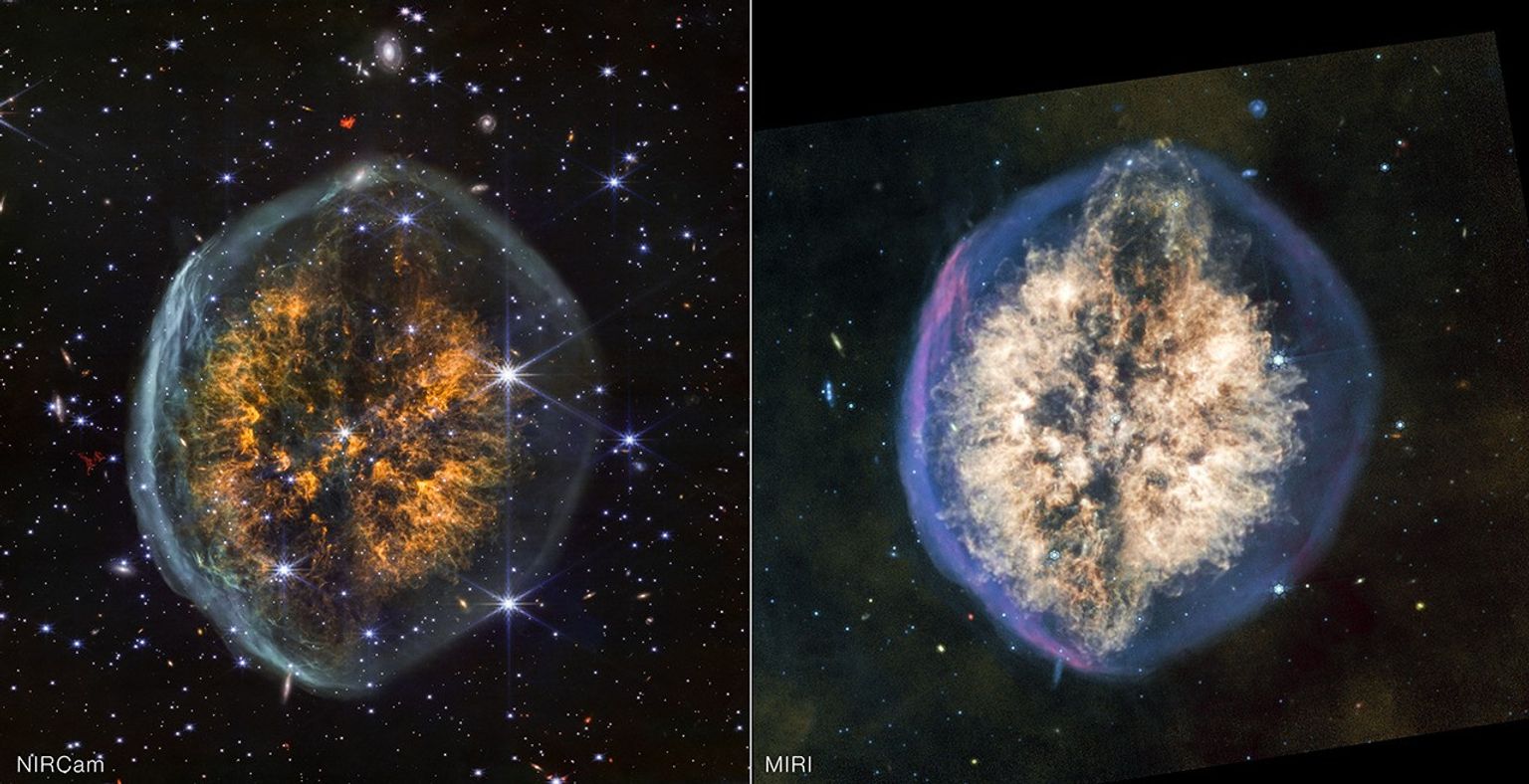
Nicknamed the “Exposed Cranium” nebula for its brain-like appearance, PMR 1 is a cloud of gas and dust formed by a star nearing the end of its life. Webb observed the object in both near-infrared and mid-infrared light, allowing astronomers to see different materials and structures within the nebula for the first time.
A nebula that looks like a brain
In near-infrared views, PMR 1 appears as a bubble with a bright outer edge and orange inner clouds, split by a dark vertical lane that gives the nebula the appearance of left and right hemispheres. Numerous stars and distant galaxies are visible through and around the nebula.
Mid-infrared observations tell a different story. Dust inside the nebula glows more strongly, the outer shell takes on a bluish tone, and the inner regions appear denser and more turbulent. Material can be seen pushing outward from the top of the nebula, with a weaker mirror effect at the bottom.
These contrasts highlight how Webb’s instruments can separate glowing dust from gas, revealing layers that were previously hidden.
What scientists are learning
Astronomers believe the nebula has at least two main components:
- An outer shell, made mostly of hydrogen gas, expelled earlier in the star’s decline
- An inner cloud, richer in heavier elements and shaped by later, more energetic outflows
The dark lane running through the center may be linked to powerful jets launched by the dying star, blasting material outward in opposite directions. Similar jets are seen in other late-stage stars but have rarely been captured in such detail.
Why this matters
PMR 1 was first detected in infrared light by NASA’s retired Spitzer Space Telescope, but Webb’s higher resolution is transforming it from a curiosity into a valuable case study of stellar evolution.
Understanding how stars lose mass at the end of their lives helps scientists predict whether a star will quietly fade into a white dwarf or explode as a supernova. These processes also enrich galaxies with elements needed to form planets and, ultimately, life.
A powerful tool for cosmic research
The James Webb Space Telescope, developed through an international partnership with European Space Agency and Canadian Space Agency, is designed to study the universe in infrared light. Its observations are reshaping research on star death, planet formation, and the origins of galaxies.
By capturing a fleeting moment in the final stages of a star’s life, Webb is giving scientists a clearer picture of how cosmic structures evolve—and how the elements that make up planets and people are created.