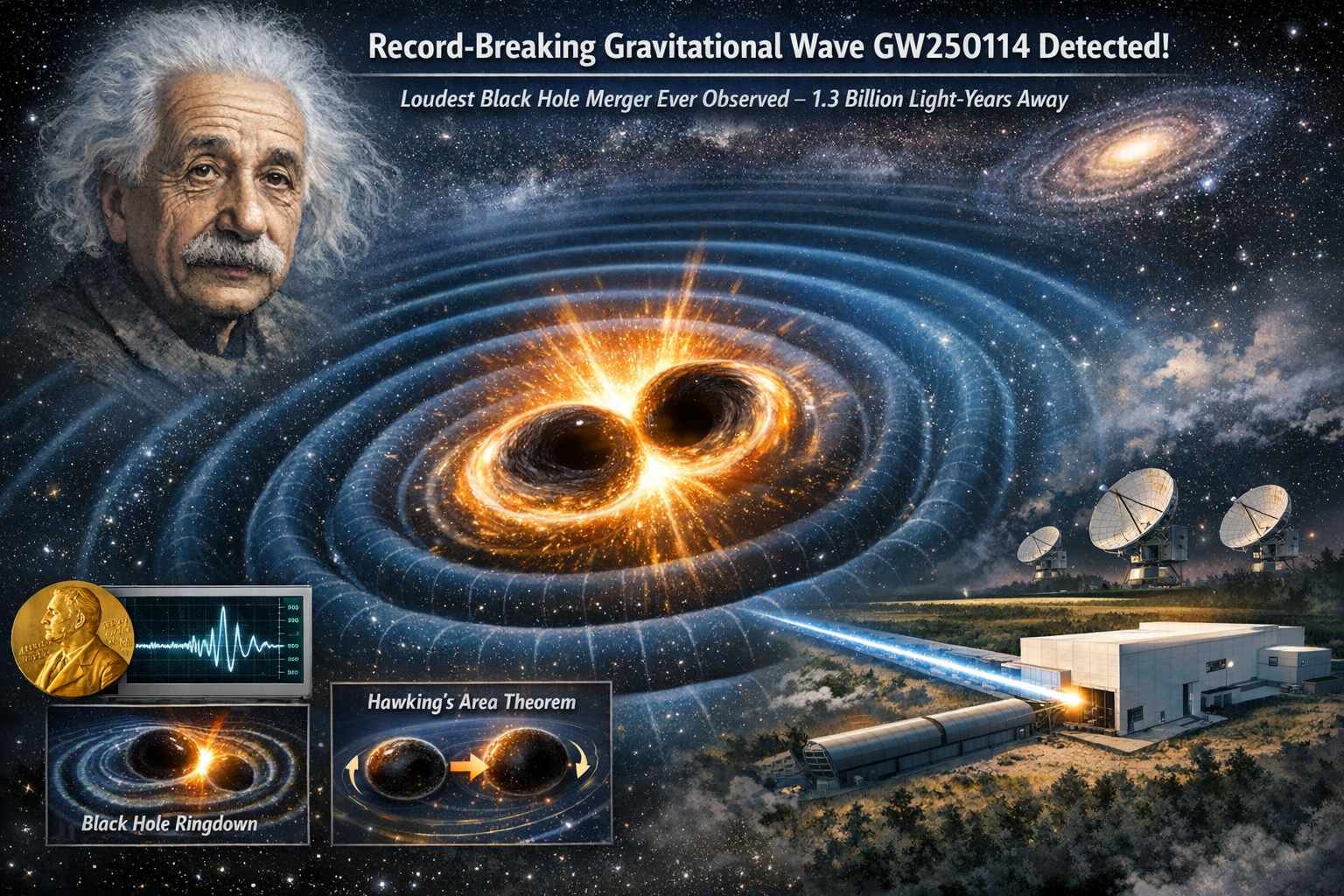
Historic Detection from 1.3 Billion Light-Years Away Confirms General Relativity with Unprecedented Precision
February 2026 – Scientists have detected the most powerful gravitational wave signal in history, providing the clearest confirmation yet of Albert Einstein’s groundbreaking predictions about the nature of gravity and spacetime. The signal, designated GW250114, represents a monumental achievement in astrophysics and offers unprecedented insights into black hole physics.
What Made GW250114 Special?
The gravitational wave event GW250114 came from the merger of two black holes — each about 30 times the mass of the sun — about 1.3 billion light-years from Earth. What sets this detection apart from previous observations is its exceptional clarity.
This new signal was recorded with roughly three times the clarity of that groundbreaking 2015 discovery, when gravitational waves were first directly detected. Researchers at the Laser Interferometer Gravitational-Wave Observatory (LIGO) captured the signal on January 14, 2025, marking nearly a decade since humanity’s first detection of these cosmic ripples.
According to scientists involved in the study, the signal’s strength was remarkable. “GW250114 is the loudest gravitational wave event we have detected to date; it was like a whisper becoming a shout,” explained Geraint Pratten, a member of the LIGO-Virgo-KAGRA collaboration and researcher at the University of Birmingham.
Understanding Gravitational Waves: Einstein’s Legacy
Gravitational waves are ripples in the fabric of spacetime caused by violent cosmic events. Einstein predicted their existence in 1915 as part of his general theory of relativity, but scientists didn’t directly detect them until September 14, 2015 – exactly 100 years after Einstein’s prediction.
Einstein’s mathematics showed that massive accelerating objects (things like neutron stars or black holes orbiting each other) would disrupt space-time in such a way that ‘waves’ of undulating space-time would propagate in all directions away from the source.
The detection of gravitational waves was so significant that it earned the 2017 Nobel Prize in Physics for Rainer Weiss, Barry Barish, and Kip Thorne, who pioneered the LIGO project.
What the Latest Discovery Reveals
The GW250114 signal provided scientists with an unprecedented opportunity to test Einstein’s theories under extreme conditions. Published in Physical Review Letters, the research validated several critical predictions:
1. Einstein’s General Relativity Passes Toughest Test Yet
The precision of the measurements confirmed the predictions made by Einstein more than 100 years ago, reaffirming the validity of his theory in the face of increasingly complex cosmic phenomena. The exceptional clarity allowed researchers to examine the “ringdown” phase – when the newly formed black hole vibrates like a struck bell, emitting characteristic gravitational waves.
The final black hole “rings” exactly as predicted by general relativity for a rotating black hole (described by the exact solution found by Roy Kerr in 1963).
2. Hawking’s Area Theorem Confirmed
The detection also validated Stephen Hawking’s black hole area theorem from 1971. Hawking’s black hole area theorem (1971) is verified: the area of the final black hole’s surface is larger than the sum of the areas of the two initial black holes.
This fundamental principle, also known as the second law of black hole mechanics, states that the total area of black hole event horizons cannot decrease with time – a concept analogous to entropy in thermodynamics.
3. Black Hole Spectroscopy
For the first time, researchers successfully performed detailed “black hole spectroscopy” by analyzing the ringdown phase. The exceptional clarity of the signal from GW250114 provided insights that allowed the researchers to identify the “ringdown” phase of the black hole merger, a key stage where the newly formed black hole vibrates, emitting gravitational waves that encode crucial information about its mass and spin.
The Technology Behind the Discovery
The detection was made possible by significant technological improvements to LIGO’s twin detectors located in Hanford, Washington, and Livingston, Louisiana. These L-shaped instruments, each with 4-kilometer-long arms, use laser interferometry to detect minuscule distortions in spacetime.
The signal was detected simultaneously at both LIGO facilities, with the global gravitational wave network including Virgo in Italy and KAGRA in Japan contributing to the analysis.
Dr. Jess McIver, associate professor at the University of British Columbia, emphasized the importance of this global collaboration: “A global network of high-performing detectors gives gravitational waves a unique ability to advance a number of fields such as general relativity and nuclear physics, in ways that are otherwise impossible”.
Why This Matters: Implications for Science
The GW250114 detection has profound implications across multiple scientific domains:
Advancing Fundamental Physics
The observation provides the strongest evidence yet that astrophysical black holes match Einstein’s theoretical predictions. Any deviation from Einstein’s equations could have pointed toward new physics beyond general relativity, but the measurements aligned perfectly with predictions.
“Had the measurements disagreed with Einstein’s predictions, it would have signaled a potential breakthrough in our understanding of gravity,” noted researchers. While the confirmation validates existing theory, it also sets the stage for detecting subtle deviations in future observations.
Understanding Black Holes
Since LIGO’s first detection in 2015, the collaboration has observed around 300 black hole mergers. Each detection adds to our understanding of these mysterious objects. “This not only means we are accelerating the rate at which we discover new black holes but also capturing detailed data that expand the scope of what we know about the fundamental properties of black holes”, said Dr. Katerina Chatziioannou, Caltech assistant professor of physics.
Opening New Windows on the Universe
Gravitational wave astronomy represents an entirely new way of observing the cosmos – one that doesn’t rely on electromagnetic radiation like traditional telescopes. These ripples in spacetime carry information about events and objects that are otherwise invisible to conventional observation methods.
The Journey from Theory to Detection
The path from Einstein’s 1915 prediction to the 2015 detection spanned exactly a century and required extraordinary technological innovation. The first indirect evidence for gravitational waves came in 1974, when physicists Russell Hulse and Joseph Taylor discovered a binary pulsar system whose orbit was decaying in a way consistent with energy loss through gravitational wave emission – work that earned them the 1993 Nobel Prize.
However, direct detection required measuring distortions in spacetime smaller than the width of an atomic nucleus. When gravitational waves from the 2015 detection reached Earth, they stretched and compressed space by a factor of one part in 10^21 – an almost inconceivably tiny effect that LIGO’s sophisticated instruments successfully measured.
What Comes Next?
The LIGO-Virgo-KAGRA collaboration continues to refine their instruments and expand their capabilities. With improved sensitivity, future observing runs are expected to detect gravitational waves from even more distant and exotic cosmic events.
Researchers are particularly interested in:
- Multi-messenger astronomy: Coordinating gravitational wave observations with electromagnetic telescopes to study events like neutron star mergers
- Cosmological measurements: Using gravitational waves to measure the expansion rate of the universe
- Testing extreme physics: Probing conditions near black holes where gravity is strongest
- Discovering new sources: Detecting gravitational waves from supernovae, pulsars, or even the early universe
As detection technology improves, scientists anticipate finding subtle deviations from Einstein’s predictions that could point toward new physics. Any consistent pattern of discrepancies could offer the first clues toward physics beyond Einstein framework.
Conclusion: Einstein Vindicated Again
The detection of GW250114 stands as a testament to human scientific achievement – from Einstein’s theoretical genius to the engineering brilliance of LIGO’s designers and the meticulous analysis by international collaborations. After more than a century, Einstein’s vision of gravitational waves has not only been confirmed but has opened an entirely new frontier in astronomy.
As we approach the 10th anniversary of the first gravitational wave detection in September 2025, GW250114 reminds us that the universe continues to reveal its secrets through the cosmic symphony of rippling spacetime. Each detection brings us closer to understanding the fundamental nature of gravity, black holes, and the cosmos itself.
The loudest gravitational wave ever recorded has spoken – and it tells us that Einstein was right all along.
Related Resources
- LIGO Laboratory Official Website
- Physical Review Letters – GW250114 Study
- NASA’s Gravitational Waves Primer
- Nobel Prize in Physics 2017
- European Gravitational Observatory
Keywords: gravitational waves, GW250114, LIGO, Einstein general relativity, black hole merger, Hawking area theorem, astrophysics, spacetime ripples, gravitational wave astronomy, black hole spectroscopy
Category: Physics, Astronomy, Space Science, Scientific Breakthroughs