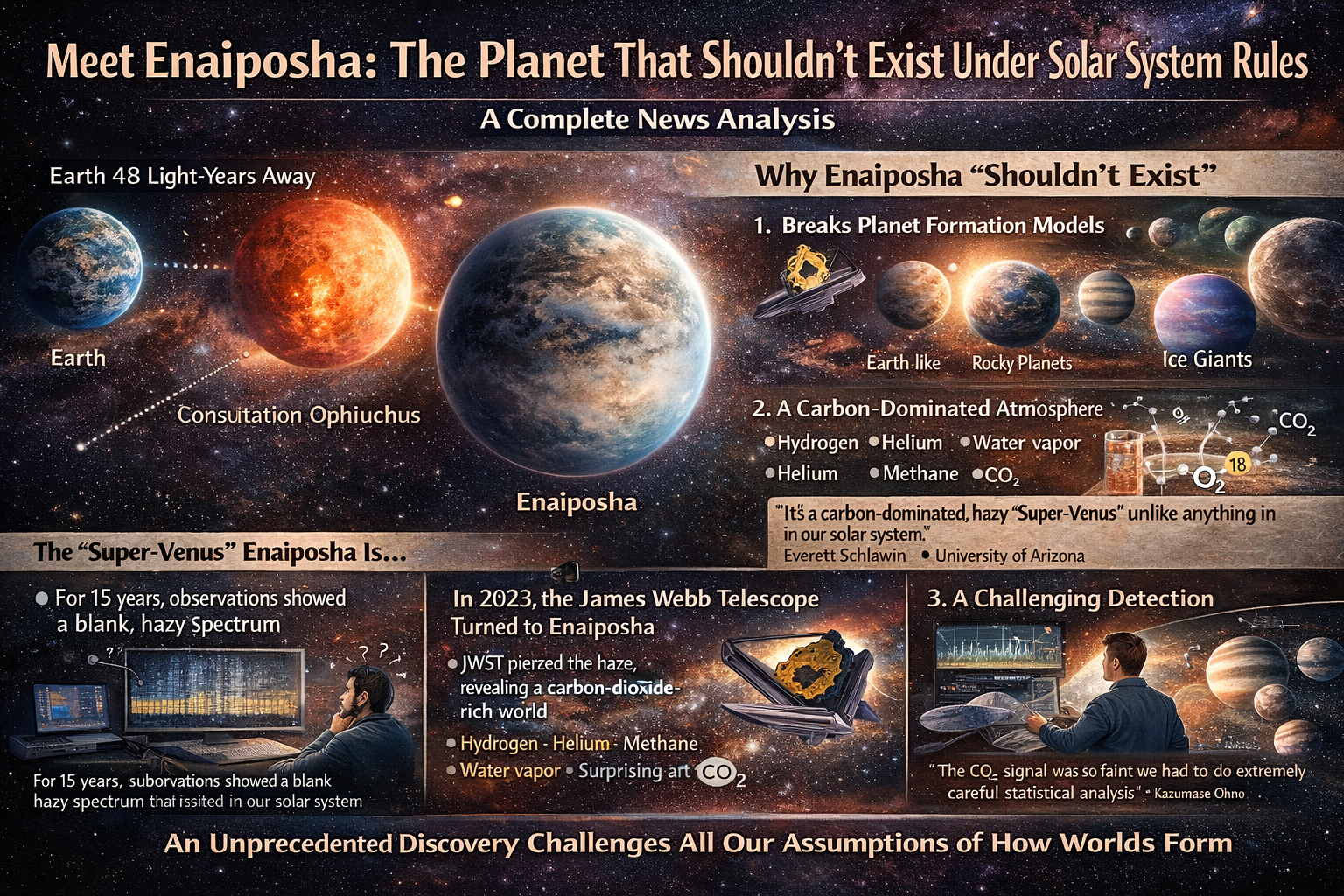
A Complete News Analysis
The Discovery That’s Rewriting Planetary Science
Forty-eight light-years from Earth, in the constellation Ophiuchus, a planet is forcing astronomers to tear up their classification rulebook. GJ 1214 b orbits a small red star, completing one circuit every 38 hours Indian Defence Review, but what makes this world truly extraordinary isn’t its breakneck orbit—it’s what scientists discovered when they finally pierced through its impenetrable atmospheric veil.
For fifteen years, this planet gave astronomers nothing but frustration. Every observation returned the same blank signal, a featureless spectrum that resisted every attempt to read its composition Indian Defence Review. The Hubble Space Telescope tried. Ground-based observatories tried. All failed, defeated by layers of haze so thick that light couldn’t carry information about what lay beneath.
Then came the James Webb Space Telescope.
The “Super-Venus” Revolution
In 2023, JWST turned its infrared instruments toward GJ 1214 b and revealed something that shouldn’t exist according to everything we know about planetary formation: What the team found was not a steaming water world, as astronomers have long anticipated, but a carbon dioxide world University of Arizona News.
The planet, formally named Enaiposha in 2023—meaning “large body of water” in the Maasai language—turned out to be the opposite of what its name suggests. Instead of an ocean world, researchers detected traces of carbon dioxide, water vapor, and complex metal-rich molecules in the planet’s atmosphere Daily Galaxy, leading scientists to propose an entirely new planetary category: the “super-Venus.”
This classification is revolutionary. Our solar system contains rocky planets, gas giants, and ice giants, but nothing like this. Sub-Neptune planets fall in a size range between Earth and Neptune and are the most common types of exoplanets, yet none exist in our Solar System University of Arizona News.
Why This Planet “Shouldn’t Exist”
Enaiposha violates our understanding of planetary formation in several ways:
1. The Composition Problem The planet is 2.7 times Earth’s radius with 8.2 times Earth’s mass, placing it firmly in the sub-Neptune category. These sub Neptunes, worlds between 1.0 and 3.9 Earth radii, simply do not exist in our solar system Indian Defence Review. Scientists expected it to be either a rocky super-Earth with a hydrogen atmosphere or a mini-Neptune with water-rich clouds. It’s neither.
2. The Atmospheric Mystery The findings have driven some scientists to propose that Enaiposha represents a new sub-type of exoplanet Earth.com. Its atmosphere contains an unexpected cocktail: hydrogen, helium, methane, carbon dioxide, and water vapor—but the carbon dioxide dominates in concentrations comparable to Venus, which has a 96.5% CO₂ atmosphere.
3. The Detection Challenge Lead researcher Everett Schlawin from the University of Arizona compared the detection difficulty to an impossible literary challenge: “It’s equivalent to Leo Tolstoy’s War and Peace. If I gave you two copies and changed one sentence in one of the books, could you find that sentence?” University of Arizona News
“The detected CO2 signal from the first study is tiny, and so it required careful statistical analysis to ensure that it is real,” explained Kazumasa Ohno from the National Astronomical Observatory of Japan University of Arizona News.
The Science Behind the Breakthrough
The discovery involved two companion papers published in The Astrophysical Journal Letters—one in October 2024 and another in January 2025—led by teams at the University of Arizona and Japan’s National Astronomical Observatory.
JWST’s Near-Infrared Spectrograph allowed researchers to use transmission spectroscopy, analyzing how starlight filters through the planet’s atmosphere during transits. The planet experiences significant temperature variations between its day and night sides, with the dayside reaching scorching temperatures of around 553 K (280°C), while the nightside cools to approximately 437 K (164°C) Jegtheme.
This dynamic environment suggests complex atmospheric processes driven by intense heat and chemistry unlike anything in our solar system.
Implications for Planetary Evolution
The existence of Enaiposha raises fundamental questions about how planets evolve. Some planetary models suggest that sub-Neptunes may gradually lose their hydrogen-rich envelopes over time, leaving behind rocky cores that resemble super-Earths or Venus-like worlds Daily Galaxy. If true, Enaiposha might represent a transitional stage in planetary evolution—a missing link between different planetary types.
The planet’s thick aerosol layers initially frustrated scientists, but they may hold clues to atmospheric evolution. Some wonder whether metals in Enaiposha’s air can form droplets or complex clouds, which might explain why so little light passes through its atmosphere Earth.com.
What Makes This Discovery Critical
1. Challenging Formation Models Our current planetary formation theories are based on what we observe in our solar system. Enaiposha demonstrates that the universe produces planetary types we never imagined, forcing a fundamental rethinking of how worlds form.
2. The Sub-Neptune Mystery Sub-Neptunes are the most common type of planet in the Milky Way galaxy. Planets in the sub-Neptune size range are the most common class of exoplanets identified to date, yet none exist in our Solar System Indian Defence Review. Understanding Enaiposha helps us comprehend the most prevalent planetary type in the universe—one we’ve never seen up close.
3. Methodological Advancement Methods developed from GJ 1214 b’s observation could be applied to cooler planets in temperate zones, where life-supporting conditions might exist Indian Defence Review. The same techniques that identified gases in this extreme environment might one day detect biosignatures on potentially habitable worlds.
The Broader Context
Since its discovery in 2009 by the MEarth Project, GJ 1214 b has been a priority target for atmospheric characterization. At the time, it was thought to be an ocean planet, and in 2023 the International Astronomical Union formally dubbed the planet Enaiposha University of Arizona News. The irony that a planet named for water turned out to be a scorching carbon dioxide world highlights how little we understood about these mysterious objects.
The planet’s host star, now officially named Orkaria (from the Maa word for red ochre), provides an ideal laboratory for studying sub-Neptunes. Its relatively small size means the planet blocks a significant fraction of starlight during transits, making atmospheric analysis more feasible than for most exoplanets.
What Comes Next
Despite the breakthrough findings, researchers emphasize that uncertainties remain. The carbon dioxide signal is subtle, and confirmation requires additional observations. Future studies will focus on:
- Confirming the carbon-dominated atmospheric composition
- Understanding why the planet developed such an atmosphere
- Determining whether Enaiposha represents a permanent state or a transitional phase
- Identifying whether similar “super-Venus” planets exist elsewhere
JWST’s ability to analyse these planets despite haze interference is shifting expectations for what kinds of atmospheric detail can be retrieved Indian Defence Review.
The Bigger Picture
Enaiposha’s discovery reflects a broader truth about exoplanet research: the universe is far more creative than our theories. The results affirm that the universe makes many kinds of worlds—not only the kinds we have in the solar system, such as rocky planets, ice moons and gas giants, but also unprecedented highly “metallic” planets like GJ1214 b University of Arizona News.
As JWST continues its mission and future telescopes come online, we’re likely to discover even more planetary types that defy our categories. Each discovery doesn’t just add to our catalog of known worlds—it forces us to reconsider the fundamental processes that shape planetary systems throughout the cosmos.
Enaiposha stands as a reminder that when we look beyond our solar system, we must be prepared to encounter worlds that challenge everything we thought we knew. In the vast cosmic laboratory, nature experiments with compositions, temperatures, and conditions that our Earth-bound perspective never anticipated. This “super-Venus” that shouldn’t exist under our solar system rules may ultimately teach us that the only rule is that there are no rules—just infinite possibilities waiting to be discovered.