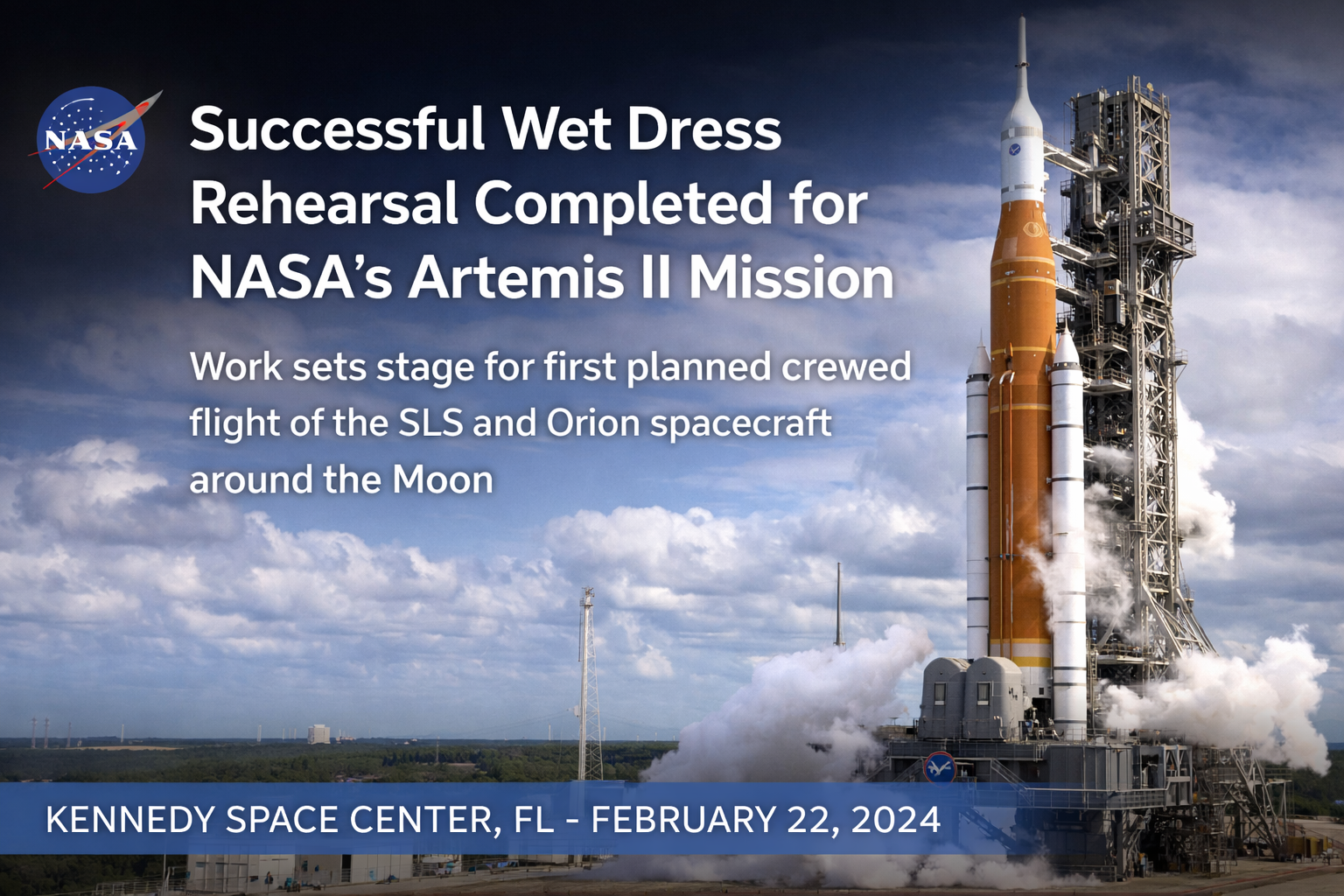
NASA successfully completed a wet dress rehearsal for its Artemis II mission at Kennedy Space Center in Florida on Thursday, loading more than 700,000 gallons of liquid propellant into the Space Launch System rocket and running through the final phases of the launch countdown.
During the test, engineers demonstrated hatch closeout procedures on the Orion spacecraft and completed two runs of terminal count — the last stage of the countdown sequence before launch. The four-person Artemis II crew observed portions of the rehearsal from the Launch Control Center.
Liquid hydrogen fueling, which had caused problems in earlier tests, proceeded within acceptable limits. NASA credited new seals installed at a fuel routing interface for keeping hydrogen gas concentrations below allowable thresholds. A temporary loss of ground communications in the Launch Control Center occurred early in fueling operations, but teams switched to backup systems until normal channels were restored. Engineers have since identified the cause.
The crew began quarantine on Friday, Feb. 20, in Houston, a precautionary measure designed to limit exposure to illness in the weeks before launch. NASA has not announced a formal launch date, but the roughly 14-day isolation period is intended to preserve options within a March launch window.
In the coming days, technicians will install temporary access platforms on the mobile launcher to service the rocket’s flight termination system and conduct required safety testing. The platforms, developed following lessons from the Artemis I mission, allow engineers to complete end-to-end safety system testing at the pad rather than rolling the rocket back to the Vehicle Assembly Building.
NASA held a news conference Friday morning to discuss rehearsal results.
Artemis II will be the first crewed flight of the SLS and Orion spacecraft, intended to carry astronauts on a flight around the Moon as part of NASA’s broader program to return humans to the lunar surface and eventually send crews to Mars.