 Krishan Gopal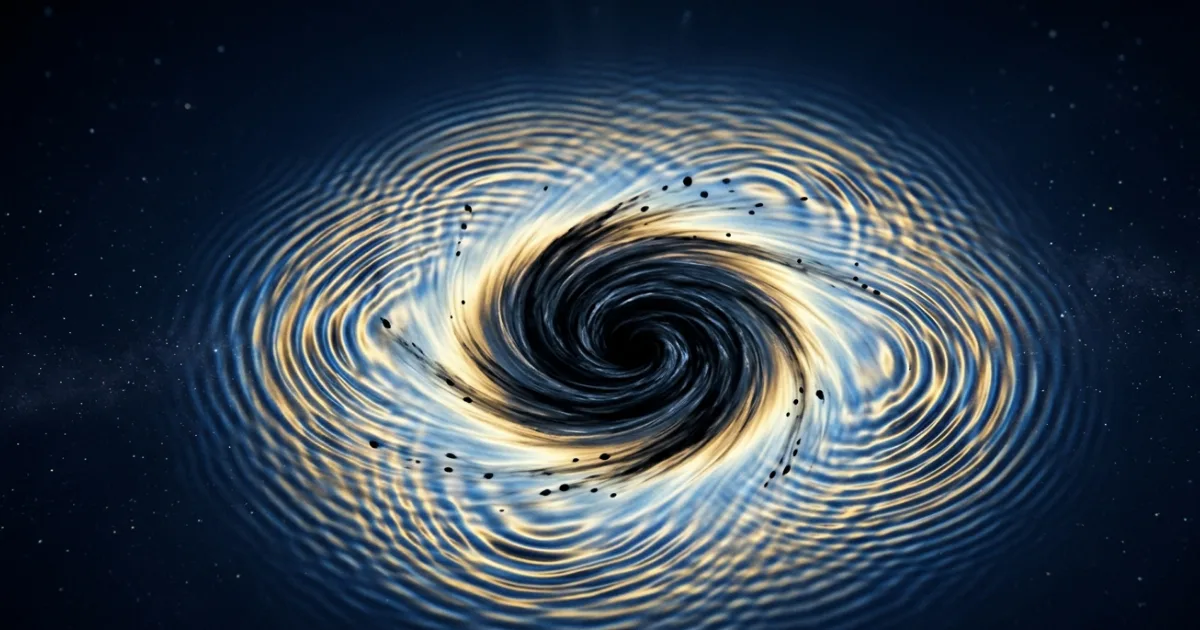
In This Article
- The Prediction That Sat Untested for 50 Years
- A "Bad" Cavity That Changed Everything
- Why Can Darkness Outrun Light — and How Did They Prove It?
- What This Means Beyond the Lab
- The Questions the Team Is Chasing Next
Darkness, it turns out, is in a hurry. Physicists at Technion — Israel Institute of Technology have measured tiny vortices of pure darkness inside light waves accelerating past the speed of light in a vacuum. The finding, published on April 28, 2026 in Nature, confirms a theoretical prediction made by physicists John Nye and Michael Berry back in 1974 — one that nobody had ever managed to test experimentally. These optical phase singularities, as they are formally called, carry no mass and no energy. Which is exactly why they can race across the universe without asking Einstein's permission.
The Prediction That Sat Untested for 50 Years
Back in 1974, Nye and Berry published a paper on what they called dislocations in wave trains — points within any wave where the amplitude collapses to exactly zero. Picture a stadium wave rolling around an arena. Now imagine a single spot in that crowd where nobody moves. That spot is a phase singularity. The light wave swirls around it, but at the centre there is nothing — absolute darkness. Nye and Berry's theoretical work suggested something wild: these dark spots could, under certain conditions, accelerate to velocities greater than the wave carrying them. Fifty years passed. The maths sat largely unchallenged. But nobody had the tools to watch it happen in real time.
A "Bad" Cavity That Changed Everything
Here is where the story takes a turn. The Technion team, led by researcher Tomer Bucher, was not even looking for singularities at the start. They were studying light-matter interactions inside flakes of hexagonal boron nitride (hBN) — an atomically thin, two-dimensional material similar to graphene. Light trapped inside hBN doesn't travel as a photon alone; it becomes a polariton, a hybrid creature that is part light and part vibration of the material. Polaritons move roughly 100 times slower than light in a vacuum, which made the measurement problem slightly more tractable. Slightly. The specific hBN sample at the centre of the paper was, by the team's own admission, originally considered a failure — a "bad" cavity. But a colleague, Arthur Niedermayr, spotted something strange in the raw data: patterns that looked like multiple dark vortices, moving.
Why Can Darkness Outrun Light — and How Did They Prove It?
To actually see these vortices move, the team needed instrumentation that borders on absurd. They modified an ultrafast transmission electron microscope (UTEM) — combining a pulsed laser with advanced opto-mechanical apparatus — and used an interferometry technique called free-electron Ramsay imaging to achieve 20 nanometres of spatial resolution alongside 3 femtoseconds of time resolution. That combination, Bucher says, is unprecedented. With that level of detail, they reconstructed the full amplitude and phase of the light-matter waves and built what they describe as a temporal movie, tracking dozens of singularities simultaneously across massive datasets. What they saw: when two singularities of opposite charge approach each other, they annihilate — and just before they vanish, they accelerate to formally divergent speeds, exceeding the speed of light in a vacuum. The reason this doesn't violate special relativity is that the vortices carry neither energy nor information. They are, in the most technical sense, nothing — which means nothing in the laws of physics prevents them from going wherever they want, as fast as they want.
"This highlights a beautiful paradox where the slower light-matter waves are found more likely to host topological features that 'race' across its surface at impossible, superluminal speeds."
— Tomer Bucher, Technion – Israel Institute of Technology · Nature, 2026What This Means Beyond the Lab
The practical angles here are more concrete than most physics papers manage. Bucher's team says the singularity-tracking methods they developed could be used to reduce common distortion artefacts in electron microscopy — including what researchers call the "bee-swarm" effect, a visual noise problem that limits how clearly scientists can image material structures at the atomic scale. That matters a lot in semiconductor research, drug development, and materials science, all fields where getting a cleaner picture of a surface could mean the difference between a workable result and a dead end. Beyond imaging, optical phase singularities can encode information within the orbital angular momentum of light — a property that could allow far higher data densities in optical communication systems. For India's rapidly expanding data infrastructure, where the demand for bandwidth keeps outpacing the cables, this kind of approach to information encoding is worth watching.
The Questions the Team Is Chasing Next
The researchers are candid about what remains unresolved. Their current results are confined to the two-dimensional surface of hBN. Bucher says the team plans to probe three-dimensional line singularities and higher-order topological defects next — structures that carry a richer set of properties for information encoding. They also want to investigate topological phases in other 2D materials and heterostructures, with an eye toward imaging exotic phenomena like "optical skyrmions" — tiny whirlpool-like magnetic textures — in real time. The most ambitious goal is near-field tomography that captures the full 3D bulk dynamics of complex wave fields. If that works, it would be, in their words, a major milestone in electron microscopy. The prediction sat dormant for half a century. The measurement tools to test it barely existed five years ago. What comes next probably requires tools that don't exist yet either — which, if history is any guide, is not a reason to stop.
- Darkness has its own physics. — Optical phase singularities are not just theoretical curiosities; they are measurable, trackable objects with real dynamics that follow predictable rules.
- Speed limits need context. — Nothing with mass or energy exceeded the speed of light here; the result is consistent with special relativity, which only forbids superluminal transfer of information or energy.
- Better microscopy is the near-term payoff. — The imaging algorithms developed to track these vortices could directly improve atomic-scale imaging across materials science, semiconductor research, and biomedical applications.
"Our experimental measurements agree incredibly well with the old and the new theoretical predictions. Our findings will deepen our understanding of topological defects, which are common to all areas of physics — from superfluids to superconductors." — Tomer Bucher, Nature, 2026.
📄 Source & Citation
Primary Source: Bucher T, Niedermayr A, Herzig Sheinfux H, et al. (2026). Superluminal motion of optical phase singularities in polariton fields. Nature. https://doi.org/10.1038/s41586-026-10209-z
Authors & Affiliations: Tomer Bucher, Arthur Niedermayr (Technion – Israel Institute of Technology); Hanan Herzig Sheinfux (Bar-Ilan University / ICFO, Barcelona); Frank Koppens (ICFO – The Institute of Photonic Sciences, Barcelona)
Data & Code: Available via Nature's online supplementary portal. Contact corresponding author for raw datasets and tracking algorithm code.
Key Themes: Optical Phase Singularities · Superluminal Motion · Polaritons · Topological Defects · Super-Resolution Imaging
Supporting References:
[1] Nye JF, Berry MV (1974). Dislocations in wave trains. Proceedings of the Royal Society A, 336(1605):165–190. Link
[2] Berry MV, Dennis MR (2000). Phase singularities in isotropic random waves. Proceedings of the Royal Society A, 456(2001):2059–2079.
[3] Kaminer I et al. (2016). Quantum Čerenkov radiation: spectral cutoffs and the role of spin and orbital angular momentum. Physical Review X, 6(1):011006.
No comments yet. Be the first to share your thoughts.
Leave a Comment