Space & Astronomy | February 26, 2026
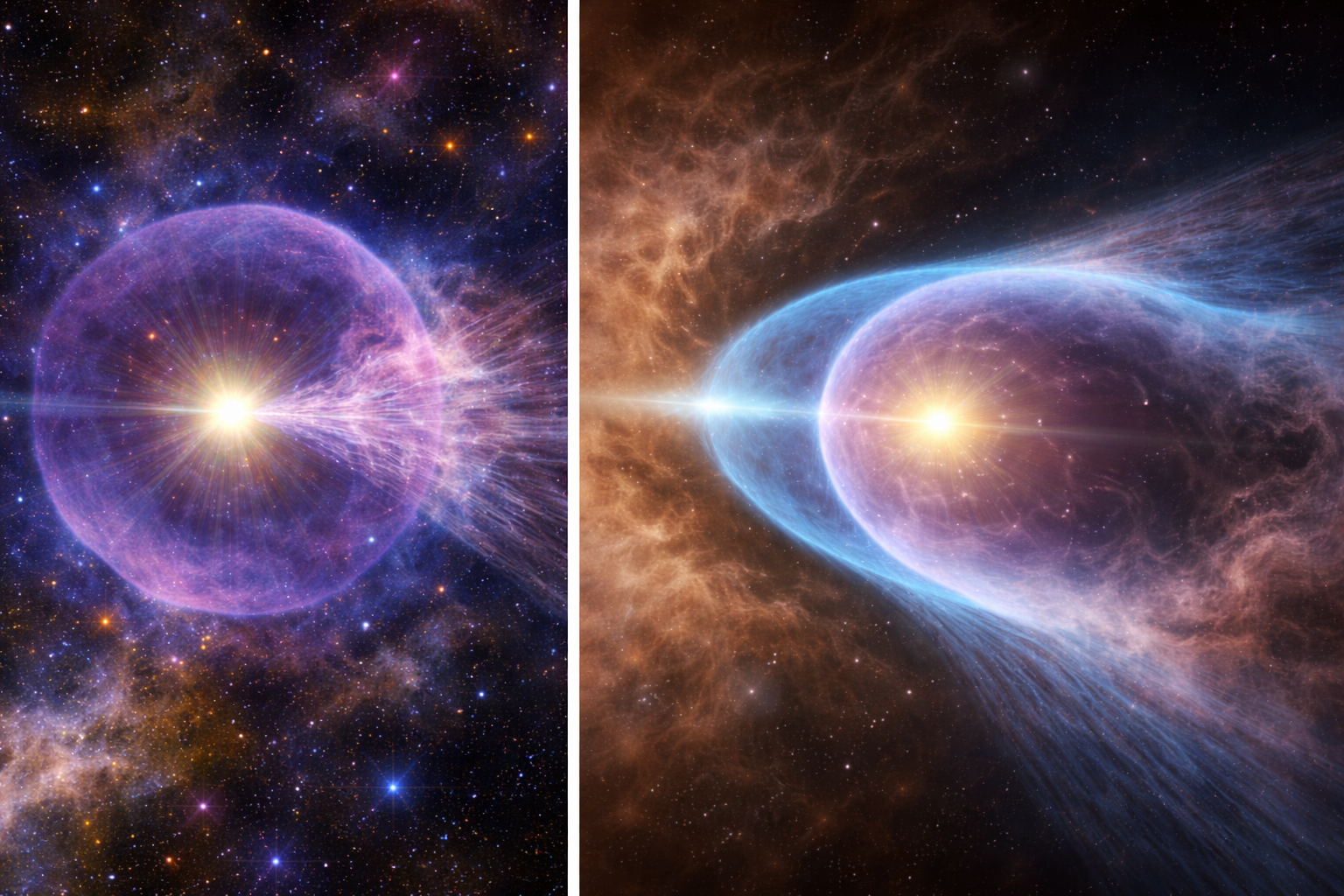
Astronomers have, for the first time, directly observed a vast protective bubble—similar to the one surrounding our own Sun—around a young, Sun-like star. Using NASA’s Chandra X-ray Observatory, scientists captured the clearest evidence yet of an astrosphere around the star HD 61005, offering a rare glimpse into what the Sun’s environment may have looked like billions of years ago.
What is an astrosphere?
An astrosphere is a vast bubble of hot gas created when a star’s powerful stellar wind collides with colder gas and dust in interstellar space. In our solar system, this structure is known as the heliosphere, which shields Earth and other planets from a significant portion of harmful cosmic radiation.
Until now, astronomers had not been able to clearly image such a bubble around a star similar to the Sun.
A younger version of the Sun
HD 61005 is located about 120 light-years from Earth and has a mass and surface temperature comparable to the Sun. The key difference is age. While the Sun is about 5 billion years old, HD 61005 is only around 100 million years old.
Because of its youth, the star produces a much stronger stellar wind—traveling about three times faster and roughly 25 times denser than today’s solar wind. This intense outflow inflates a large astrosphere filled with X-ray–emitting gas, making it detectable by Chandra.
Why Chandra could see it
Previous attempts to detect astrospheres around Sun-like stars were unsuccessful. In this case, several factors aligned:
- A strong stellar wind from HD 61005
- An unusually dense surrounding interstellar environment
- The star’s relative proximity to Earth
- Chandra’s high-resolution X-ray sensitivity
Together, these conditions allowed astronomers to observe faint, extended X-ray emission instead of a single point of light—clear evidence of a surrounding bubble. The astrosphere spans roughly 200 times the distance between Earth and the Sun.
The “Moth” star system
Astronomers often refer to HD 61005 as “the Moth.” Infrared observations from the Hubble Space Telescope show wing-like structures made of dust and debris left over from star formation, similar to the Kuiper Belt in our solar system. This dusty environment is far denser than the space surrounding the Sun today, further shaping the astrosphere’s size and structure.
Why this discovery matters
Understanding how stellar winds behaved when the Sun was young helps scientists reconstruct the early conditions of the solar system. Stronger winds may have influenced planetary atmospheres, radiation exposure, and even the early habitability of Earth.
The findings also have practical relevance. Solar wind affects satellites, astronauts, and future missions to the Moon and Mars. Studying HD 61005 provides a natural laboratory for understanding extreme space weather around young stars.
A window into the Sun’s past
Researchers believe the Sun once passed through a similar phase, possibly moving through denser regions of the galaxy. If the Sun were in the same environment as HD 61005 today, its heliosphere could be dramatically smaller. Conversely, HD 61005’s astrosphere would be much larger if it were located in our current galactic neighborhood.
The study, led by scientists at Johns Hopkins University with collaborators from the Center for Astrophysics | Harvard & Smithsonian, was published in The Astrophysical Journal.
Looking ahead
This milestone demonstrates the power of X-ray astronomy to study stellar environments beyond our solar system. As missions like Chandra continue, astronomers expect to find more examples of astrospheres—helping piece together how stars, planets, and protective space bubbles evolve across the galaxy.