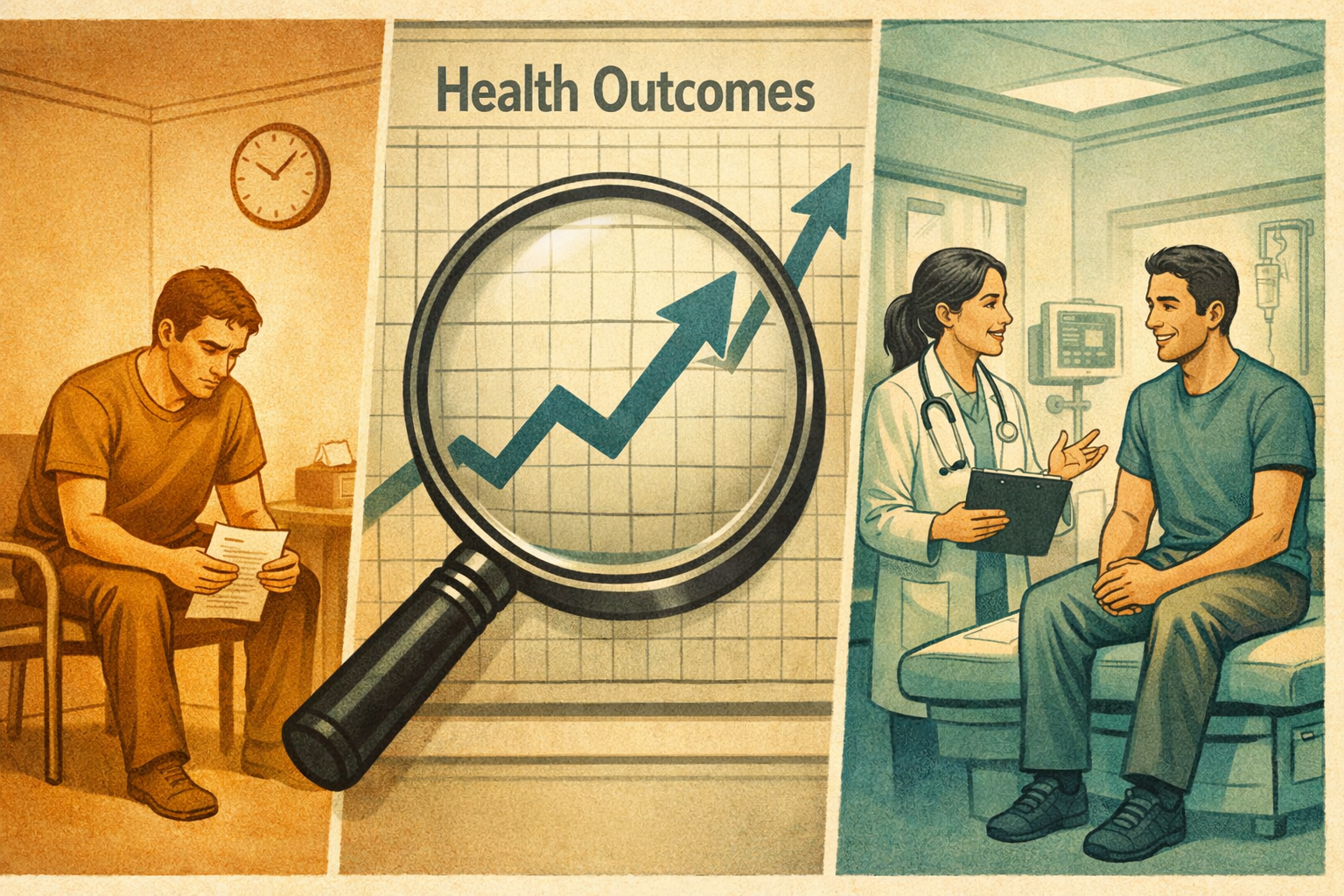
It seems almost self-evident: health insurance should improve health. After all, insurance unlocks access to medical care, and medical care has proven, in many instances, to be enormously beneficial. And yet, as Helen Levy and David Meltzer reveal in their landmark review for the Annual Review of Public Health, the science behind this assumption is far more fragile — and far more fascinating — than conventional wisdom suggests.
Why Proving Health Insurance Improves Health Is Harder Than It Sounds
The central problem is what economists call endogeneity. Health insurance coverage is shaped, at least in part, by the same factors that determine health — income, employment, education, and lifestyle. When researchers observe that insured people are healthier, they cannot easily determine whether insurance caused the improvement, or whether both simply reflect deeper, pre-existing advantages. An observed correlation, however robust, is not proof of causation.
Three Types of Evidence: Observational Studies, Natural Experiments, and Social Trials
Levy and Meltzer organise the vast literature into three tiers of evidentiary quality. Observational studies — the most numerous — document a consistent positive link between insurance and health but cannot rule out confounding. Natural experiments exploit policy changes to isolate insurance's effect more cleanly. And social experiments, the gold standard, randomly assign insurance status — a design so costly and complex it has been achieved only once at scale in the entire history of health research.
What the RAND Health Insurance Experiment Revealed
The RAND Health Insurance Experiment remains the only study in which health insurance coverage was genuinely randomly assigned to individuals. Participants were allocated to plans of varying generosity — from fully free care to catastrophic-only coverage — and their health outcomes tracked over time. The headline finding was striking: for the average adult, the generosity of insurance coverage had no significant effect on most health measures.
But the details matter enormously. For individuals with poor eyesight or elevated blood pressure, more generous coverage translated into real health gains. Low-income participants with hypertension saw meaningful reductions in blood pressure when given access to free care. The lesson is not that insurance does nothing — it is that the effect depends heavily on who is being insured and what conditions they carry.
The effects of health insurance on health depend very much on whose health is being studied.
— Levy & Meltzer, Annual Review of Public Health, 2008Medicaid Expansions and Child Health: The Clearest Evidence Yet
Among the most compelling findings in the natural experiments literature are studies by Currie and Gruber examining Medicaid expansions to children and pregnant women. These studies found that expansions were associated with meaningful reductions in child mortality and significant declines in infant mortality — among the most convincing causal evidence in the entire field, and directly relevant to live policy debates about coverage expansion.
Medicare at 65: More Care, But Does It Save Lives?
Medicare — the federal programme providing coverage to Americans at age 65 — offers a natural experiment on a massive scale. Three rigorous studies examined whether the sharp increase in coverage at 65 produces a corresponding reduction in mortality. The answer, consistently: not detectably so. Hospital utilisation rises sharply at 65; death rates do not fall in a correspondingly sharp way.
"In its first 10 years, the establishment of universal health insurance for the elderly had no discernible impact on their mortality." — Finkelstein & McKnight
These null results do not mean Medicare does nothing. They mean mortality may be the wrong measure, or the benefits may take longer to manifest than short-run studies can detect. Advances in medical technology since the 1970s may also have significantly increased Medicare's marginal health value today.
Who Benefits Most from Health Insurance Coverage?
The evidence converges on a clear answer to this question, even if it cannot yet answer the broader one. Health insurance most demonstrably improves health for:
- Infants and young children — Medicaid expansions reliably reduce child and infant mortality.
- Pregnant women — Coverage expansions are associated with better birth outcomes.
- Individuals with HIV/AIDS — Access to antiretroviral therapies significantly reduces mortality.
- Low-income adults with hypertension — Free care demonstrably improves blood pressure control.
- Individuals with poor vision — More generous coverage translates into better corrected vision.
The Policy Gap: What We Still Don't Know About Working-Age Adults
For most of the population at greatest risk of being uninsured — adults aged 19 to 50 — reliable causal evidence on how health insurance affects health is remarkably sparse. This is precisely the demographic at the centre of most policy debates about coverage expansion. The absence of evidence is not evidence of absence, but confident claims about health benefits for this group run ahead of what science can currently support.
Why Social Experiments Are the Only Path to Definitive Answers
Only genuine social experiments, with random assignment of coverage, can resolve the questions that natural experiments and observational studies cannot. The key policy question is not simply whether insurance affects health, but how much, for whom, and at what cost — and how those effects compare with alternative investments in public health. Without rigorous experimental evidence, policymakers choose between options whose relative merits remain fundamentally uncertain.
To summarise the effects of health insurance on health is, inevitably, to misrepresent.
— Levy & Meltzer, Annual Review of Public Health, 2008📄 Source & Citation
Primary Source: Levy H, Meltzer D. (2008). The Impact of Health Insurance on Health. Annual Review of Public Health, 29:399–409. doi: 10.1146/annurev.publhealth.28.021406.144042
Authors: Helen Levy (Institute for Social Research, University of Michigan) · David Meltzer (Section of General Internal Medicine, University of Chicago)
Key themes: Health insurance endogeneity · RAND Health Insurance Experiment · Medicaid expansion · Medicare natural experiment · causal inference · coverage expansion policy
💬 Comments (0)
No comments yet. Be the first to share your thoughts.
Leave a Comment