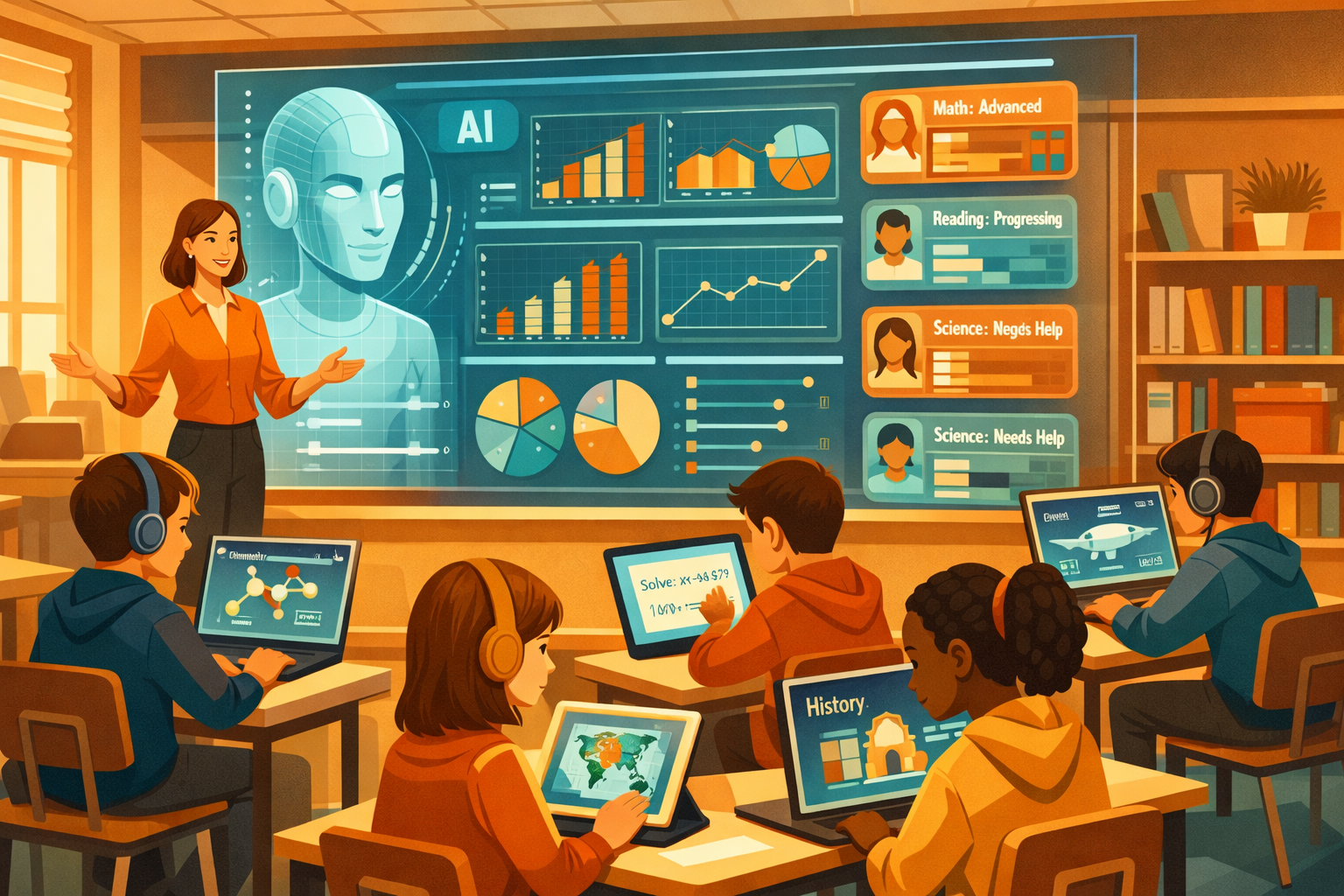
Artificial intelligence is no longer a distant prospect for education — it is already inside the classroom, reshaping how students learn, how teachers teach, and how institutions manage themselves. From algorithms that tailor lessons to a single student's pace and learning style, to chatbots that answer questions at midnight, to systems that can grade thousands of essays in seconds, AI is rewriting the rules of one of humanity's oldest enterprises. The question is no longer whether AI will transform education. It already has. The question now is whether we are ready to manage that transformation wisely.
What AI in Education Actually Means
At its core, AI in education refers to the application of technologies — primarily machine learning and natural language processing (NLP) — to improve the educational process. These tools allow systems to analyze data, recognize patterns, make predictions, and adapt to individual learners in ways that a single teacher serving thirty students simply cannot.
For sustainable adoption, however, educational institutions need more than enthusiasm. They need a clear-eyed understanding of what AI can do, what it cannot, and what risks must be managed along the way.
The Benefits: Ten Ways AI Is Already Improving Education
Personalized learning is the most celebrated benefit. AI algorithms can analyze a student's strengths, weaknesses, and preferred learning style, then tailor lessons, exercises, and resources to match. Students who learn more slowly are supported at their own pace; advanced students are challenged at theirs. This individual responsiveness has historically required a private tutor — AI makes it available at scale.
Intelligent tutoring systems simulate the experience of one-on-one instruction. Using NLP and machine learning, these platforms hold meaningful conversations with students, respond to their questions, identify misconceptions, and adjust the difficulty of tasks based on demonstrated understanding. They are particularly valuable in subjects where students need support outside regular class hours.
Administrative efficiency represents a less glamorous but enormously practical gain. Automated grading systems can assess multiple-choice tests and increasingly complex essay formats, freeing teachers from repetitive evaluation tasks and allowing them to invest more time in actual teaching and mentoring. Scheduling, enrollment management, and institutional logistics can all be streamlined through AI-driven tools.
Data-driven insights give educators and administrators a clearer picture of what is working. AI can analyze vast volumes of performance data to identify trends, flag at-risk students early, and measure curriculum efficacy — enabling evidence-based decisions rather than intuition-based ones.
Beyond these, AI enhances student engagement through immersive tools like simulations, virtual reality experiences, and gamified learning activities. It improves accessibility and inclusivity through speech-to-text, text-to-speech, and real-time language translation, making educational materials available to students with disabilities and language barriers. It supports teacher development by providing professional resources and analyzing classroom interactions. And it helps prepare students for the future job market by emphasizing the digital literacy and data analysis competencies that a technology-driven economy demands.
AI in Grading and Assessment: Speed, Scale, and New Risks
The integration of AI into grading and assessment is one of the field's most significant — and most contested — advances. Automated grading systems can evaluate multiple-choice answers, fill-in-the-blank responses, and increasingly complex essay formats with a high degree of consistency, eliminating the human variability that can make grading feel arbitrary. For institutions running massive open online courses serving thousands of simultaneous students, this scalability is transformative.
AI-powered plagiarism detection tools such as Turnitin can scan assignments against vast databases and the live internet, identifying not just direct copying but sophisticated paraphrasing that traditional methods struggle to catch. Predictive analytics allow educators to identify students at risk of failing or dropping out well before it happens, enabling early intervention rather than remediation after the fact.
Instead of relying solely on final exams, AI can facilitate ongoing assessments that adapt to a student's progress — ensuring a more accurate representation of their knowledge and skills.
— Bit, Biswas & Nag, International Journal of Scientific Research in Science and Technology, 2024Yet the risks are real. AI grading systems trained on biased data can perpetuate inequities — disadvantaging students whose language use, cultural references, or socioeconomic backgrounds differ from the training dataset. Natural language processing for essay evaluation remains imperfect. And the speed and apparent objectivity of AI assessment can create a false sense of fairness that obscures systemic problems.
AI Chatbots in Education: The Always-On Instructor
AI chatbots are becoming integral to modern education by automating support tasks, providing personalized guidance, and creating new modes of student-institution interaction. Unlike a human teacher, a chatbot is available at any hour, never loses patience, and can simultaneously assist thousands of students with individualized responses.
In practice, chatbots serve students as on-demand tutors — answering questions, offering feedback, tracking learning progress, and recommending resources tailored to individual needs. They serve institutions by automating repetitive administrative functions: scheduling, answering common enrollment queries, routing support requests. And they can gamify the learning process, offering rewards and incentives for completing tasks and meeting learning milestones.
"Chatbots have the potential to serve as online instructors, offering immediate feedback, responding to inquiries, and assisting students with their educational process." — Bit, Biswas & Nag, 2024
The challenges are equally important to acknowledge. Chatbots must be designed with genuine student-centeredness — not just functional efficiency — at their core. Accessibility matters: a chatbot that cannot be used by students with disabilities, or that performs poorly in languages other than English, reproduces rather than reduces inequality. Accuracy matters too: a chatbot that confidently delivers incorrect information can do more harm than no support at all.
Personalized Learning: AI as the Adaptive Instructor
Personalized learning — the adjustment of educational content and pace to the unique needs, interests, and strengths of each student — is perhaps the most profound promise AI brings to education. Through machine learning algorithms that continuously analyze student behavior, performance, and learning preferences, AI can construct and update individualized learning pathways in real time.
A struggling student receives targeted support and simplified explanations. An advanced student is pushed further and faster. A student who learns best through visual content receives more visual material; one who absorbs information through practice problems receives more exercises. The system adapts not just to what a student knows, but to how they learn.
AI is able to adjust its speed of instruction to match the learning pace of the student — a capability that scales personalized education from the private tutoring room to the global classroom.
— Bit, Biswas & Nag, IJSRST, 2024This model has already been deployed successfully across schools, universities, and corporate training programmes worldwide. Its potential to close achievement gaps — by ensuring that no student is left behind simply because the pace of instruction does not match their learning speed — is genuinely significant.
Intelligent Tutoring Systems: Bridging the Gap Between Classroom and One-on-One
Intelligent tutoring systems represent the most sophisticated expression of AI's pedagogical ambition. Using powerful algorithms and machine learning, these platforms aim to replicate the experience of learning from a human tutor — providing personalized, adaptive instruction that responds to each student's evolving understanding.
Central to ITS is student modeling: AI builds dynamic profiles of each learner's knowledge, abilities, misconceptions, and preferred learning methods through their interactions with the system. These models allow the ITS to identify precisely where a student is struggling, what they misunderstand, and what instructional approach is most likely to help them progress.
Natural language processing enables ITS to hold substantive conversations, respond to open-ended questions, and offer instruction across a wide range of subjects — bridging the gap between standardized classroom teaching and the responsive, individualized guidance that only the best human tutors have historically been able to provide.
Global Accessibility: AI as an Equalizer — With Caveats
One of the most compelling arguments for AI in education is its potential to democratize access to high-quality learning. In many developing countries, lack of qualified teachers, inadequate infrastructure, and geographic isolation create profound barriers to education. AI-powered platforms can transcend linguistic, socioeconomic, and geographic boundaries — delivering knowledge more equitably than any previous technology.
The research shows that interest in AI-based education is growing across every region of the world, with particularly strong uptake in Asia, Latin America, and parts of Africa where traditional educational infrastructure is most strained. The economic case is powerful: universal access to quality education is one of the strongest drivers of sustained economic development.
Teacher–Student Collaboration: AI as a Partner, Not a Replacement
A persistent fear surrounding AI in education is that it will displace human teachers. The evidence suggests a more nuanced reality: AI is most powerful when it augments and supports the teacher rather than replacing them. AI can offer real-time analytics on student performance, flag which students are struggling and why, suggest targeted interventions, and even act as a creative brainstorming partner for educators developing lesson plans and support strategies.
AI-driven chatbots can handle the routine, repetitive queries that consume a disproportionate share of teacher time — freeing educators to focus on what they do best: mentoring, inspiring, building relationships, and addressing the complex emotional and developmental needs that no algorithm can meet.
The Disadvantages: Ten Challenges That Cannot Be Ignored
A balanced account of AI in education must confront its significant risks. The research identifies ten challenges that institutions must address:
- Privacy concerns — AI systems collect and analyze vast amounts of student data, raising serious questions about data security and the potential misuse of personal information.
- Bias and inequity — Systems trained on biased data can produce unequal outcomes, disadvantaging students from underrepresented or under-resourced backgrounds.
- Dependence on technology — Over-reliance on AI tools may erode critical thinking and problem-solving skills in both students and educators.
- Cost and accessibility — Advanced AI solutions are expensive to implement, potentially widening the gap between well-funded and underfunded institutions.
- Job displacement — Automation of grading and administrative tasks could reduce the need for certain support roles in educational settings.
- Quality and accuracy — AI tools are not infallible; inaccurate feedback or flawed assessments can harm student learning experiences.
- Lack of human interaction — AI cannot replicate the empathy, mentorship, and emotional intelligence that are central to effective teaching.
- Ethical concerns — Questions of surveillance, data commercialization, and algorithmic accountability require clear governance frameworks.
- Resistance to change — Educators and students accustomed to traditional methods may resist adoption, slowing integration and limiting impact.
- Technical challenges — Implementing and maintaining AI systems requires infrastructure and expertise that many schools currently lack.
The Path Forward: Balance, Not Evangelism
AI in education is neither a silver bullet nor a threat to be resisted. It is a powerful set of tools that, applied thoughtfully, can make learning more personalized, more accessible, more efficient, and more equitable. Applied carelessly, it can entrench bias, erode privacy, widen inequality, and hollow out the human dimensions of education that matter most.
The institutions that will navigate this transition most successfully are those that approach AI not as a replacement for educational judgment, but as an enhancement of it — protecting student privacy, auditing for bias, preserving the irreplaceable human relationships at the heart of learning, and ensuring that the benefits of AI reach every student, not just those in well-resourced settings.
We can give every student a more individualized, effective, and efficient learning experience by balancing the advantages and disadvantages of artificial intelligence in the classroom.
— Bit, Biswas & Nag, IJSRST, 2024📄 Source & Citation
Primary Source: Bit D, Biswas S, Nag M. (2024). The Impact of Artificial Intelligence in Educational System. International Journal of Scientific Research in Science and Technology, 11(4):419–427.
Authors: Dipanwita Bit (Kuntala Das College of Education, Howrah, West Bengal) · Souvik Biswas (Bharat Technology, Howrah, West Bengal) · Mrinmoy Nag (NEF College of Pharmaceutical Education & Research, Assam)
Key themes: Artificial intelligence in education · personalized learning · intelligent tutoring systems · AI chatbots · automated assessment · NLP in education · AI ethics · global education access
References:
[1] Gocen A, Aydemir F. (2020). Artificial Intelligence in Education and Schools. Research on Education and Media, 12(1):13–21.
[2] Zhang K, Aslan AB. (2021). AI technologies for education: Recent research & future directions. Computers and Education: Artificial Intelligence, 2:100025.
[3] Seo K, Tang J, Roll I, Fels S, Yoon D. (2021). The impact of artificial intelligence on learner–instructor interaction in online learning. International Journal of Educational Technology in Higher Education, 18(1):1–23.
[4] Chen L, Chen P, Lin Z. (2020). Artificial Intelligence in Education: A Review. IEEE Access, 8:75264–75278.
[5] Yang Y, Chen L, He W, Sun D, Salas-Pilco SZ. (2024). Artificial Intelligence for Enhancing Special Education for K-12. International Journal of Artificial Intelligence in Education, 1–49.
[6] Hennekeuser D, Vaziri DD, Golchinfar D, Schreiber D, Stevens G. (2024). Enlarged Education – Exploring the Use of Generative AI to Support Lecturing in Higher Education. International Journal of Artificial Intelligence in Education, 1–33.
[7] Coy A, Mohammed PS, Skerrit P. (2024). Inclusive Deaf Education Enabled by Artificial Intelligence. International Journal of Artificial Intelligence in Education, 1–39.
[8] Neha K, Sidiq SJ. (2020). Analysis of Student Academic Performance through Expert systems. International Research Journal on Advanced Science Hub, 2(Special Issue ICIES 9S):48–54.
[9] Paper Blog. Driving impact: Paper's approach to AI in education. Retrieved August 25, 2024, from paper.co
[10] Krstić L, Aleksić V, Krstić M. (2022). Artificial Intelligence in Education: A Review. Proceedings TIE 2022, 223–228.
[11] Huang J, Saleh S, Liu Y. (2021). A Review on Artificial Intelligence in Education. Academic Journal of Interdisciplinary Studies, 10(3):206.
[12] Tahiru F. (2021). AI in Education. Journal of Cases on Information Technology, 23(1):1–20.
[13] Kamalov F, Santandreu Calonge D, Gurrib I. (2023). New Era of Artificial Intelligence in Education: Towards a Sustainable Multifaceted Revolution. Sustainability (Switzerland), 15(16).
[14] Beck J, Stern M, Haugsjaa E. (1996). Applications of AI in education. XRDS: Crossroads, The ACM Magazine for Students, 3(1):11–15.
[15] Garito MA. (1991). Artificial intelligence in education: evolution of the teaching–learning relationship. British Journal of Educational Technology, 22(1):41–47.
[16] Bhutoria A. (2022). Personalized education and Artificial Intelligence in the United States, China, and India. Computers and Education: Artificial Intelligence, 3:100068.
[17] Kolchenko V. (2018). Can Modern AI Replace Teachers? Not so Fast! HAPS Educator, 22(3):249–252.
[18] Putra Pratama M, Sampelolo R, Lura H. (2023). Revolutionizing Education: Harnessing The Power of Artificial Intelligence for Personalized Learning. KLASIKAL: Journal of Education, Language Teaching and Science, 5(2):350–357.
[19] van der Vorst T, Jelicic N. (2019). Artificial Intelligence in Education: Can AI bring the full potential of personalized learning to education? International Telecommunications Society (ITS), Calgary, 1–21.
[20] Ayeni OO, et al. (2024). AI in education: A review of personalized learning and educational technology. GSC Advanced Research and Reviews, 18(2):261–271.
[21] Maghsudi S, Lan A, Xu J, van der Schaar M. (2021). Personalized Education in the Artificial Intelligence Era. IEEE Signal Processing Magazine, 38(3):37–50.
[22] Kokku R, et al. (2018). Augmenting Classrooms with AI for Personalized Education. IEEE ICASSP 2018.
[23] Murtaza M, Ahmed Y, Shamsi JA, Sherwani F, Usman M. (2022). AI-Based Personalized E-Learning Systems: Issues, Challenges, and Solutions. IEEE Access, 10:81323–81342.
[24] Hashim S, Omar MK, Ab Jalil H, Mohd Sharef N. (2022). Trends on Technologies and Artificial Intelligence in Education for Personalized Learning. IJARPED, 11(1).
[25] Rad P, Roopaei M, Beebe N, Shadaram M, Au YA. (2018). AI Thinking for Cloud Education Platform with Personalized Learning. 51st Hawaii International Conference on System Sciences, 3–12.
[26] Harry A. (2023). Role of AI in Education. Injuruty: Interdisciplinary Journal and Humanity, 2(3):260–268.
[27] Bates T, Cobo C, Mariño O, Wheeler S. (2020). Can artificial intelligence transform higher education? International Journal of Educational Technology in Higher Education, 17(1):1–12.
[28] Dandachi I el. (2024). AI-Powered Personalized Learning: Toward Sustainable Education. In Navigating the Intersection of Business, Sustainability and Technology (pp. 109–118). Springer, Singapore.
[29] Raza F, Iqbal M. (2023). AI in Education: Personalized Learning and Adaptive Assessment. Cosmic Bulletin of Business Management, 2(1):280–297.
[30] Zavalevskyi Y, et al. (2024). The role of AI in individualizing learning and creating personalized programs. Amazonia Investiga, 13(73):200–208.
[31] Riaz M. (2024). A personalized Learning system: education by AI. Theseus.
[32] Chaudhry MA, Kazim E. (2021). Artificial Intelligence in Education (AIEd): a high-level academic and industry note 2021. AI and Ethics, 2(1):157–165.
[33] Walden University. 5 Pros and Cons of AI in the Education Sector. Retrieved August 26, 2024.
[34] ClassPoint. The Pros and Cons of AI In Education and How It Will Impact Teachers In 2023. Retrieved August 26, 2024.
[35] Al-Tkhayneh KM, Alghazo EM, Tahat D. (2023). The Advantages and Disadvantages of Using Artificial Intelligence in Education. Journal of Educational and Social Research, 13(4):105–117.
[36] Bambinos.live. AI in Education: The Advantages and Disadvantages. Retrieved August 26, 2024.
[37] Chaushi BA, Ismaili F, Chaushi A. (2024). Pros and Cons of Artificial Intelligence in Education. International Journal of Advanced Natural Sciences and Engineering Researches, 8(2):51–57.
[38] Instrucko. AI in Education: The Advantages and Disadvantages. Retrieved August 26, 2024.
[39] Patugwu. 15 Negative Effects of Artificial Intelligence in Education. Retrieved August 26, 2024.
[40] HS Insider. The effects of AI on education. Retrieved August 26, 2024.
[41–42] Qin H, Wang G. (2022). Benefits, Challenges and Solutions of Artificial Intelligence Applied in Education. 2022 11th International Conference on Educational and Information Technology (ICEIT 2022), 62–66.
💬 Comments (0)
No comments yet. Be the first to share your thoughts.
Leave a Comment