 Sanjay Verma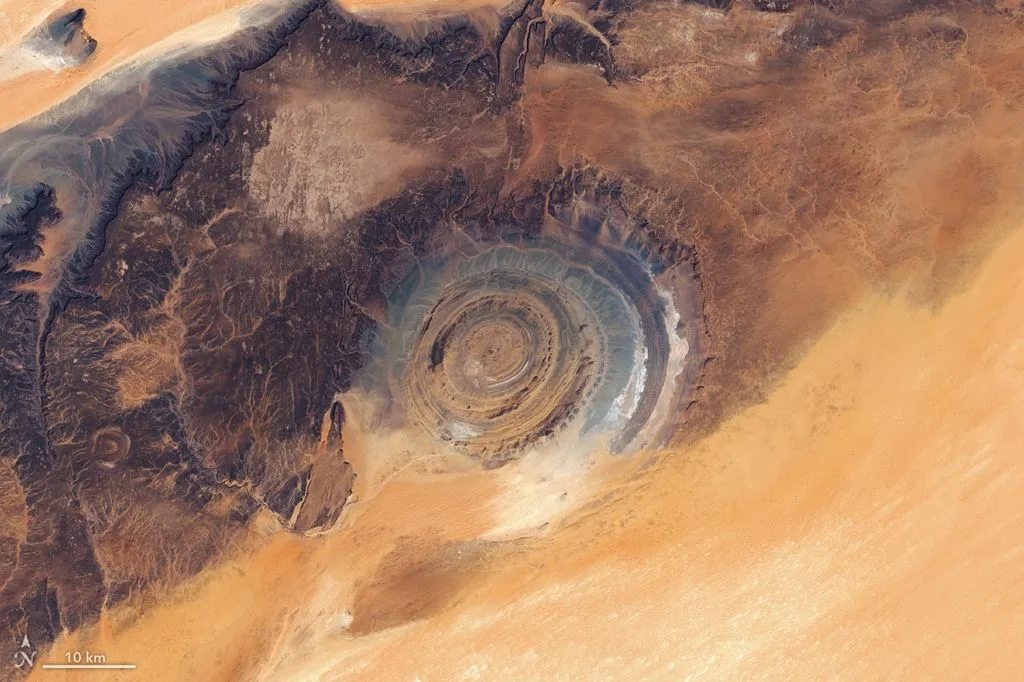
In This Article
- The Bullseye That Fooled Geologists for Decades
- What the Early Space Missions Revealed
- Why Was the Richat Structure So Hard to Identify?
- The Two-Act Geological Drama Behind the Eye
- More Than Just a Pretty Face from Space
Deep in the Sahara Desert, there's a giant bullseye. It's 40 kilometers wide, perfectly circular, and completely invisible from the ground. Astronauts have used it as a landmark for decades. But for nearly 50 years, no one could agree on how it got there. The Richat Structure, sometimes called the "Eye of Africa," sparked a geological whodunit that has finally been solved. The answer isn't a meteor. It's something much stranger.
The Bullseye That Fooled Geologists for Decades
The Richat Structure sits in northwestern Mauritania, on the Adrar Plateau. French geographers first described it in the 1930s, calling it the Richat "buttonhole."[reference:0] It looks exactly like what you'd expect from a massive space rock slamming into Earth. Raised outer rim. Sunken center. Textbook impact crater. But there was a problem. When geologists went looking for shock-altered minerals or melted rock — the kind of evidence you always find at impact sites — they came up empty.[reference:1] The structure was hiding its true origins. And it would take a view from orbit to finally unravel the mystery.
What the Early Space Missions Revealed
NASA astronauts Ed White and James McDivitt were the first to photograph the Richat Structure from space during the Gemini IV mission in 1965.[reference:2] They couldn't miss it. The bullseye stood out against the endless pale sands of the Erg Ouarane like a dark, alien target. From that vantage point, the impact crater theory seemed obvious. But as more missions flew over and more images came down, a different picture emerged. Researchers noticed something the early geologists had missed: the structure's flat middle and lack of shock-altered rock just didn't add up.[reference:3] It was time to look elsewhere.
Why Was the Richat Structure So Hard to Identify?
Here's the thing: the Richat Structure isn't an impact crater. It's not a volcano, either. The real story involves magma, but not the kind that erupts. Around 100 million years ago, molten rock pushed up from deep underground, bending the layers of sedimentary rock above it into a dome.[reference:4] Imagine a fist pushing up the center of a stack of blankets. That's exactly what happened here.[reference:5] The magma never broke the surface. It just lifted everything above it. Then, over tens of millions of years, wind and water eroded the dome. Harder rocks — quartzite, mainly — remained as ridges. Softer rocks wore away. The result? A series of concentric rings. A bullseye carved by time itself.
"Rather than an explosive origin, this is a story of slow uplift and even slower erosion."
— Dr. Fred Jourdan, Study Lead · Lithos, 2024The Two-Act Geological Drama Behind the Eye
A 2024 study in the journal Lithos revealed that the formation was not a single event, but a two-stage process spanning over 100 million years.[reference:6] First, around 200 million years ago, gabbroic sills intruded into the sedimentary layers. Then, about 100 million years later, a separate alkaline intrusion pushed everything upward, creating the domed structure we see today.[reference:7] The research team, led by scientists from Université de Bretagne-Occidentale and Curtin University, used updated radiometric dating to finally piece the timeline together.[reference:8] For geologists, the Richat Structure is now a textbook example of how Earth's deep interior shapes the surface in ways that aren't always obvious at first glance.
More Than Just a Pretty Face from Space
The Richat Structure isn't just a geological curiosity. It's also an archaeological site. Researchers have found Acheulean hand axes and other stone tools scattered across the outer rings, evidence that early humans used the area for toolmaking and hunting.[reference:10] The region was once much wetter than it is today, with rivers, lakes, and ecosystems that attracted human activity during the African Humid Period.[reference:11] And then there's the Atlantis theory. Some internet theorists claim the concentric rings match Plato's description of the lost city. Classicists disagree — strongly.[reference:12] But the myth persists. Sometimes the truth is stranger than fiction.
- Not a crater — The Richat Structure lacks shocked quartz and other impact evidence, ruling out a meteor origin.
- Two-phase formation — The structure formed in two distinct magmatic events, separated by about 100 million years.
- Human history — Stone tools found at the site show that early humans used the area for hunting and toolmaking.
"Its regular shape comes from a force that acted almost at a single point. It's almost like a finger or a fist pushing up the centre of a stack of blankets." — Haakon Fossen, Geology Professor, Science Norway, 2025.[reference:13]
📄 Source & Citation
Primary Source: Abdeina, E.H., et al. (2024). How old is the Eye of Africa? A polyphase history for the igneous Richat Structure, Mauritania. Lithos, 482-483, 107698. https://doi.org/10.1016/j.lithos.2024.107698
Authors & Affiliations: E.H. Abdeina (Université de Bretagne-Occidentale), et al., including researchers from Curtin University.
Data & Code: Available via the journal's online portal or by contacting the corresponding author.
Key Themes: Richat Structure · Eye of Africa · Geological Formation · Magmatic Intrusion · Earth Observation
Supporting References:
[1] Abdeina, E.H., et al. (2021). Geophysical modelling of the deep structure of the Richat magmatic intrusion (northern Mauritania). Arabian Journal of Geosciences, 14(22), 2315. https://doi.org/10.1007/s12517-021-08734-4
[2] Fossen, H. (2025). Here you can gaze straight into the Eye of Africa – but what are you really looking at? Science Norway. https://www.sciencenorway.no/geology-geosciences/here-you-can-gaze-straight-into-the-eye-of-africa-but-what-are-you-really-looking-at/2589628
[3] NASA Earth Observatory. (2026). Eyeing the Richat Structure. https://science.nasa.gov/earth/earth-observatory/eyeing-the-richat-structure/
No comments yet. Be the first to share your thoughts.
Leave a Comment