 Dr. Raj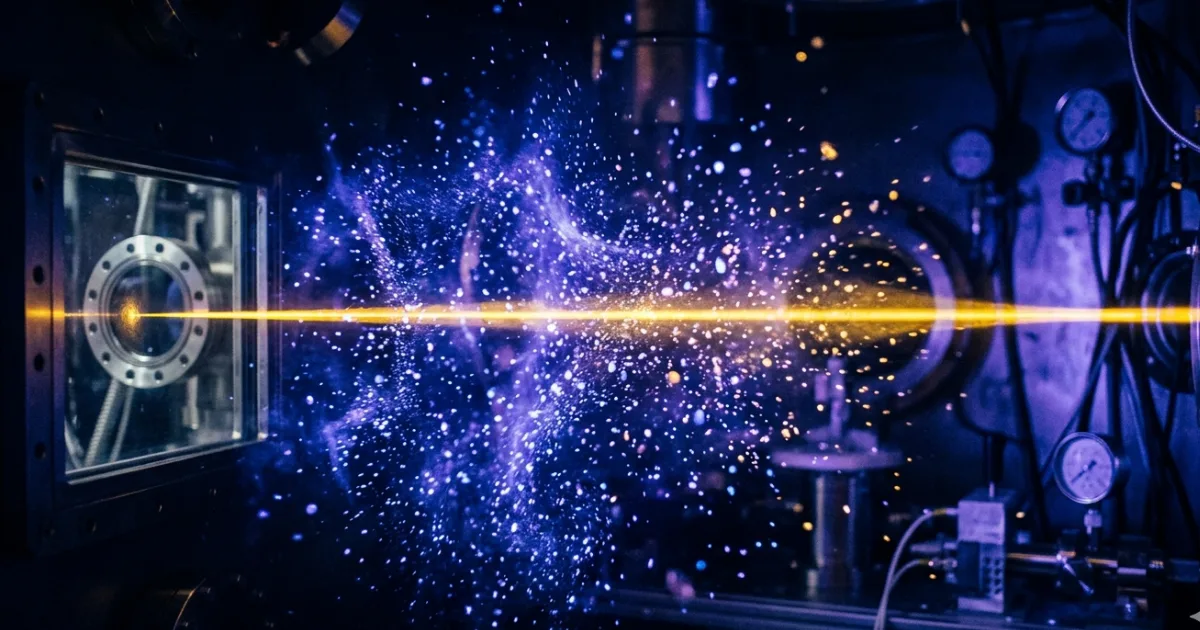
In This Article
- The Material That Makes Up 99.9% of the Visible Universe
- Why Physics Had Struggled With This Problem for Years
- How Did the AI Actually Uncover New Laws of Nature?
- What the Results Overturned — and Why That's Surprising
- Where This Research Goes From Here
Scientists at Emory University have used a custom-built neural network to uncover new physical laws hiding inside dusty plasma — and in doing so, quietly dismantled assumptions that physicists had treated as settled for decades. The AI didn't just make predictions. It corrected the field. Published in PNAS in 2025, the findings show that AI can now do something few expected: discover physics that human researchers had actually gotten wrong.
The Material That Makes Up 99.9% of the Visible Universe
Plasma is the fourth state of matter — and by far the most common one in the universe. Forget solid, liquid, gas. Plasma makes up roughly 99.9% of all visible matter, from the solar wind streaming past Earth to lightning cutting through a monsoon sky over Mumbai. When you look up at the sun, you're looking at plasma.
Dusty plasma takes this already strange material and adds something stranger: charged grains of dust floating inside the ionised gas. These dust particles pick up an electric charge from the surrounding plasma, and that's where things get complicated. They start pushing and pulling each other in ways that don't follow the familiar rules of electromagnetism.
Why Physics Had Struggled With This Problem for Years
The issue wasn't that physicists didn't know non-reciprocal forces existed in dusty plasma. They did. The problem was measuring them accurately enough to say anything precise. These forces are asymmetric, they change depending on particle position, and they're buried inside a cloud of other competing effects — drag from the surrounding gas, gravity, and chaotic particle collisions all happening at once.
Traditional mathematical models made simplifying assumptions to handle this complexity. Two of the biggest ones: that a particle's electric charge scales in direct proportion to its size, and that the force between particles weakens with distance in a way that doesn't depend on how large those particles are. Clean assumptions. Mathematically convenient. And, as this study found, not quite right.
How Did the AI Actually Uncover New Laws of Nature?
Here's the part that sets this work apart from most AI-in-science headlines. The team didn't just feed data into a black-box model and take its word for it. They designed the neural network deliberately — structuring it around known physical constraints, so that whatever the AI learned had to be physically meaningful.
Justin Burton, the experimental physicist leading the project, and his theoretical collaborator Ilya Nemenman spent over a year in weekly meetings just working out the right architecture. The goal was a network that could be trained on a relatively small dataset — because when you're studying something genuinely new, you don't have the luxury of millions of training examples — and still extract real physics from it.
The experimental side was equally careful. Burton's lab built a tomographic imaging system: a laser sheet sweeping through a plasma-filled vacuum chamber while a high-speed camera captured frame after frame. Those images were stitched together into 3D reconstructions of particle positions over time. Dozens of particles. Tracked continuously. It's the kind of painstaking data collection that rarely gets mentioned in the headline.
The final model separated particle motion into three components — drag from the surrounding gas, background forces like gravity, and the particle-to-particle interactions themselves. Then it was left to work out what those interactions actually looked like. It got there. With more than 99% accuracy.
"We showed that we can use AI to discover new physics. Our AI method is not a black box: we understand how and why it works."
— Justin Burton, Emory University · PNAS, 2025What the Results Overturned — and Why That's Surprising
Two findings stand out. The first is about electric charge. Older models assumed a clean linear relationship: a particle twice as large carries twice the charge. The AI found that while larger particles do carry more charge, the actual relationship is messier — it depends on plasma density and temperature in ways the simpler model had glossed over.
The second is about how forces weaken with distance. The standard assumption was that they decay exponentially, and that this decay rate doesn't depend on particle size. Wrong on the second count. Particle size does affect how quickly the force falls off. It's a subtle correction, but it changes the quantitative predictions of any model that uses the older formula.
The team confirmed these findings through separate experiments — this wasn't just a model artifact. And the corrected behaviour was something the AI spotted because it could see the data at a level of detail that previous methods simply couldn't achieve.
For Indian readers, there's a tangible connection here. Dusty plasma forms during wildfires when soot mixes with smoke, and these charged particles are known to disrupt radio communications. Firefighters in states like Uttarakhand or Himachal Pradesh already deal with degraded comms during fire season — a better physical model of how dusty plasma behaves is, in the long run, a step toward understanding and mitigating that disruption.
Where This Research Goes From Here
The researchers are clear about what this isn't yet. The neural network was trained on a controlled laboratory system — a vacuum chamber with a few dozen plastic particles, not the Saturn ring system or the Earth's ionosphere. Whether the same approach transfers cleanly to denser, more chaotic environments is still an open question.
But the framework itself — a physics-constrained neural network that runs on a standard desktop computer — is designed to be portable. Nemenman is already taking it to the Konstanz School of Collective Behavior in Germany, where he'll teach students to apply the same method to living systems: cells moving through tissue, crowds navigating public spaces, flocks of birds changing direction. The physics is different, but the underlying problem — inferring interaction rules from observed collective motion — is the same.
The team also wants to tackle denser plasma conditions, which would push the model toward real-world scenarios like fusion research or semiconductor manufacturing — two areas where India has growing investment through initiatives like the National Quantum Mission and domestic chip fabrication programmes.
- AI as a discovery tool — This study goes beyond AI as a data analyser; the model actively identified errors in established theory, a genuinely different role for machine learning in physics.
- Small data, real results — The neural network was designed to learn from limited experimental data, making the approach practical for fields where massive datasets don't exist.
- Broader than plasma — The same framework can be applied to biological systems, materials science, and crowd dynamics — anywhere collective behaviour emerges from hidden interaction rules.
"For all the talk about how AI is revolutionising science, there are very few examples where something fundamentally new has been found directly by an AI system." — Ilya Nemenman, PNAS, 2025.
📄 Source & Citation
Primary Source: Yu W, Abdelaleem E, Nemenman I, Burton JC. (2025). Physics-tailored machine learning reveals unexpected physics in dusty plasmas. Proceedings of the National Academy of Sciences, 122(31). https://doi.org/10.1073/pnas.2505725122
Authors & Affiliations: Wentao Yu (now at Caltech), Eslam Abdelaleem (now at Georgia Tech), Ilya Nemenman and Justin C. Burton (Emory University, Atlanta). Funded by the National Science Foundation and the Simons Foundation.
Data & Code: Available via PNAS online supplementary materials and the journal's data portal.
Key Themes: Dusty Plasma · Non-Reciprocal Forces · Machine Learning · Collective Motion · Complex Systems
Supporting References:
[1] Ivlev AV et al. (2015). Complex plasmas and colloidal dispersions: particle-resolved studies of classical liquids and solids. World Scientific.
[2] Morfill GE, Ivlev AV. (2009). Complex plasmas: an interdisciplinary research field. Reviews of Modern Physics, 81(4):1353.
[3] Rackauckas C et al. (2020). Universal differential equations for scientific machine learning. arXiv, 2001.04385.
No comments yet. Be the first to share your thoughts.
Leave a Comment