 Krishan Gopal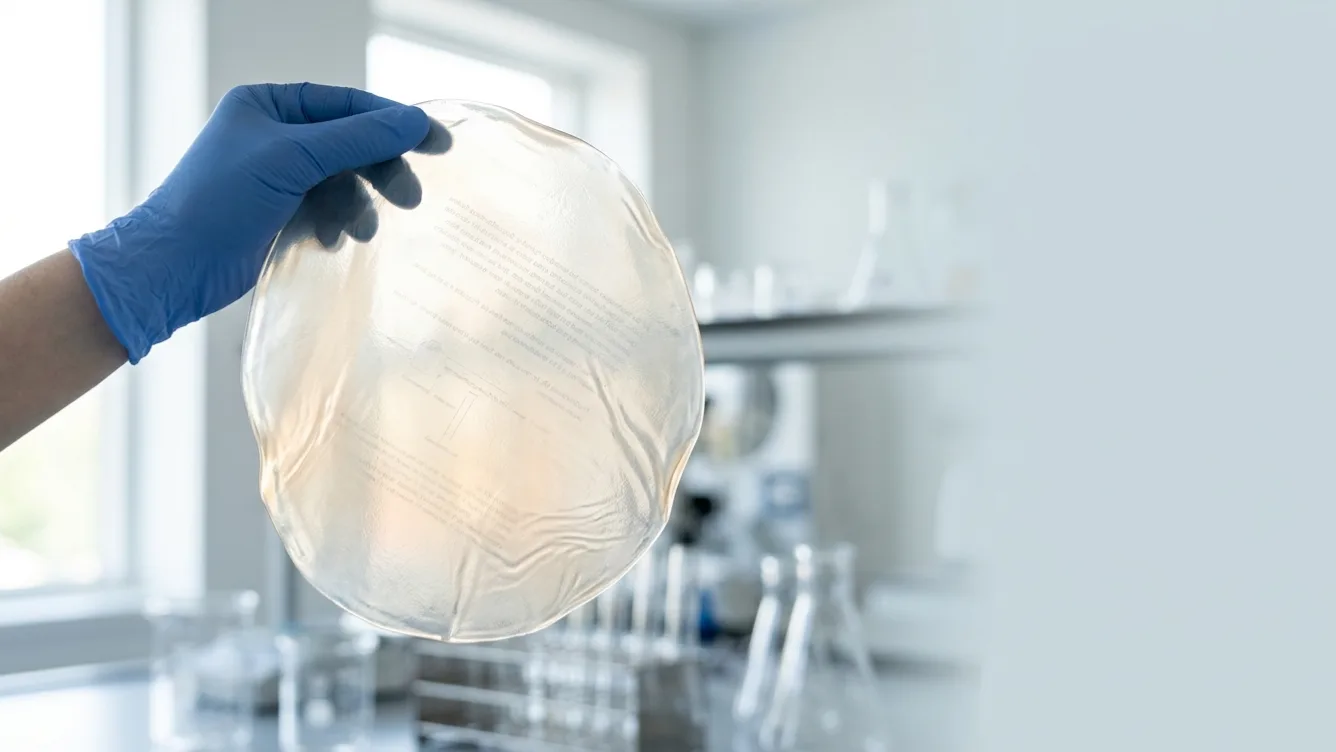
In This Article
- A Sheet Grown by Living Bacteria
- Why Older Methods Made Weak Sheets
- How Does Spinning Make Bacterial Cellulose So Strong?
- What This Could Replace in Daily Life
- The Questions Still Left to Answer
Picture a sheet so thin you can read a word through it, yet so tough it pulls harder than glass and many metals before it tears. Now picture it being built not in a steel factory but by tiny living bacteria swimming in sugar water. That is exactly what a team at Rice University did with bacterial cellulose, and the trick that made it work is almost funny in how simple it sounds: they just kept the water gently spinning.
A Sheet Grown by Living Bacteria
Most of the strong materials around you are dug up, melted, or made from oil. Bacterial cellulose is different. It is grown. Certain microbes feed on sugar and slowly spin out incredibly thin threads, called nanofibrils, that knit themselves into a sheet you can hold.
These threads are stunning on their own. A single fibril is, in theory, far stronger for its weight than steel. The problem has always been turning that tiny strength into something big enough to use. For years, the sheets stayed disappointingly weak.
So the raw ingredient was always brilliant. The puzzle was why the final sheet kept letting everyone down.
Why Older Methods Made Weak Sheets
The usual way to grow bacterial cellulose is to leave the liquid still and let the bacteria wander. They drift in every direction, so the threads they leave behind point every which way. The result is a messy tangle, like a plate of cooked noodles.
A tangle is weak. When you pull on it, only a few threads line up with your pull and take the load. The rest twist, kink, and snap early. Scientists tried fixing this by stretching the wet sheet after growing it, a method described by researchers like Rahman and Netravali, but stretching needs extra machines and can tear the delicate gel.
The team wanted the strength without the extra machinery. So instead of fixing the tangle later, they decided to stop it from ever forming.
How Does Spinning Make Bacterial Cellulose So Strong?
The fix is a small device that looks like a clear tube with a paddle inside. A slow motor turns the paddle, keeping the sugar water gently moving in one circular direction, day after day, for about ten days. The bacteria get carried along that flow.
Because every microbe now travels the same way, the threads they spin all line up the same way too. The noodle tangle becomes something closer to a neatly combed bundle of hair. Lined-up threads share a pull evenly, so far fewer snap early.
The numbers show how well it worked. The spun sheet reached about 393 megapascals of pulling strength, more than double an ordinary sheet, and the best samples climbed to roughly 436. It also became stiffer and tougher at the same time, two things that usually fight each other in materials. Even after being pulled and released 10,000 times, the sheet barely changed.
"This simultaneous enhancement of both strength and toughness is noteworthy, as these properties are typically considered mutually exclusive in materials engineering."
— Saadi et al., Nature Communications, 2025What This Could Replace in Daily Life
A clear, foldable, plant-free sheet that beats plastic on strength is a real answer to a real mess. The world is drowning in petroleum-based packaging that lingers for centuries. A grown material that breaks down naturally could quietly take its place on shelves and in shipping boxes.
The team also gave the sheet a second talent. They dropped flakes of boron nitride nanosheets, a heat-spreading nanomaterial, straight into the sugar water. The spinning flow mixed them in evenly. The new hybrid sheet pulled even harder, near 553 megapascals at its best, and moved heat away about three times faster.
A material that is strong, see-through, and good with heat opens doors well past the packaging aisle.
The Questions Still Left to Answer
This is a promising start, not a finished product. The current device makes small sheets, around 7.5 milligrams of dry material a day, so growing factory-sized rolls is still untested. The sheet is also stronger in its lined-up direction than across it, which engineers must plan around.
The team also notes that the heat-spreading flakes did not bond tightly to the cellulose threads, leaving room to improve. The bigger prize, mixing in other nanomaterials to add electrical or other powers, remains a hope rather than a proven result.
- Spinning beats stretching — gentle, steady flow lines up the fibers as they grow, so no extra machine is needed afterward.
- Strong and tough together — the spun sheet gained both qualities at once, which materials rarely manage.
- A grown alternative to plastic — it is made from sugar and water, breaks down in nature, and can carry heat-smart add-ins.
"We envisage our aligned, strong, and multifunctional BC sheets will pave the way towards a wide range of practical applications." — Saadi et al., Nature Communications, 2025.
It is easy to think of strength as something we hammer out of furnaces. This work is a quiet reminder that nature has been doing it the whole time, thread by thread, and that sometimes the smartest move is simply to stop fighting how living things want to grow and let them line up on their own.
📄 Source & Citation
Primary Source: Saadi, M.A.S.R., Cui, Y., Bhakta, S.P., et al. (2025). Flow-induced 2D nanomaterials intercalated aligned bacterial cellulose. Nature Communications, 16, 5825. https://doi.org/10.1038/s41467-025-60242-1
Authors & Affiliations: Led by Muhammad M. Rahman (Rice University and University of Houston), with collaborators across Rice University's departments of Materials Science, Bioengineering, Biosciences, and Chemical Engineering.
Data & Code: All data needed to evaluate the conclusions are in the paper and its Supplementary Information; further data are available from the corresponding author on request.
Key Themes: Bacterial cellulose · Aligned nanofibrils · Sustainable materials · Boron nitride hybrids · Green packaging
Supporting References:
[1] Rahman, M.M. & Netravali, A.N. (2016). Aligned bacterial cellulose arrays as 'green' nanofibers for composite materials. ACS Macro Letters, 5(10):1070–1074.
[2] Wang, S. et al. (2018). Transparent, anisotropic biofilm with aligned bacterial cellulose nanofibers. Advanced Functional Materials, 28:1707491.
[3] Roy, S. et al. (2021). Structure, properties and applications of two-dimensional hexagonal boron nitride. Advanced Materials, 33:2101589.
No comments yet. Be the first to share your thoughts.
Leave a Comment