 Sanjay Verma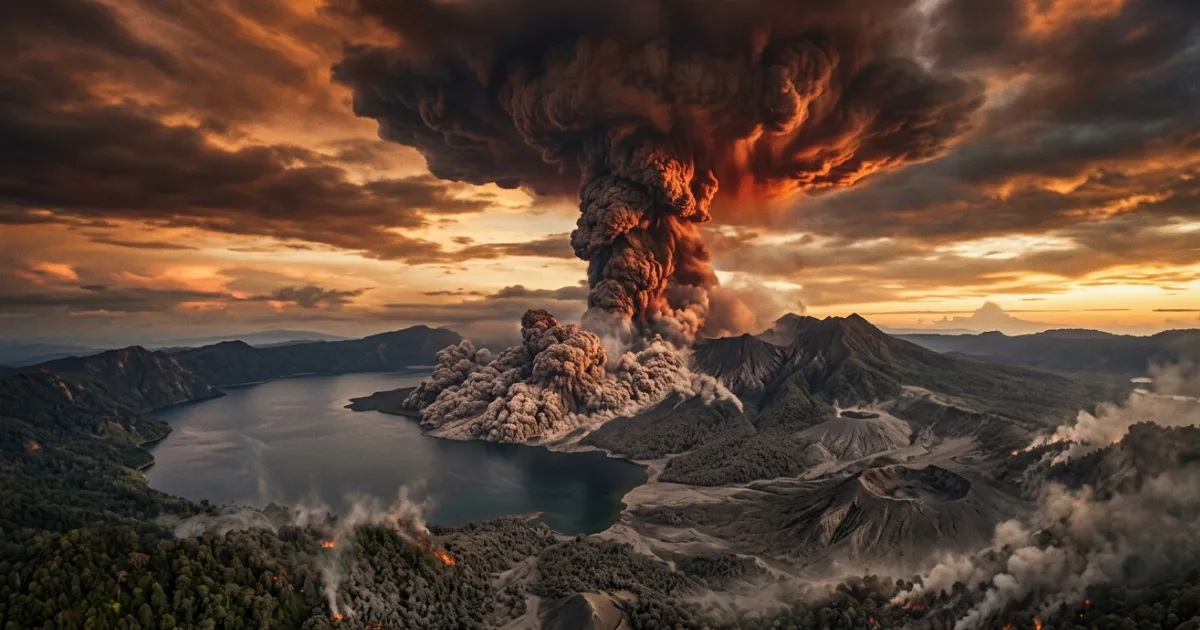
In This Article
- The Eruption That Changed the Planet
- Why Scientists Thought Humanity Was Finished
- How Do Archaeologists Detect Invisible Ash?
- What the Evidence Actually Shows
- What Toba Still Cannot Tell Us
Seventy-four thousand years ago, the sky went dark and stayed that way. The Toba supervolcano in what is now Sumatra erupted with a force more than 10,000 times greater than the 1980 Mount St. Helens blast, blanketing the planet in ash and potentially plunging it into years of cooling darkness. By every reasonable expectation, Homo sapiens should not have survived it. Yet here we are. And archaeologists are now piecing together exactly how our ancestors pulled it off.
The Eruption That Changed the Planet
The Toba supervolcano didn't just erupt. It restructured Earth. The blast ejected 672 cubic miles of ash into the stratosphere and left behind a caldera measuring roughly 100 by 30 kilometres in northern Sumatra.
Acid rain likely poisoned freshwater sources. Thick ash buried vegetation under suffocating layers of debris. Sunlight, filtered through a veil of stratospheric particles, may have dimmed for as long as six years.
For anyone living near the volcano, survival was almost certainly impossible. The question researchers have spent decades wrestling with is what happened to everyone else.
Why Scientists Thought Humanity Was Finished
Picture the entire human population of Earth fitting inside a single stadium. That is what some researchers believe Toba left behind. The Toba catastrophe hypothesis, first proposed in the 1990s, argued the eruption triggered a volcanic winter so severe it collapsed our global population to fewer than 10,000 survivors — roughly the number of people in a small town today.
The genetic evidence seemed to confirm the worst. Every human alive carries the same remarkably narrow band of DNA diversity, far less than most other species on Earth. Scientists call this a genetic bottleneck: the fingerprint left in our genes when a catastrophe kills so many people that the survivors' limited gene pool becomes the entire blueprint for everyone who follows. For a generation of researchers, Toba was the obvious culprit.
Climate records backed the theory up. Ice cores and ocean sediment showed genuine cooling in the aftermath of the eruption. Ash from Toba has been found buried deep in the soil from India to East Africa, thousands of kilometres from the source. On paper, the case for near-extinction was airtight. Then the archaeologists started digging.
How Do Archaeologists Detect Invisible Ash?
Here is where the science gets unexpectedly detective-like. The most critical tool for testing what actually happened during the Toba supervolcano event is something called cryptotephra: microscopic shards of volcanic glass so small they are invisible to the naked eye.
Unlike the thick visible ash layers preserved in some geological records, cryptotephra travels farther on atmospheric winds and settles more evenly across landscapes. Finding it requires sifting soil samples through a painstaking lab process, using precision instruments called micromanipulators to isolate individual glass fragments that could pass through the eye of a needle.
Each eruption produces tephra with a distinct chemical fingerprint, a particular ratio of iron, silica, and mineral compounds that acts like a forensic timestamp. Once researchers confirm a shard came from Toba, they can compare the human activity layers directly above and below it. The result is a before-and-after picture of human behaviour at ground zero of the most violent event in recent geological history.
"Finding cryptotephra at an archaeological site is only the first step. Scientists then compare evidence of human activity from before and after the eruption."
— Jayde N. Hirniak, Arizona State University · The Conversation, 2026What the Evidence Actually Shows
The results from multiple sites have surprised researchers who expected to find ash layers marking sudden abandonment. At Pinnacle Point 5-6 in South Africa, cryptotephra from the Toba supervolcano appears within sediment layers showing unbroken human occupation before, during, and after the eruption. Activity at the site didn't collapse after the event. It increased, accompanied by signs of new technological approaches.
The picture from Ethiopia's Shinfa-Metema 1 site is equally striking. Toba cryptotephra appears in layers documenting continuous human presence. The communities living there appear to have responded to the environmental stress by following seasonal rivers and exploiting shallow waterholes during prolonged dry periods. Around the same time, evidence of bow and arrow technology emerges in the region, a sophisticated development that suggests cognitive flexibility, not collapse.
Comparable signs of continuity have been documented at sites in India, Indonesia, and China. The pattern is consistent enough that many researchers now believe the Toba catastrophe hypothesis significantly overstated the eruption's effect on human populations globally.
What Toba Still Cannot Tell Us
None of this means the story is settled. Researchers still cannot agree on whether the genetic bottleneck in human DNA was caused by Toba, by an earlier climate event, or by something else entirely. Finding ash and finding humans in the same soil layer is not the same as proving one caused the other. The debate is very much alive.
The USGS Volcanic Hazards Program and the Global Volcanism Program now monitor active volcanoes worldwide with sensors and satellites that would have been incomprehensible to anyone alive 74,000 years ago. Early warning systems exist. Evacuation plans exist. And yet Toba still carries a quiet lesson that no monitoring programme can replace: the humans who made it through did so because when everything familiar was buried under ash, they found something new to eat, a new route to follow, a new way to hunt. They adapted before they even had a word for it.
That is what makes Toba worth studying beyond the archaeology. It is not just a story about ancient people surviving a volcano. It is the earliest evidence we have of the one trait that has defined our species ever since — the refusal to treat any situation as the last one.
- Resilience, not luck — Multiple continents show continuous human occupation across the Toba ash boundary, suggesting adaptive strategy rather than mere chance survival.
- Innovation under pressure — Bow and arrow technology and new foraging strategies appear in the archaeological record around the same period, pointing to behavioural flexibility as a key survival mechanism.
- The bottleneck debate continues — Whether Toba caused the genetic narrowing in human DNA remains unresolved, and answering it may require comparing ancient genomes from sites on multiple continents.
"The disaster may not have destroyed humanity. It may have revealed just how tough humans really are." — Jayde N. Hirniak, Institute of Human Origins, Arizona State University, The Conversation, 2026.
📄 Source & Citation
Primary Source: Hirniak, J. N. (2026). A massive eruption 74,000 years ago affected the whole planet — archaeologists use volcanic glass to figure out how people survived. The Conversation. Republished via ScienceDaily, May 11, 2026. https://www.sciencedaily.com/releases/2026/05/260510234711.htm
Authors & Affiliations: Jayde N. Hirniak, Ph.D. Candidate in Anthropology, Institute of Human Origins, Arizona State University.
Data & Code: Cryptotephra analysis data referenced via published site reports for Pinnacle Point 5-6 (South Africa) and Shinfa-Metema 1 (Ethiopia). Supporting geological data via the Smithsonian Institution Global Volcanism Program.
Key Themes: Toba supervolcano · Human resilience · Cryptotephra analysis · Volcanic winter · Early human innovation
Supporting References:
[1] Brown, K. S. et al. (2018). Understorey plant foods and the subsistence ecology of Middle Stone Age humans at Pinnacle Point, South Africa. Nature, 555, 228–233. https://doi.org/10.1038/nature25967
[2] Sahle, Y. et al. (2024). Toba supereruption and early modern human adaptations at Shinfa-Metema 1, Ethiopia. Nature, 628, 82–88. https://www.nature.com/articles/s41586-024-07208-3
[3] Ambrose, S. H. (1998). Late Pleistocene human population bottlenecks, volcanic winter, and differentiation of modern humans. Journal of Human Evolution, 34(6), 623–651. https://doi.org/10.1006/jhev.1998.0219
No comments yet. Be the first to share your thoughts.
Leave a Comment