 Krishan Gopal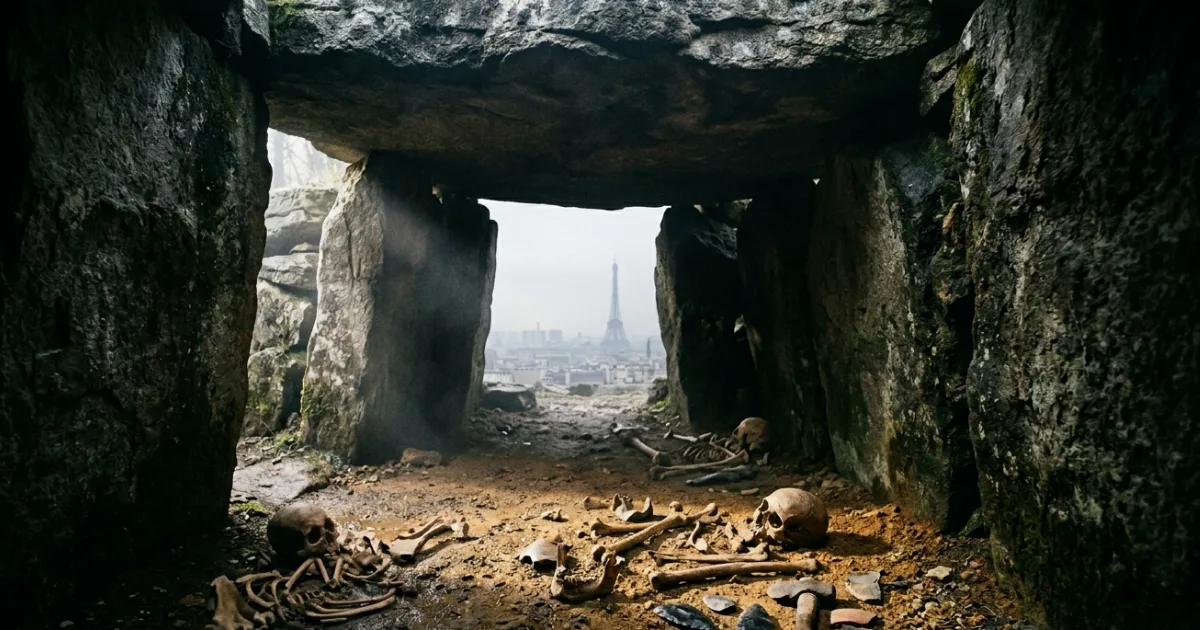
In This Article
- The Tomb That Held Two Worlds Apart
- How Scientists Read 5,000-Year-Old DNA
- Why Did an Entire Population Vanish Overnight?
- Strangers From the South — and What They Changed
- What This Means for Understanding Human Prehistory
Somewhere north of Paris, buried under layers of earth and stone, lie the bones of two completely different peoples — separated not by metres, but by a catastrophe. Scientists have just extracted DNA from 132 Stone Age skeletons at a single megalithic tomb site, and what they found has rewritten one of the most puzzling chapters in European prehistory: a Neolithic population collapse so total that an entire community simply ceased to exist.
The Tomb That Held Two Worlds Apart
The site is called Bury, a large megalithic burial monument about 50 kilometres north of Paris in the Seine valley. For thousands of years, Neolithic farming communities used it as a tomb — a communal resting place for the dead, built from enormous slabs of stone. Think of it as the prehistoric equivalent of a family vault that a village returned to generation after generation.
But when an international team led by the University of Copenhagen's Globe Institute began sequencing DNA from the 132 individuals buried there, they found something extraordinary. The people buried in the earlier phase of the tomb and those buried later were not related. At all. They belonged to genetically distinct populations, separated by a sharp break around 3000 BC — a moment in time when, apparently, one group disappeared and another took its place.
This wasn't slow cultural change. This wasn't one group gradually merging with another over centuries. This was a hard stop. A full population replacement.
How Scientists Read 5,000-Year-Old DNA
Ancient DNA analysis has transformed archaeology in the last decade — the way X-ray machines once transformed medicine. Instead of guessing about migrations from pottery styles and burial customs, researchers can now extract actual genetic material from bones and teeth, even after five millennia. The team used a method called whole-genome sequencing, which analyses all the genetic material preserved in bone rather than just select markers.
This approach also allowed them to screen for something unexpected: ancient pathogens. Hidden inside those old bones, preserved by cold and chemistry, were traces of bacteria that hadn't been seen by any living human for thousands of years.
Why Did an Entire Population Vanish Overnight?
Here is where the story gets genuinely unsettling. The researchers found DNA from two dangerous pathogens in the ancient remains: Yersinia pestis — the very bacterium that would later cause the Black Death — and Borrelia recurrentis, which causes louse-borne relapsing fever. Plague was present in both burial phases, though it was more common in the earlier population.
But plague alone didn't do this. The scientists are clear on that point. The skeletal remains also showed something archaeologists call a "demographic crisis signature" — unusually high mortality among children and young adults in the earlier phase. When a population starts losing its youngest members at abnormal rates, it loses its future. The group simply cannot replace itself fast enough.
"The decline was likely driven by a combination of disease, environmental stress, and other disruptive events — not a single pathogen acting alone."
— Sikora, University of Copenhagen · Nature Ecology & Evolution, 2026The research — a deeply interdisciplinary effort combining genetics, archaeology, radiocarbon dating, strontium isotope analysis, and palynology (the study of ancient pollen) — also found evidence of land-use changes in pollen records from the same period. Forests were returning where farmland had been cleared. Fields were being abandoned. Whatever happened, it reshaped the landscape itself.
Think of it like a slow-motion disaster: disease weakening the population, crops failing, the young dying disproportionately, communities fragmenting — until one day the tomb simply stopped receiving the same people's bones.
Strangers From the South — and What They Changed
The second act of this story is just as striking. After the original population collapsed, the tomb didn't stay empty forever. New people arrived — and their DNA tells a completely different story. Where the earlier group genetically resembled Stone Age farming communities from northern France and Germany, the later group showed strong genetic affinities with populations from southern France and the Iberian Peninsula. They came from the south, and they were not related to the people who had been buried there before.
The social structure shifted too. Earlier burials showed large, multigenerational extended families — grandparents, parents, children — buried together across decades. The later burials were smaller and more selective, dominated by a single male lineage. The family unit had contracted. The community model had changed.
What This Means for Understanding Human Prehistory
This study, published in Nature Ecology & Evolution in April 2026, matters well beyond the borders of France. It transforms the Neolithic decline from a vague archaeological observation — "populations seemed to drop around this time" — into a documented, genetic reality. A community existed. It collapsed. Strangers from distant regions moved in. And the world they built — their tombs, their traditions, their monument-building ambitions — ended with them.
For researchers studying ancient disease, the pathogen-screening method used here opens a powerful new toolkit. The same approach can be applied to burial sites across the world to map prehistoric epidemics, track human migrations, and understand how combined biological and environmental stressors topple entire societies. History, it turns out, has a long habit of repeating in patterns we are only now learning to read.
- Plague is ancient history — Yersinia pestis was circulating in human populations thousands of years before the medieval Black Death, suggesting the bacterium has shaped human demographics far longer than we realised.
- Population collapses aren't simple — The Bury evidence shows that societal collapse typically involves multiple simultaneous stressors — disease, environmental change, demographic crisis — rather than a single dramatic cause.
- DNA rewrites the map — Ancient genomics can now reconstruct prehistoric migrations and replacements with a precision that no other archaeological method can match, turning cold cases thousands of years old into solvable mysteries.
"By joining forces of experts from a wide variety of disciplines, we can now begin to understand what happened during one of the most dramatic transitions in European prehistory." — Kristiansen, University of Gothenburg · Nature Ecology & Evolution, 2026.
📄 Source & Citation
Primary Source: Seersholm FV, Ramsøe A, Cao J, et al. (2026). Population discontinuity in the Paris Basin linked to evidence of the Neolithic decline. Nature Ecology & Evolution. https://doi.org/10.1038/s41559-026-03027-z
Authors & Affiliations: Frederik V. Seersholm, Martin Sikora, Eske Willerslev (University of Copenhagen / Globe Institute); Kristian Kristiansen (University of Gothenburg); Laure Salanova (CNRS France); and international collaborators across Denmark, France, and Sweden.
Data & Code: Genomic data available via the European Nucleotide Archive (ENA); supplementary materials accessible through the Nature Ecology & Evolution online portal.
Key Themes: Ancient DNA · Neolithic decline · Population collapse · Archaeogenetics · Prehistoric Europe
Supporting References:
[1] Haak W et al. (2015). Massive migration from the steppe was a source for Indo-European languages in Europe. Nature, 522:207–211. https://doi.org/10.1038/nature14317
[2] Rascovan N et al. (2019). Emergence and spread of basal lineages of Yersinia pestis during the Neolithic decline. Cell, 176(1-2):295–305. https://doi.org/10.1016/j.cell.2018.11.005
[3] Olalde I et al. (2019). The genomic history of the Iberian Peninsula over the past 8,000 years. Science, 363(6432):1230–1234. https://doi.org/10.1126/science.aav4040
[4] Kristiansen K et al. (2017). Re-theorising mobility and the formation of culture and language among the Corded Ware Culture in Europe. Antiquity, 91(356):334–347.
[5] University of Copenhagen press release (April 2026): globe.ku.dk
No comments yet. Be the first to share your thoughts.
Leave a Comment