 Krishan Gopal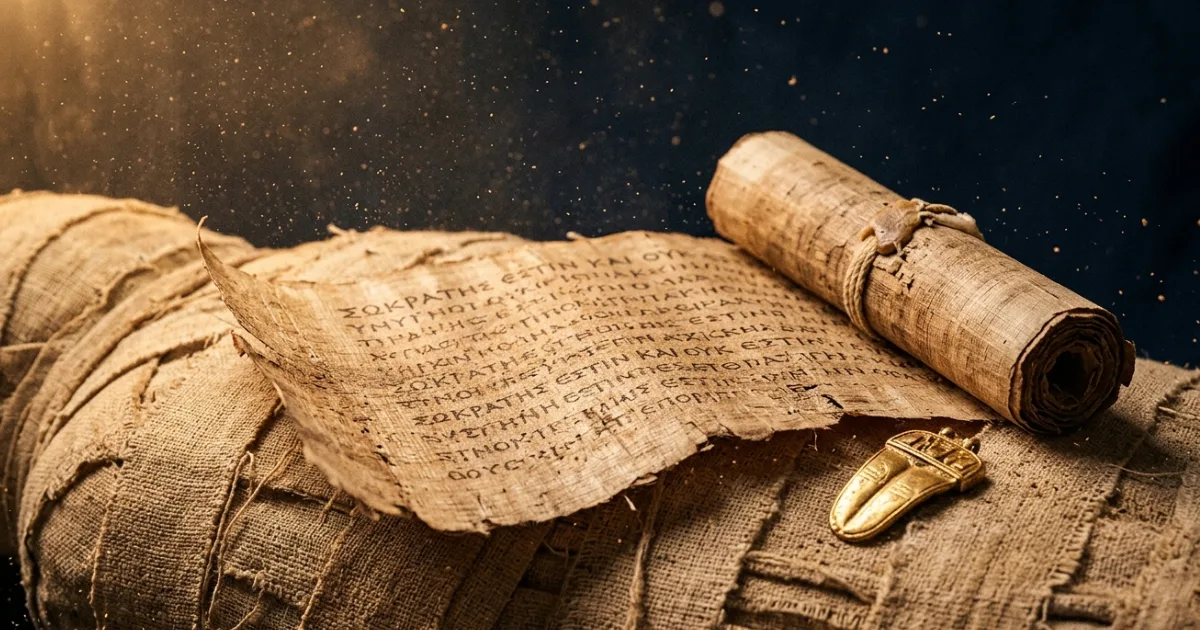
In This Article
- The Discovery Inside Tomb 65
- What Made Oxyrhynchus So Special
- Why Was Homer's Iliad Placed Inside a Dead Person?
- What This Tells Us About Ancient Egypt and Greece
- What Happens Next — and What We Still Don't Know
Someone placed a copy of Homer's Iliad — one of the oldest stories ever written — inside a dead person's stomach 1,600 years ago. And nobody knew about it until now. Archaeologists from the University of Barcelona announced in April 2026 that they had found a papyrus fragment of the Iliad tucked inside the abdomen of a Roman-era mummy at the ancient Egyptian city of Oxyrhynchus. It is the first time in the history of archaeology that a Greek literary text — not a magical scroll, not a prayer — was found deliberately placed inside a mummy as part of the burial.
The Discovery Inside Tomb 65
Between November and December 2025, a team led by archaeologist Núria Castellano was digging through a necropolis at Al Bahnasa in Egypt's Minya Governorate, about 190 kilometres south of Cairo. The site sits near the branch of the Nile called Bahr Yussef — and underneath the sand was a funerary complex with three limestone chambers packed with Roman-era mummies. Many of the tombs had been looted long before. But Tomb 65 was different.
Inside, they found a mummy with something unusual on its body. A sheet of papyrus, folded and placed directly on the abdomen. When the team carefully removed and studied it, the text turned out to be from Book II of the Iliad — specifically the famous "Catalog of Ships," the section where Homer lists all the Greek forces that sailed to Troy to fight for Helen. It is one of the most recognisable passages in all of ancient literature. Sitting inside a mummy for over a millennium and a half.
What Made Oxyrhynchus So Special
Oxyrhynchus is not just any old Egyptian site. Since the late 19th century, it has been one of the most document-rich locations ever excavated. British archaeologists digging through its ancient rubbish dumps in the early 1900s found roughly half a million papyrus fragments — lost plays by Euripides, government tax records, private letters, shopping lists, even early Christian texts. The place was essentially the world's oldest paper landfill.
The University of Barcelona's mission at Oxyrhynchus has been running since 1992, first under Professor Josep Padró. In previous digs at the same necropolis, the team had already found papyri written in Greek placed inside mummies. But every single one of those scrolls had magical or ritual content — spells, prayers, protective charms. The kind of thing you would expect a family to tuck into a burial. A passage from a famous war poem? That had never been seen before.
Why Was Homer's Iliad Placed Inside a Dead Person?
Here's the question everyone is asking — and honestly, nobody has a firm answer yet. Ignasi-Xavier Adiego, a classical philologist at the University of Barcelona who studied the fragment, put it plainly: previous papyri found in burial contexts were magical in nature, but this one is genuinely literary. The person who placed the scroll chose a war epic, not a prayer. Why?
One possibility is education. By the time this mummy was buried — roughly around 400 CE, during the Roman period — Homer's works were widely used as school texts across Egypt. Greek was the language of culture and administration, and the Iliad was the equivalent of what Shakespeare is for English students today. Maybe the scroll belonged to a teacher, a student, or simply someone who loved the poem.
Another thought: maybe the family believed that placing an important, culturally respected text alongside the body offered some form of protection or honour — similar to how magical papyri were used. But that is just speculation. The research team is still working through their hypotheses.
"The real novelty is finding a literary papyrus in a funerary context."
— Ignasi-Xavier Adiego, University of Barcelona · Oxyrhynchus Archaeological Mission Statement, 2026What This Tells Us About Ancient Egypt and Greece
This discovery says something interesting about how cultures blend when they occupy the same space for long enough. Egypt was under Greek influence after Alexander the Great's conquest in 332 BCE, and under Roman rule from 30 BCE onwards. During those centuries, Greek culture did not simply sit on top of Egyptian culture — the two mixed. People spoke Greek, read Greek literature, and apparently even took Greek literature with them to the grave.
The same necropolis contained other remarkable items: mummies decorated with golden geometric patterns, and several with gold tongues placed in their mouths. Ancient Egyptians believed gold helped the dead speak in the afterlife. This particular mummy, however, was found near a tongue-shaped golden artifact — suggesting it may have been a person of some status or means, someone whose family could afford both the gold and, perhaps, the books.
What Happens Next — and What We Still Don't Know
The research team at the University of Barcelona, led by Maite Mascort and Esther Pons, is still formally studying the papyrus. The text itself has been confirmed as authentic — the Greek letters match the Catalog of Ships from Book II. What scholars are now working to understand is whether this was an isolated choice by one family, or whether literary texts were placed in burials more widely and simply haven't survived in other sites.
There are also questions about the mummy itself. Who was this person? Male, female? A scholar? A wealthy merchant? The excavation records are still being processed. The tomb dates to around 400 CE, but a more precise date requires further analysis. And the broader necropolis at Al Bahnasa still holds unexcavated sections — there may be more surprises buried beneath the sand.
- First literary burial text — This is the first confirmed case of a Greek literary work being intentionally used in the Egyptian mummification process, making it unique in the entire archaeological record.
- Greek culture ran deep in Egypt — The discovery shows that Homer's works were not just read in Egypt — they were considered important enough to carry into the afterlife, reflecting how deeply Greek culture had taken root under Roman rule.
- Big questions remain open — Researchers still don't know why the Iliad was chosen or who the mummy was, meaning this discovery raises as many questions as it answers.
"The discovery of a copy of the Iliad in an Egyptian city like Oxyrhynchus is certainly not unusual. What is new is finding it here, in this context, as part of the burial itself." — Leah Mascia, papyrologist, Oxyrhynchus Archaeological Mission, 2026.
📄 Source & Citation
Primary Source: Oxyrhynchus Archaeological Mission, Institute of Ancient Near East Studies (IPOA), University of Barcelona. Official statement released April 2026 via Egypt's Ministry of Tourism and Antiquities. Reported by Phys.org, Smithsonian Magazine, and Scientific American.
Authors & Affiliations: Maite Mascort and Esther Pons (Mission Directors, University of Barcelona); Núria Castellano (Field Team Leader); Ignasi-Xavier Adiego (Classical Philologist, University of Barcelona); Leah Mascia (Papyrologist, Oxyrhynchus Mission)
Data & Code: Excavation records and papyrus images available via Egypt's Ministry of Tourism and Antiquities and the University of Barcelona's IPOA department.
Key Themes: Homer's Iliad · Egyptian Archaeology · Greco-Roman Egypt · Ancient Papyrology · Oxyrhynchus
Supporting References:
[1] Grenfell BP, Hunt AS. (1898). The Oxyrhynchus Papyri, Part I. Egypt Exploration Fund, London. — The original foundational study of the Oxyrhynchus papyrus archive.
[2] Cribiore R. (2001). Gymnastics of the Mind: Greek Education in Hellenistic and Roman Egypt. Princeton University Press. — Documents the use of Homer's works in Egyptian schools during the Greco-Roman period.
[3] Montserrat D. (1996). Sex and Society in Graeco-Roman Egypt. Kegan Paul International. — Provides broader cultural context for Greco-Roman burial practices in Egypt.
No comments yet. Be the first to share your thoughts.
Leave a Comment