 Krishan Gopal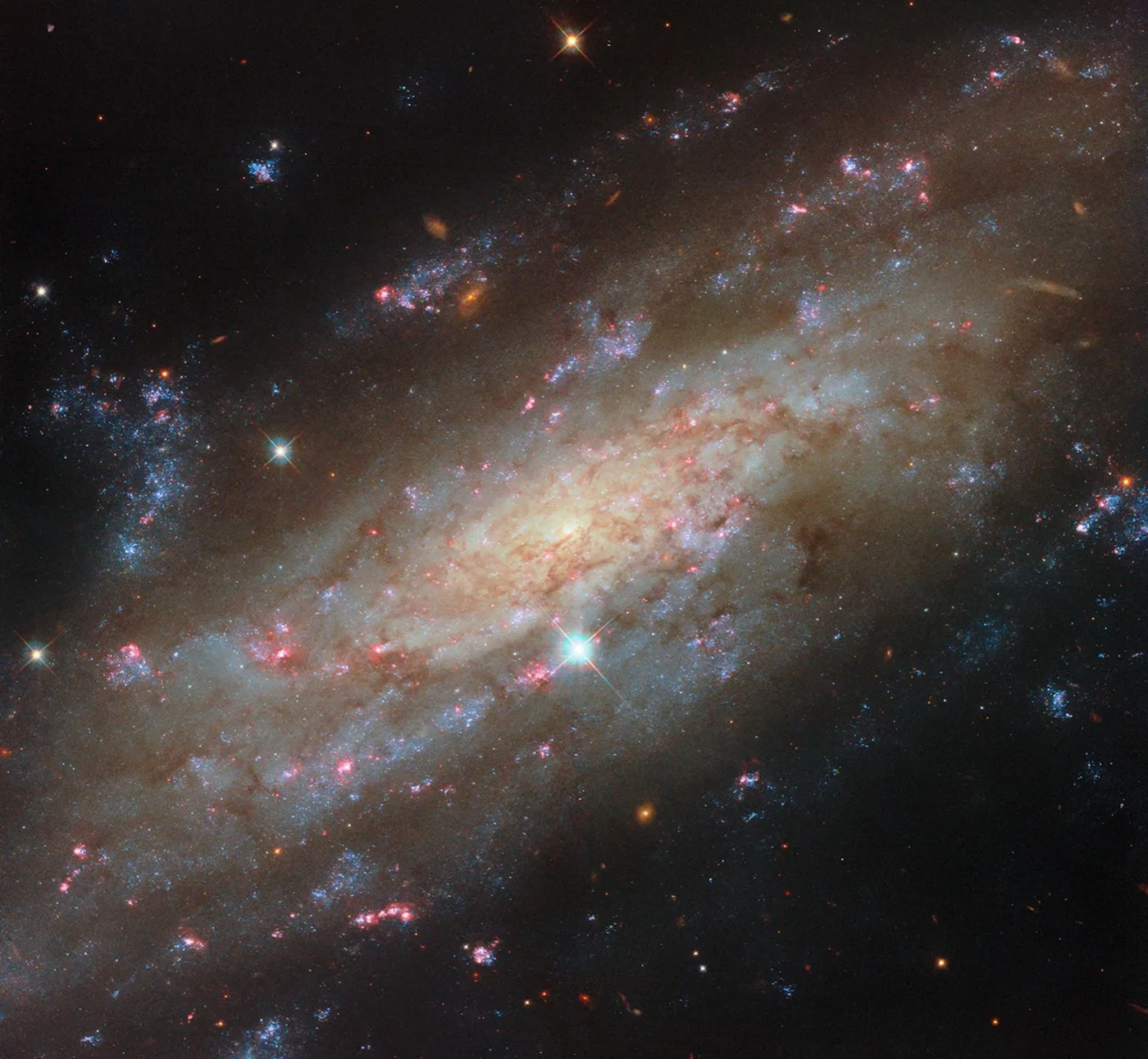
In This Article
- A Galaxy Worth a Second Look
- The Local Group Next Door
- Why Does NGC 3137 Help Us Understand the Milky Way?
- What Hubble Actually Sees — and What It Tells Us
- What Astronomers Still Don't Know
Fifty-three million light-years away, a spiral galaxy is quietly going about its business — forming stars, recycling dust, and living inside a family of galaxies that looks almost exactly like our own. NASA's Hubble Space Telescope turned toward it in April 2026, and the result is one of the sharpest portraits ever taken of NGC 3137 — a galaxy that astronomers now treat as something of a stand-in for studying the Milky Way from the outside.
A Galaxy Worth a Second Look
At first glance, NGC 3137 looks like a dozen other spiral galaxies Hubble has photographed. But that's a bit like saying Tokyo and Mumbai look the same because both have skyscrapers. The details are everything. Located in the faint southern constellation Antlia (the Air Pump), this galaxy sits close enough to resolve individual star clusters — those brilliant blue clumps scattered through its arms — but far enough away to fit the whole thing in a single frame. That combination doesn't come along often.
The image released on May 4, 2026 comes from the PHANGS-HST survey (Physics at High Angular resolution in Nearby GalaxieS), led by David Thilker and his team. PHANGS is essentially an atlas project — astronomers are building a consistent, high-resolution catalogue of nearby spiral galaxies to understand how star formation actually works across a whole range of environments. NGC 3137 is one of their latest additions.
The Local Group Next Door
Here's the part that makes NGC 3137 genuinely interesting. It doesn't live alone. It belongs to a small cluster called the NGC 3175 group, and when astronomers mapped out this group's structure, they noticed something striking: it's organised almost identically to the Local Group — the galaxy cluster our own Milky Way inhabits.
Both groups are anchored by two large spiral galaxies. In ours, that's the Milky Way and Andromeda. In the NGC 3175 group, it's NGC 3137 and NGC 3175. Both groups are surrounded by a swarm of smaller dwarf galaxies. Researchers have already catalogued more than 500 dwarf galaxy candidates orbiting the NGC 3175 group — though the final tally may be different once follow-up observations are complete. The structural resemblance is close enough that studying the NGC 3175 group gives astronomers a way to see what a Local Group-type environment looks like from a safe observational distance.
Why Does NGC 3137 Help Us Understand the Milky Way?
There's an obvious problem with studying our own galaxy: we're inside it. Imagine trying to describe the layout of a city while standing at a random bus stop with no map and buildings blocking your view in every direction. That's roughly the challenge facing Milky Way astronomers. We can't step back and photograph it. We infer its spiral arms from indirect measurements, and those measurements still have notable uncertainties after decades of work.
NGC 3137 offers something the Milky Way never can — a view from the outside. Because it's in a similar environment, with a similar mass and similar companions, the evolutionary pressures on it have been comparable to ours. When astronomers watch how star formation is distributed across NGC 3137's disk, how the dust lanes wind inward toward the core, or how the blue clusters fade in age as you move outward along the arms — they're reading a story that probably has a lot of parallels with what happened, and is happening, in our own galaxy.
"By studying this nearby galaxy group, astronomers can learn about the dynamics of our own galactic home."
— NASA Hubble Mission Team · NASA.gov, May 2026What Hubble Actually Sees — and What It Tells Us
The new image is worth studying slowly. The galaxy's disk runs diagonally across the frame, and the colour gradient alone tells a story. The core glows a warm yellow — older, cooler stars that formed billions of years ago, burning quietly. Move outward and the colour shifts to pale blue: younger, hotter stars still blazing at full intensity. Thin brown dust lanes spiral inward like grooves in vinyl. And scattered through the arms, pink knots mark where gas clouds are collapsing under gravity right now, building new stars in real time.
Those sparkling blue patches — the ones that look almost decorative — are star clusters, groups of hundreds to thousands of stars that formed together from the same cloud of gas. Hubble's resolution is sharp enough to pick them out individually, which is the key to PHANGS science. Each cluster has a measurable age and mass, so the team can essentially read the star-formation history of the galaxy like tree rings: older clusters tell you about calmer periods, while the fresh ones mark recent bursts of activity.
What Astronomers Still Don't Know
The NGC 3175 group study is still early. Researchers have identified over 500 dwarf galaxy candidates, but confirming each one requires distance measurements — time-consuming work that hasn't been completed yet. The final count could be lower, or surprisingly higher. It's also not clear whether the two large spirals in the group are approaching each other the way Andromeda is approaching the Milky Way — a slow-motion collision expected roughly four billion years from now. If they are, that would make the parallel with our own Local Group even more precise.
Hubble's career is also not unlimited. The telescope has been operating since 1990, and its gyroscopes have required careful management for years. Each new image it produces is, in a sense, a reminder that the window for this kind of high-resolution nearby-galaxy science is finite. The James Webb Space Telescope will take over much of this work in infrared wavelengths, but Hubble's ultraviolet and optical view of star clusters remains unmatched for now.
- A Milky Way mirror: NGC 3137 lives in a galaxy group so structurally similar to our Local Group that studying it is the closest astronomers can get to observing our own cosmic neighbourhood from the outside.
- Star formation, in real time: The pink nebulae and blue clusters visible in Hubble's image are active star-forming regions — the galaxy is building new stars right now, and Hubble's resolution is sharp enough to map them individually.
- A finite scientific window: Every image Hubble produces from its current vantage point is irreplaceable — no future telescope replicates its specific optical and UV wavelength combination for nearby galaxy science at this resolution.
"NGC 3137 is located 53 million light-years away in the constellation Antlia. As a nearby spiral galaxy, this target offers astronomers an excellent opportunity to study the cycle of stellar birth and death." — NASA Hubble Mission Team, NASA.gov, 2026.
📄 Source & Citation
Primary Source: NASA Hubble Mission Team. (2026, May 4). Hubble Spots a Starry Spiral [Image Article]. NASA Goddard Space Flight Center. https://www.nasa.gov/image-article/hubble-spots-a-starry-spiral/
Authors & Affiliations: David Thilker (Johns Hopkins University) and the PHANGS-HST Team; image credit ESA/Hubble & NASA.
Data & Code: PHANGS-HST data products and catalogues are publicly available via the PHANGS team website and the Mikulski Archive for Space Telescopes (MAST).
Key Themes: Spiral Galaxies · Star Formation · Local Group Analogues · Hubble Space Telescope · Extragalactic Astronomy
Supporting References:
[1] Lee JC et al. (2022). The PHANGS-HST survey: physics at high angular resolution in nearby galaxies with the Hubble Space Telescope. The Astrophysical Journal Supplement Series, 258(1):10. https://doi.org/10.3847/1538-4365/ac1fe5
[2] van den Bergh S. (2000). The galaxies of the Local Group. Publications of the Astronomical Society of the Pacific, 112(770):529.
[3] NASA/ESA Hubble Space Telescope. (2024). Hubble views NGC 3175 — a galaxy's dazzling display. science.nasa.gov
No comments yet. Be the first to share your thoughts.
Leave a Comment