 Krishan Gopal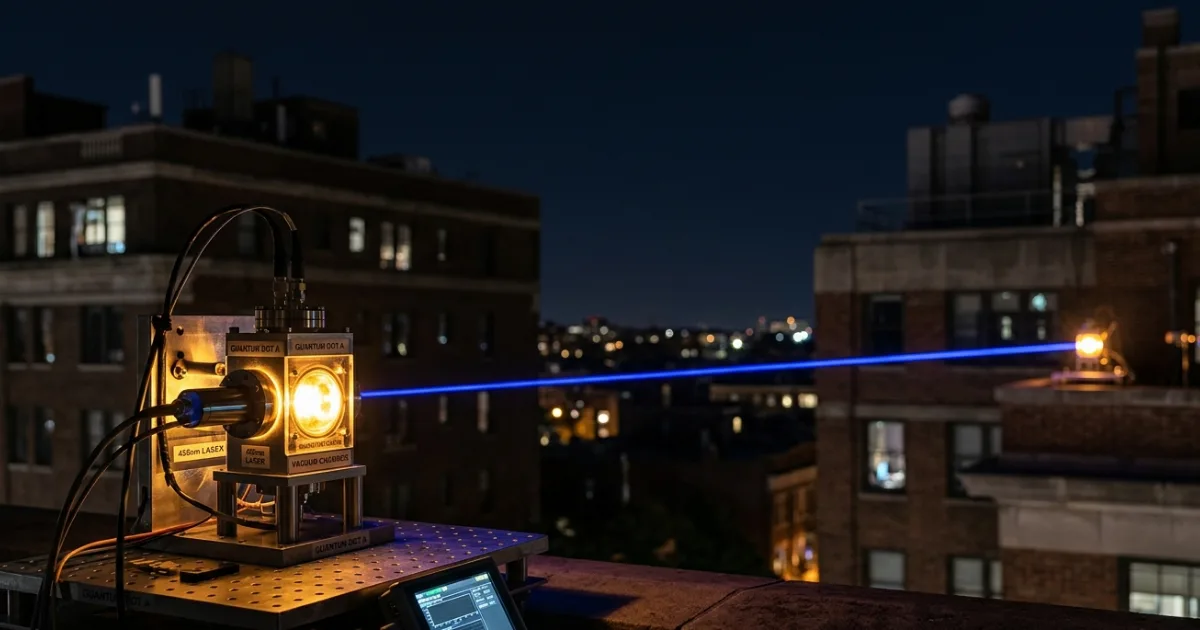
In This Article
- Ten Years in the Making — What Scientists Actually Did
- Why One Photon Source Was Never Going to Be Enough
- How Did They Transfer a Quantum State Across 270 Metres?
- What This Unlocks for Secure Communication — Including in India
- The Questions That Still Need Answering
Quantum teleportation sounds like science fiction. Photons disappearing in one place and reappearing somewhere else, carrying information that is — by the laws of physics — impossible to intercept without detection. Scientists have been chasing this for decades. On April 30, 2026, a team from Paderborn University, Sapienza University of Rome, and several other European institutions announced they had done it between two entirely separate quantum devices — for the very first time.
Ten Years in the Making — What Scientists Actually Did
Here's the key detail that makes this different from everything before it. Previous quantum teleportation experiments worked, but they cheated a little — both photons involved in the transfer always came from the same source. That's a bit like saying two phones can communicate, but only if they share a battery. Useful for the lab. Not useful for building a real network.
The team around Professor Klaus Jöns at Paderborn and Professor Rinaldo Trotta at Sapienza started planning this experiment roughly ten years ago. They wanted to show that teleportation could work between two completely independent quantum dots — tiny semiconductor structures that produce single photons almost on demand. Getting those two independent sources to produce photons compatible enough to interact and transfer quantum information is extraordinarily hard. The photons have to be indistinguishable from each other, even though they were created in separate devices.
Why One Photon Source Was Never Going to Be Enough
To understand why using two separate sources is such a jump, consider what quantum teleportation actually requires. You need quantum entanglement — a state where two particles share properties so completely that measuring one instantly affects the other, regardless of distance. For a real quantum network, different nodes across a city — or a country — each need their own light source. Those independent sources must produce photons that are quantum-mechanically compatible. Get it wrong by even a tiny amount of frequency or timing, and the whole thing collapses.
Until now, no one had managed to pull that off between two genuinely distinct quantum dot devices. Researchers at Johannes Kepler University Linz engineered the quantum dots with extreme precision, while partners at the University of Würzburg handled the nanofabrication of the resonator structures. The assembly of the right materials, fabricated to the right tolerances, took years of iteration.
How Did They Transfer a Quantum State Across 270 Metres?
The actual experiment took place between two buildings at Sapienza University in Rome. A 270-metre free-space optical link — basically, a beam of quantum light travelling through open air — connected the two quantum dot systems. Free-space transmission is notably harder than fibre optic, because the atmosphere moves. Wind, temperature changes, even tiny vibrations can knock photons off course or introduce timing errors that destroy quantum coherence.
To handle that, the team used GPS-assisted synchronisation to keep both systems ticking in precise unison, ultra-fast single photon detectors to catch the fragile signals, and active stabilisation methods to compensate for atmospheric turbulence in real time. The result: a teleportation fidelity of 82 ± 1%. That's the measure of how accurately the quantum state was preserved during transfer. Anything above 50% beats what classical physics can achieve. Beating it by more than ten standard deviations — as this experiment did — leaves no doubt that genuine quantum teleportation occurred.
"The combination of excellent materials science, nanofabrication and optical quantum technology was the key to our success."
— Prof. Klaus Jöns, Paderborn University · Nature Communications, 2025What This Unlocks for Secure Communication — Including in India
The practical consequence worth paying attention to: this result is a direct proof of concept for a quantum relay. A relay is the quantum equivalent of a signal booster — it extends a quantum network across distances that would otherwise be impossible. Without relays, quantum communication is limited by how far a single photon can travel without degrading, which is not very far at all through standard optical fibre.
With relays built from quantum dot pairs like the ones in this experiment, you could in theory chain together a network of nodes across a city, a country, or eventually between continents. Any message sent through such a network would be physically impossible to eavesdrop on without leaving a detectable trace — a guarantee that no conventional encryption system can make.
For India, the stakes are significant. The country has been investing in quantum technology through its National Quantum Mission, with ₹6,003 crore committed through 2031. Research institutions including IISc Bangalore and TIFR Mumbai are actively working on quantum communication. This European result sets a clear experimental benchmark for what those programmes need to match and build upon.
The Questions That Still Need Answering
None of this is ready to be deployed as infrastructure tomorrow. The 270-metre link is a carefully controlled experiment, not a battle-hardened system running through a city's messy electromagnetic environment. Scaling the fidelity and distance simultaneously — while keeping the hardware small and economical enough to replicate hundreds of times across a real network — remains an open engineering challenge of considerable size.
The immediate next step for the Paderborn-Rome collaboration is entanglement swapping — linking two separate quantum dot pairs so that particles that have never interacted become entangled through an intermediary. That would constitute the first true quantum relay using deterministic photon sources. Getting there could take another few years of painstaking refinement. But ten years ago, what they just achieved was also considered out of reach.
- Two sources, not one — For the first time, quantum teleportation was demonstrated between genuinely independent devices, a requirement for any real-world quantum network.
- 82% fidelity over open air — The result exceeded classical limits by more than ten standard deviations across a 270-metre free-space link, proving the method is robust enough to survive real atmospheric conditions.
- Quantum relays are now closer — The next target is entanglement swapping between two quantum dot pairs, which would create the first functional quantum relay using on-demand photon sources.
"Successful quantum teleportation between two independent quantum emitters represents a vital step towards scalable quantum relays and thus the practical implementation of a quantum internet." — Prof. Klaus Jöns, Paderborn University · Nature Communications, 2025.
📄 Source & Citation
Primary Source: Laneve A, Ronco G, Beccaceci M, et al. (2025). Quantum teleportation with dissimilar quantum dots over a hybrid quantum network. Nature Communications, 16(1). https://doi.org/10.1038/s41467-025-65911-9
Authors & Affiliations: Alessandro Laneve, Giuseppe Ronco, et al. — Sapienza University of Rome (Italy), Universität Paderborn (Germany), Johannes Kepler University Linz (Austria), University of Würzburg (Germany)
Data & Code: Supplementary data available via the Nature Communications online portal at the DOI link above.
Key Themes: Quantum Teleportation · Quantum Internet · Photonic Entanglement · Semiconductor Quantum Dots · Quantum Communication Networks
Supporting References:
[1] Rozpędek F et al. (2019). Near-term quantum-repeater experiments with nitrogen-vacancy centers. Physical Review A, 99(5):052330.
[2] Wehner S, Elkouss D, Hanson R. (2018). Quantum internet: A vision for the road ahead. Science, 362(6412):eaam9288.
[3] Tomm N et al. (2021). A bright and fast source of coherent single photons. Nature Nanotechnology, 16, 399–403.
No comments yet. Be the first to share your thoughts.
Leave a Comment