 Krishan Gopal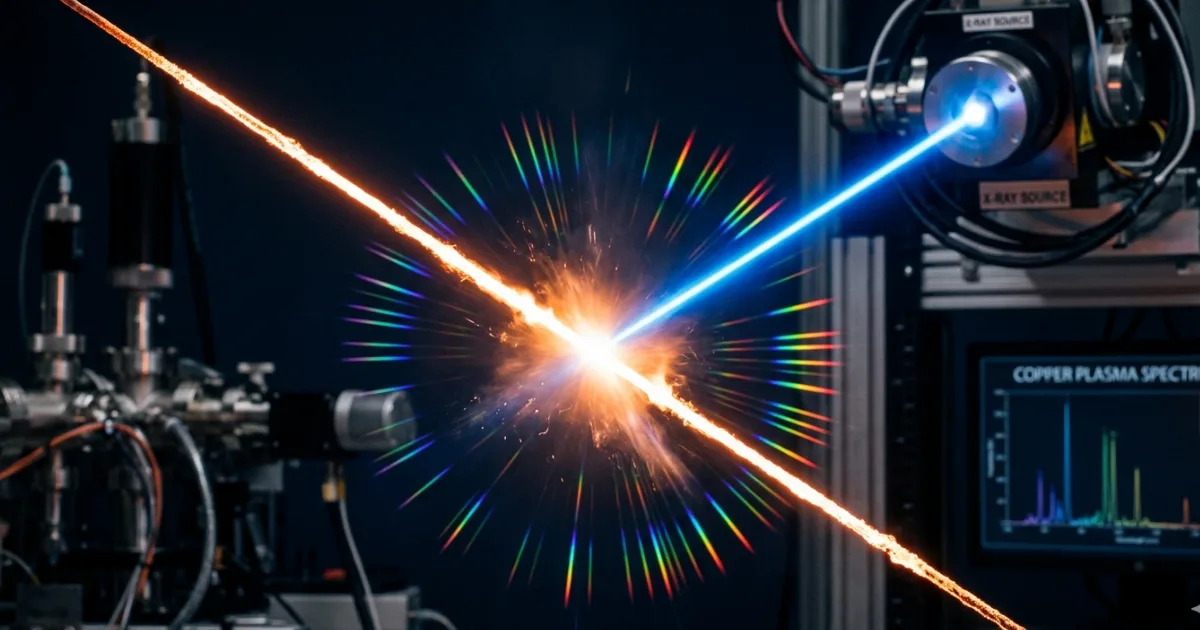
In This Article
- The Problem Nobody Could Actually Measure
- Why Old Diagnostic Tools Kept Falling Short
- How Did Scientists Finally Capture These Ultrafast Plasma Dynamics?
- What the Results Actually Showed — and Why It Surprised Them
- What This Means for Fusion Energy Research
Take a copper wire, thinner than a strand of hair, and blast it with a laser so powerful it rips electrons clean off atoms — all in 30 femtoseconds. That's 30 millionths of a billionth of a second. Now the real question: can you actually watch what happens next, in real time, at the atomic level? A team of researchers from Helmholtz-Zentrum Dresden-Rossendorf and the European XFEL just proved you can — and what they saw is already rewriting the playbook for plasma physics and fusion energy research.
The Problem Nobody Could Actually Measure
When a high-powered laser hits a solid material, it instantly creates what physicists call a "solid-density plasma" — a state of matter so hot and so densely packed that it doesn't behave like anything in everyday life. Electrons get stripped from atoms, ions get charged to extreme levels, and the whole thing evolves in picoseconds. That's a trillionth of a second. Fast.
The catch? Nobody had a good way to actually watch this happen. Previous diagnostic tools — including X-ray streak cameras — could only manage a time resolution of about 1 picosecond. That's like trying to film a hummingbird's wings with a camera from the 1980s. You'd see a blur, not a wingbeat. The heating and ionization dynamics that matter most in laser-plasma physics happen in that blurry, unresolved window.
Why Old Diagnostic Tools Kept Falling Short
For decades, scientists studying laser-plasma interactions have relied on X-ray emission spectroscopy — essentially listening to the light a hot plasma emits and reading its temperature and ion charge states from the spectrum. Useful, but time-integrated. You get a snapshot of the whole event averaged together, not a frame-by-frame record.
Simulations filled in the gaps, but they had a dirty secret. Most computer models assumed the laser had a perfect Gaussian beam profile — a neat, symmetrical focus with all the energy in the centre. In reality, the ReLaX laser at the European XFEL puts only 44% of its energy into that central spot. The rest spills out. That difference, it turns out, is enormous. Run the simulation with the wrong laser intensity, and your plasma temperature comes out three to six times too high.
How Did Scientists Finally Capture These Ultrafast Plasma Dynamics?
Here's the interesting part. The team tuned the European XFEL — a facility that fires roughly a trillion photons per pulse — to exactly 8.2 keV. That's a very specific photon energy. Why? Because at that energy, the X-ray beam resonates with a single, highly charged copper ion: Cu²²⁺. Think of it like a tuning fork that only vibrates when the exact right note is played.
When the optical laser creates enough plasma heat to produce Cu²²⁺ ions, the XFEL beam literally lights them up. Electrons in those ions absorb the X-ray and jump to a higher energy level, then fall back down — releasing a bright flash of resonant X-ray emission. By varying the delay between the optical laser pulse and the XFEL probe pulse, the team built a frame-by-frame picture of how the ion population changed over time. They also measured X-ray absorption simultaneously, giving two independent windows into the same process at once.
No previous experiment had achieved both charge-state-selective resonant absorption and emission in a transient, solid-density plasma at the same time. That's the genuine novelty here.
"A realistic peak laser intensity, together with appropriate preplasma conditions, is essential for simulations incorporating non-equilibrium collisional processes to reproduce experimentally observed plasma dynamics."
— Huang et al., Helmholtz-Zentrum Dresden-Rossendorf · Nature Communications, 2026What the Results Actually Showed — and Why It Surprised Them
The resonant X-ray emission — the signal that tracks Cu²²⁺ ions specifically — became visible just 0.5 picoseconds after the laser pulse. It peaked sharply at 2.5 picoseconds, then faded over the next 10 picoseconds. That timing tells scientists the plasma stayed above 500 eV in temperature for nearly 10 picoseconds — hot enough to sustain that specific ion charge state — before cooling began.
What surprised the team was how localised the ionisation was. The Cu²²⁺ ions didn't spread through the whole wire. They were confined to a thin shell — about 1.5 micrometres — right at the front surface where the laser first hit. The wire geometry actually helped here: in a wire target, hot electrons are trapped more tightly than in a flat foil, so heating is more concentrated.
And the computer models? The standard simulations — assuming an idealised laser beam and simple pre-plasma conditions — overestimated the surface temperature by more than five times. Only when the team fed in the actual measured laser profile, along with a pre-plasma density profile from separate magnetohydrodynamics (MHD) simulations, did the numbers match what the experiment saw.
What This Means for Fusion Energy Research
Plasma physics at this scale isn't just an academic exercise. The same processes being studied here — electron transport, rapid ionisation, heat distribution — are directly relevant to inertial confinement fusion (ICF), the approach to fusion energy where a tiny fuel pellet is crushed by powerful lasers from all sides until it ignites. ICF programs in the US, Europe, and increasingly in China and India are all betting heavily on understanding these dynamics better.
Right now, the biggest gap isn't just building a powerful enough laser. It's understanding exactly what the plasma is doing in the nanoseconds during and after ignition. Get the model wrong, and your fuel capsule behaves differently than you predicted. The new diagnostic platform developed in this study — resonant X-ray emission combined with simultaneous absorption imaging — is a direct step toward closing that gap.
The team also notes that the technique can be extended. Thicker targets, layered targets, different elements — all could be probed with the same resonant approach, provided you pick the right XFEL photon energy for the charge state you want to track. That kind of flexibility is exactly what large-scale fusion experiments need.
- Models need real laser data — Computer simulations that assume a perfect Gaussian laser beam can overestimate plasma heating by a factor of five or more, making experimental validation essential.
- Wire targets outperform flat foils — The cylindrical geometry confines hot electrons more tightly, producing cleaner, more localised ionisation data that's easier to interpret and reproduce.
- Two diagnostics beat one — Measuring resonant emission and X-ray transmission simultaneously provides independent cross-checks that neither method alone can offer, opening the door to more reliable plasma characterisation.
"This work is of broad interest to the high energy density and ICF communities, both as an experimental platform for accessing theoretically challenging conditions and as a benchmark for improving models of high-power laser–plasma interactions." — Huang et al., Nature Communications, 2026.
📄 Source & Citation
Primary Source: Huang L, Mishchenko M, Šmíd M, et al. (2026). Probing ultrafast heating and ionization dynamics in solid density plasmas with time-resolved resonant X-ray absorption and emission. Nature Communications. https://doi.org/10.1038/s41467-026-71429-5
Authors & Affiliations: Lingen Huang (Helmholtz-Zentrum Dresden-Rossendorf; TU Dresden) and 35 co-authors from the European XFEL, DESY, Universität Siegen, ELI Beamlines, and the National Institute for Fusion Sciences, Japan.
Data & Code: Experimental data available at the EuXFEL repository (HED 3129) after embargo. Simulation source data at the Rossendorf data repository (RODARE). PIC code PICLS available upon request.
Key Themes: Solid-density plasma · Ultrafast ionization · X-ray free-electron laser · Inertial fusion energy · Particle-in-cell simulation
Supporting References:
[1] Sawada H et al. (2024). Spatiotemporal dynamics of fast electron heating in solid-density matter via XFEL. Nature Communications, 15(1).
[2] Humphries OS et al. (2020). Time evolution of transient plasma states from nanowire arrays irradiated at relativistic intensities. Communications Physics, 3(1).
[3] Berg QY et al. (2018). Clocking femtosecond collisional dynamics via resonant X-ray spectroscopy. Physical Review Letters, 120, 055002.
No comments yet. Be the first to share your thoughts.
Leave a Comment