 Sanjay Verma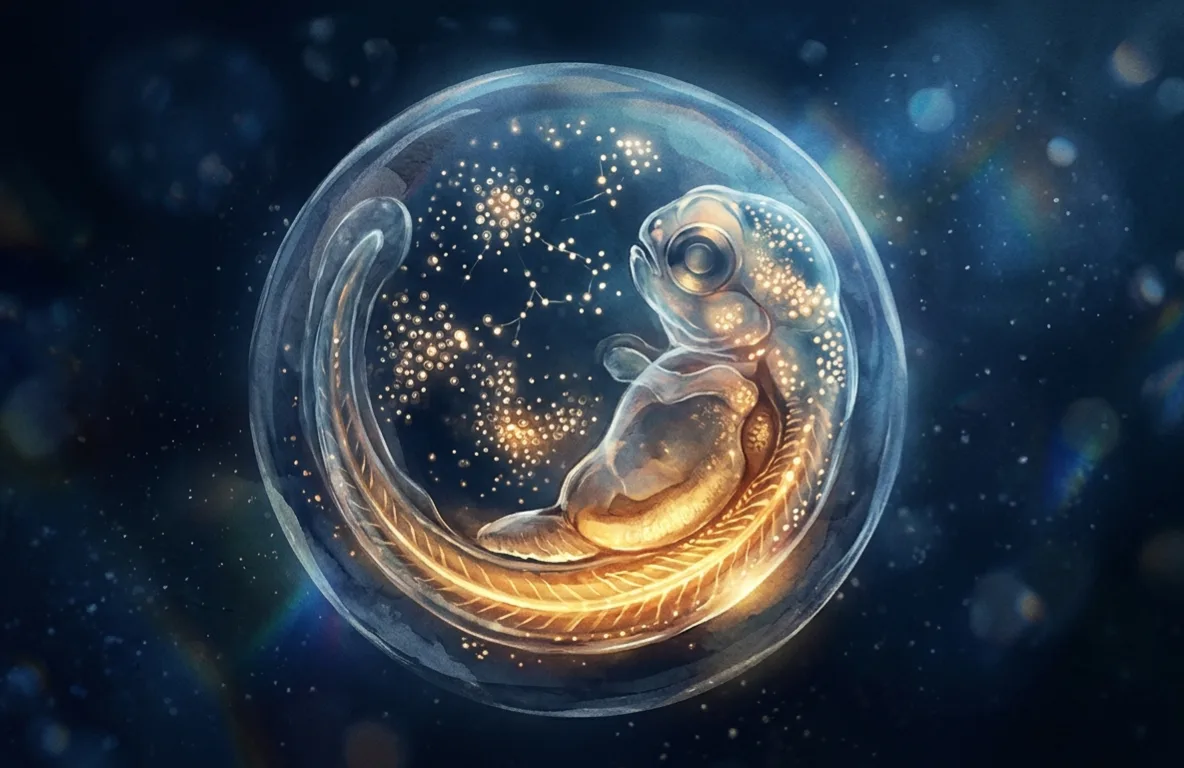
In This Article
- A Tiny Fish With a Big Secret
- The Soft-to-Hard Jelly Trick
- How Do Cells Know What to Become?
- Why This Discovery Excites Doctors
- What Scientists Want to Try Next
Drop a zebrafish egg under a microscope and you can watch a wonder unfold. In just a few hours, a tiny ball of soft cells turns into a fish with a head, a tail, muscles, and a heart that beats. For a long time, scientists knew the cells were chatting with chemical messages. What they did not know is that the tissue itself was changing shape and stiffness, almost like jelly turning into firm jelly, to help the message land in the right place at the right time.
A Tiny Fish With a Big Secret
Zebrafish are one of the most-loved animals in science labs. Their eggs are as clear as glass, so scientists at the European Molecular Biology Laboratory in Germany can watch every cell move and grow live, without cutting the fish open. A team led by Nicoletta Petridou spent months filming baby fish and running computer models of their cells. They wanted to crack a puzzle that has bothered biologists for years. How does a soft blob of cells know to make muscle here, gut there, and skin somewhere else, all at the same time?
The Soft-to-Hard Jelly Trick
At the start, the baby fish looks like a soft bowl of jelly. The cells float loosely with tiny gaps of water between them. Then something amazing happens. In one part of the embryo, the cells suddenly stick together much more tightly. The water gaps close. The soft jelly turns into firm jelly, all in less than an hour. This is called a rigidity transition, and it does not just change how the tissue feels. It changes what the cells inside can do, and even what they can hear from each other.
How Do Cells Know What to Become?
Inside the soft jelly, the cells send each other a chemical message called Nodal. Think of Nodal as a tiny whisper that says, "you become a muscle, you become a gut." But here is the clever part. The Nodal whisper travels through the water gaps between cells. When the cells stick together tightly and shut those gaps, the whisper cannot travel far anymore. It stops right where it needs to. At the same time, the cells use that quick moment to make another message called Lefty that switches Nodal off. So the body tells itself, very gently, "okay, that is enough now, time to stop."
"Cells do not just listen to chemical signals. They feel each other too. The shape and the message work together to build a baby step by step."
— Nicoletta Petridou, EMBL Heidelberg · Nature Cell Biology, 2026Why This Discovery Excites Doctors
This finding is more than a cute story about fish. The same rules work in human babies too, since all animals with backbones share these very old building tools. When the system goes wrong, body parts can grow in the wrong place. To prove their idea, the team turned the tissue soft on purpose using a special light trick called optogenetics, which lets scientists switch cell parts on and off with a flash of blue light. When the tissue stayed too soft, the Nodal whisper traveled too far and the wrong cells got the message. When the team made the tissue firm again, everything went back to normal. That proved the stiffening is doing real work, not just sitting in the background.
What Scientists Want to Try Next
The Petridou team now wants to know if the same soft-to-hard trick happens in other animals, including human embryos grown safely in lab dishes for study. They also want to ask if the trick can be copied to grow simple body parts, called organoids, that doctors can use for testing new medicines. The bigger lesson is a beautiful one. A baby fish is not a recipe that follows fixed steps. It is more like a conversation, where the shape of the tissue and the chemical messages keep replying to each other until a perfect little body is built. Next time you see a fish dart through water, remember: it started life as a tiny bowl of jelly that learned, on its own, how to firm up at just the right time.
- Tissue can change feel: A baby fish's soft jelly can stiffen in under an hour, all on its own.
- Stiffness shapes the message: When the tissue gets firm, the chemical signal that builds body parts cannot travel as far.
- Body parts grow on time: The trick makes sure the right cells become the right body parts, at the right moment.
"This work uncovers a multiscale mechanism by which positional information and tissue material properties dynamically tune one another." — Autorino, Khoromskaia et al., Nature Cell Biology, 2026.
📄 Source & Citation
Primary Source: Autorino, C., Khoromskaia, D., Harari, L., Floris, E., Booth, H., Pallares-Cartes, C., Petrasiunaite, V., Dorrity, M., Corominas-Murtra, B., Hadjivasiliou, Z., & Petridou, N. I. (2026). Tissue rigidity phase transition shapes morphogen gradients. Nature Cell Biology. https://doi.org/10.1038/s41556-026-01954-4
Authors & Affiliations: Nicoletta Petridou (European Molecular Biology Laboratory, Heidelberg, Germany) with co-leads at the Francis Crick Institute (London), University College London, University of Münster, and the University of Graz (Austria).
Data & Code: Cell sequencing data is open at NCBI GEO under accession GSE299074. Computer models are available on Zenodo at https://doi.org/10.5281/zenodo.18978110.
Key Themes: Embryo Development · Zebrafish · Nodal Signal · Tissue Mechanics · Cell Biology
Supporting References:
[1] Petridou, N. I. et al. (2019). Fluidization-mediated tissue spreading by mitotic cell rounding and non-canonical Wnt signalling. Nature Cell Biology, 21:169–178.
[2] Müller, P. et al. (2012). Differential diffusivity of Nodal and Lefty underlies a reaction-diffusion patterning system. Science, 336:721.
[3] Mongera, A. et al. (2018). A fluid-to-solid jamming transition underlies vertebrate body axis elongation. Nature, 561:401–405.
No comments yet. Be the first to share your thoughts.
Leave a Comment