 Krishan Gopal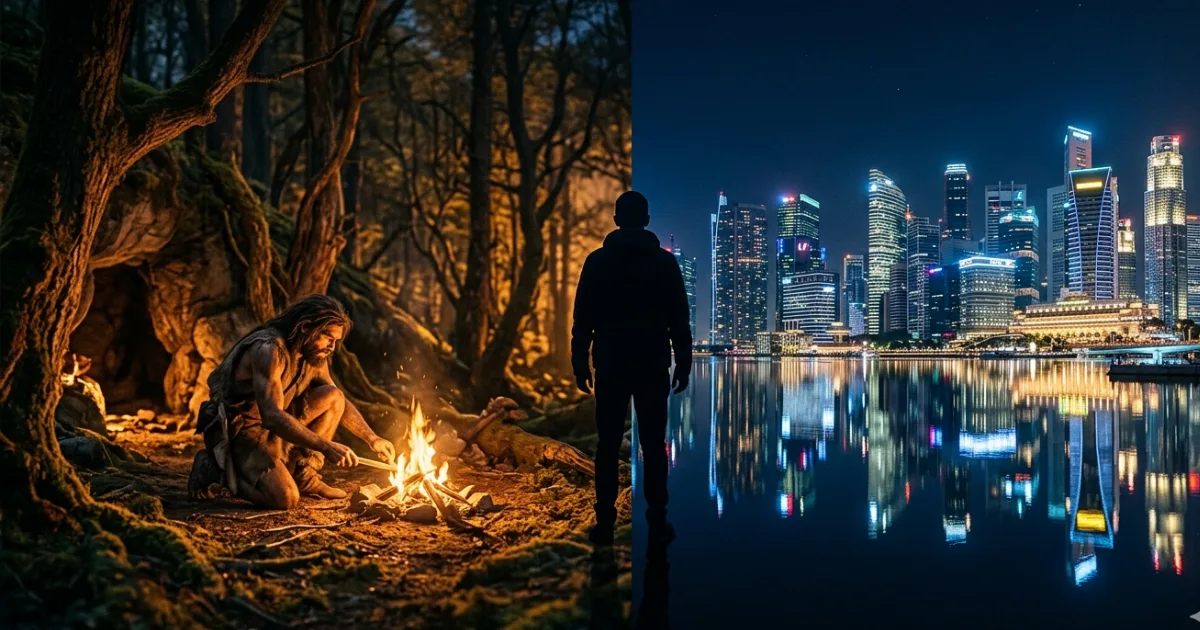
In This Article
- This Didn't Start With Coal Mines
- The Feedback Loop That Changed Everything
- Why Do Crisis Messages Fail to Move People to Act?
- What This Means for You — and for India
- The Questions Scientists Are Still Wrestling With
Every time there's a flood, a wildfire, or a record-breaking summer, someone says it: "This is what climate change looks like." They're right. But according to a 2023 paper published in Philosophical Transactions of the Royal Society B, we've been doing this — reshaping Earth — for a very long time. The crisis isn't a modern accident. And neither, argues ecologist Erle C. Ellis of the University of Maryland, is the solution.
This Didn't Start With Coal Mines
Here's something that doesn't get said enough: climate change and biodiversity loss didn't start with the Industrial Revolution. They started with fire.
Hunter-gatherers burning land to flush out prey. Early farmers clearing forests to plant wheat. Herders moving livestock across ancient grasslands. All of it, over thousands of years, quietly reshaping the planet. Ellis calls this "sociocultural niche construction" — a fancy phrase for something very simple: humans building the world they want to live in, generation after generation.
What's different today isn't that humans are changing nature. It's the speed and the scale. And that's where things get complicated.
The Feedback Loop That Changed Everything
Ellis introduces an idea he calls "runaway sociocultural niche construction," and once you understand it, you start seeing it everywhere.
It works like this. A human group starts doing something new — say, keeping dairy cattle. That gives them access to milk, which is a big nutritional advantage. Over generations, the people who can digest milk as adults survive better. So the trait spreads. Now more people are keeping cattle. More cattle means more land cleared for grazing. More grazing means more ecological change. And so the loop keeps going, each turn of the wheel pulling society toward more complexity, more resource use, and bigger environmental footprints.
This wasn't a plan. Nobody decided to kick off the Anthropocene. It just kept compounding.
That last number is wild when you sit with it. Humans and their farm animals now make up more than 90% of all mammal biomass on Earth. Wild mammals — lions, elephants, wolves, deer — account for less than 10%. That's not a footnote. That's the entire story of the Anthropocene in a single stat.
Why Do Crisis Messages Fail to Move People to Act?
This is the part of Ellis's paper that really stands out — and it cuts against a lot of mainstream environmental messaging.
Think about how climate change is usually talked about. Tipping points. Planetary boundaries. "We have 12 years to act." The language is almost always about limits, danger, and catastrophe. And yet — global emissions are still rising. Biodiversity is still declining. Why?
Ellis argues it's partly because crisis narratives, especially abstract ones tied to numbers people can't personally experience, tend to produce anxiety more than action. Worse, when these messages mostly come from elite institutions — international bodies, wealthy-country scientists, big NGOs — they can feel distant and even alienating to the billions of people who are focused on feeding their families and getting ahead in life.
"To harness the social superpowers of human aspirations, the long-term successes of extended kinship relationships should be seen as foundational."
— Ellis, University of Maryland · Philosophical Transactions of the Royal Society B, 2023The alternative? Lead with aspiration. Throughout history, the things that actually moved large societies to change were shared visions of a better life — not warnings about what would be lost. Ellis points to things like the Montreal Protocol (which fixed the ozone hole) and the green revolution in agriculture as examples of humans deploying their sociocultural capabilities for good — when enough people believed the outcome was worth wanting.
The capability already exists. That's Ellis's core argument. The question is whether societies can find the shared aspiration to use it.
What This Means for You — and for India
India sits at a fascinating crossroads in this story. On one side: rapid urbanisation, growing energy demand, an agricultural sector under pressure, and a young population that is — entirely reasonably — aspiring to higher living standards. On the other: some of the world's most biodiverse landscapes, a rich tradition of ecological stewardship, and a front-row seat to the consequences of a warming planet, from erratic monsoons to extreme heat events in cities like Delhi and Ahmedabad.
Ellis's framework suggests India's path forward isn't about choosing between development and environment. It's about recognising that the two are entangled — and always have been. The sociocultural capabilities already exist: solar technology, regenerative farming techniques, community water management, urban green infrastructure. The missing ingredient, Ellis would argue, is a widely shared aspirational story about what Indian society wants to become.
That's not a soft, feel-good observation. It's a structural one. Large-scale societal change, the paper argues, has only ever happened when societies collectively decided it was worth wanting.
The Questions Scientists Are Still Wrestling With
Ellis is careful not to oversell this. Aspirational narratives alone won't refreeze glaciers or bring back extinct species. And there are real tensions in his framework that haven't been resolved. Who gets to define the shared aspiration? Historically, it's been elites — and elites have frequently shaped narratives that served their interests, not everyone else's. The paper acknowledges this honestly: the same runaway processes that are causing planetary harm have also lifted billions out of poverty.
What Ellis calls for isn't a single global story, but a plurality of aspirational narratives rooted in specific cultures, places, and peoples — including Indigenous communities whose land stewardship practices have sustained ecosystems for centuries. It also means being honest that "stabilising" existing inequalities under the banner of sustainability isn't good enough. Meaningful change, as the paper notes, has historically only come through struggle.
The science of how to actually redirect a runaway civilisational process at planetary scale is, to put it mildly, still in its early stages. But Ellis makes a case worth taking seriously: that the story we tell about our future shapes the future itself.
- Crisis framing has limits — Abstract warnings about planetary tipping points tend to produce anxiety rather than sustained collective action, especially when people feel they can't personally change the outcome.
- The capability already exists — From solar power to regenerative agriculture, the tools to build a better Anthropocene are already developed; what's missing is widespread societal will to deploy them.
- Aspiration is a force of nature — Throughout history, the most transformative changes in how human societies relate to their environment have been driven by shared visions of a better life, not just fear of what comes next.
"The sociocultural capabilities to shape a far better future for people and nature already exist. The time has come to put the focus where it belongs — on our shared aspirations for a better future." — Ellis, Philosophical Transactions of the Royal Society B, 2023.
📄 Source & Citation
Primary Source: Ellis EC. (2023). The Anthropocene condition: evolving through social–ecological transformations. Philosophical Transactions of the Royal Society B, 379: 20220255. https://doi.org/10.1098/rstb.2022.0255
Authors & Affiliations: Erle C. Ellis — Department of Geography & Environmental Systems, University of Maryland Baltimore County; Oxford Martin School, University of Oxford; Leverhulme Centre for Nature Recovery, University of Oxford.
Data & Code: No supplementary datasets. Full paper freely available via Royal Society open access under Creative Commons Attribution Licence (CC BY 4.0).
Key Themes: Anthropocene · Sociocultural Evolution · Niche Construction · Environmental Messaging · Sustainability Transformations
Supporting References:
[1] Ellis EC. (2015). Ecology in an anthropogenic biosphere. Ecological Monographs, 85(3):287–331.
[2] Rendell L, Fogarty L, Laland KN. (2011). Runaway cultural niche construction. Phil. Trans. R. Soc. B, 366:823–835.
[3] Ellis EC et al. (2021). People have shaped most of terrestrial nature for at least 12,000 years. Proc. Natl Acad. Sci. USA, 118, e2023483118.
No comments yet. Be the first to share your thoughts.
Leave a Comment