 Sanjay Verma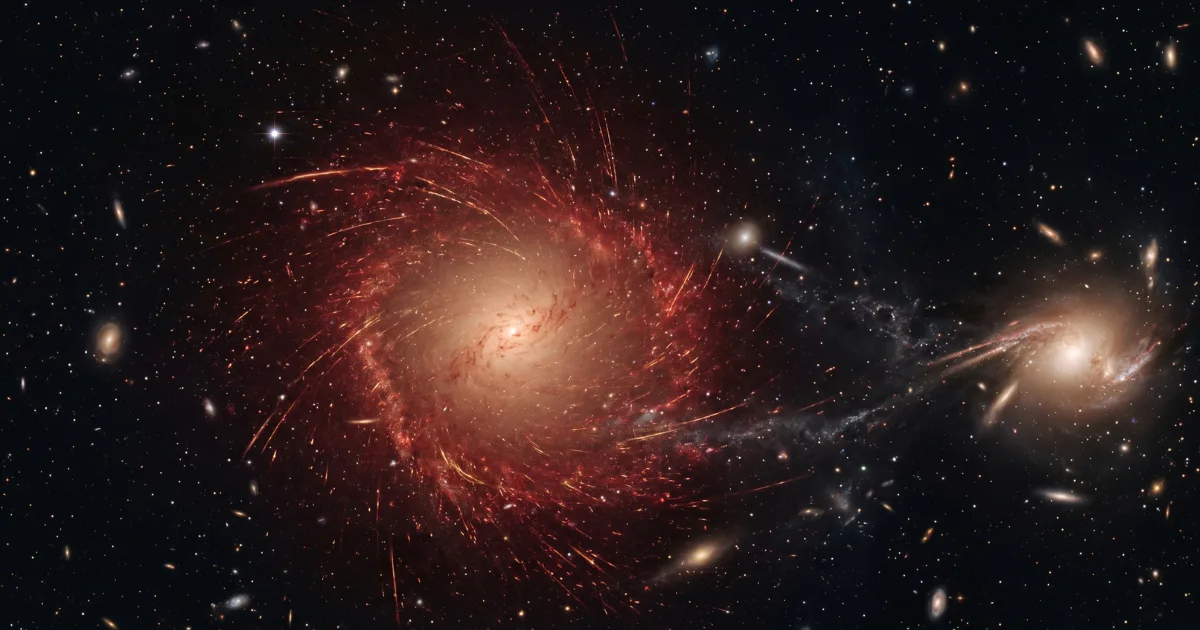
In This Article
- The Galaxy That Should Not Exist Yet
- Why Every Galaxy Is Supposed to Spin
- What Webb Saw That Keck Could Not
- What Could Have Killed This Galaxy's Rotation
- What It Means for Our Models of the Universe
Throw a ball of clay into the air and it spins. Pour water down a drain and it spirals. When enough gas and dust collapses under gravity to form a galaxy, the same physics applies — it spins too. That is not a theory waiting to be tested. It is one of the most fundamental predictions in cosmology. Which is why the galaxy XMM-VID1-2075, spotted by the James Webb Space Telescope in the ancient universe, has left astronomers genuinely unsettled. It is not spinning at all.
The Galaxy That Should Not Exist Yet
XMM-VID1-2075 existed when the universe was less than 2 billion years old — a cosmic infant by any measure. Yet it already contained several times as many stars as our entire Milky Way, and it had already stopped forming new ones. Both of those facts alone would make it unusual. But the finding that stopped researchers in their tracks was simpler: the galaxy shows no rotation whatsoever.
Lead author Ben Forrest, a research scientist at the University of California, Davis, described the discovery with a directness that reflects just how unexpected it was. "This one in particular did not show any evidence of rotation, which was surprising and very interesting," Forrest said.
Non-rotating galaxies — what astronomers call slow rotators — do exist. But they are found among the oldest, most evolved galaxies in the nearby universe, systems that have spent billions of years grinding through collision after collision until all their organised motion cancelled out. Finding one this fully formed, this early, breaks the expected timeline by a wide margin.
Why Every Galaxy Is Supposed to Spin
Picture a figure skater pulling their arms inward mid-spin and accelerating. That same principle — conservation of angular momentum — applies to galaxies. As gas and dust collapse under gravity during a galaxy's formation, any slight initial rotation gets amplified, setting the entire system spinning. The physics is so reliable that a galaxy not spinning is a bit like a top that falls up.
Over billions of years, galaxies in dense clusters do collide and merge. When two galaxies hit each other at complementary angles, their rotations can partially cancel. Enough mergers, over enough time, can reduce a spinning galaxy to a chaotic tangle of randomly moving stars. Current models predict this process is slow — it requires the accumulated effect of many interactions across cosmic timescales.
XMM-VID1-2075 had not had that time. The universe around it was barely getting started. The question the research team is now trying to answer is what could have accelerated that process by billions of years — or whether the models themselves are missing something fundamental.
What Webb Saw That Keck Could Not
XMM-VID1-2075 was not a new discovery when the Webb observations were made. It had already been identified and catalogued by the W.M. Keck Observatory in Hawaii as part of the MAGAZ3NE survey — a programme dedicated to finding and characterising the most massive galaxies in the early universe. Keck had confirmed its size and confirmed it was no longer forming stars. That was already remarkable enough to flag it as a priority target for Webb follow-up.
What Keck could not do was measure how material moves inside it. High-redshift galaxies — those in the very distant, early universe — appear extremely small in the sky. Resolving their internal structure requires a combination of sensitivity and resolution that ground-based telescopes struggle to achieve at that distance. The James Webb Space Telescope, operating in space above Earth's atmosphere, changes that equation entirely.
The team observed three galaxies from the same cosmic era side by side. One rotated clearly. One showed irregular, disturbed structure. And the third — XMM-VID1-2075 — showed strong random stellar motion with no coherent rotation at all. Three galaxies, three different outcomes, all from the same period of cosmic history. The comparison made the non-rotating result impossible to dismiss as noise.
"James Webb Space Telescope is really pushing the frontier for these kinds of studies — it's very difficult to do with high redshift galaxies because they appear a lot smaller in the sky."
— Ben Forrest, UC Davis · Nature Astronomy, 2026What Could Have Killed This Galaxy's Rotation
The leading hypothesis does not require a long, slow history of many collisions. It requires just one — but a particularly catastrophic kind. If two large galaxies spinning in nearly opposite directions merged violently enough, their angular momenta could cancel almost completely, leaving behind a single massive system with stars ricocheting in every direction.
The observational evidence points in that direction. Forrest and his colleagues noticed a large excess of light positioned off to the side of XMM-VID1-2075 — a bright concentration that does not belong to the main galaxy body. "That's suggestive of some other object which has come in and is interacting with the system and potentially changing its dynamics," Forrest said.
Whether that companion is the culprit, a bystander, or a remnant of the collision that already happened remains an open question. What makes it scientifically significant is that it provides a testable mechanism — one that can be compared against computer simulations to see if a single major merger can produce what Webb observed.
What It Means for Our Models of the Universe
The immediate implication is a stress test for galaxy formation theory. Current simulations do predict that non-rotating galaxies can occasionally appear in the early universe — but they predict them to be exceptionally rare. Finding one in a sample of just three galaxies from that era is statistically uncomfortable. Either the team got very lucky, or slow rotators in the early universe are more common than the models expect.
The team is now searching for more. By building a larger sample of early-universe galaxies and comparing their internal motion patterns against cosmological simulations, researchers can begin to quantify how often this happens and what drives it. Each new detection either tightens or loosens the constraints on the models that describe how the universe evolved from a featureless sea of hot gas into the structured cosmos we observe today.
What the discovery of XMM-VID1-2075 ultimately demonstrates is that the early universe was capable of producing things we did not expect it to — not because the physics was different, but because the conditions allowed extreme events to happen faster than our models predicted. The universe, it turns out, did not read our textbooks. It is up to us to catch up.
- Zero rotation, maximum mass — Galaxy XMM-VID1-2075 is one of the most massive known objects from its era and yet shows none of the spin that mass and youth should produce together.
- A single collision may explain it — Researchers identified a bright companion object beside the galaxy, suggesting a major merger between two oppositely-spinning systems cancelled out all organised rotation in one violent event.
- Simulations need updating — Current models predict early non-rotators should be vanishingly rare. Finding one in a sample of three suggests the models may be underestimating how often extreme mergers occur in the young universe.
"There are some simulations that predict there will be a very small number of these non-rotating galaxies very early in the universe, but they expect them to be quite rare. This is one way in which we can test these simulations and really figure out how common they are." — Ben Forrest, UC Davis, Nature Astronomy, 2026.
📄 Source & Citation
Primary Source: Forrest, B., Muzzin, A., Marchesini, D., Pan, R., Ozden, N., Antwi-Danso, J., Chang, W., Cooper, M. C., Edward, A. H., Gomez, P., Kimmig, L., Lemaux, B. C., McConachie, I., Noble, A., Remus, R.-S., Urbano Stawinski, S. M., Wilson, G., & Wisz, M. E. (2026). A massive and evolved slow-rotating galaxy in the early Universe. Nature Astronomy. https://doi.org/10.1038/s41550-026-02855-0
Authors & Affiliations: Ben Forrest (UC Davis, lead); Adam Muzzin and Adit H. Edward (York University); Danilo Marchesini, Richard Pan, and Nehir Ozden (Tufts University); Jacqueline Antwi-Danso (University of Toronto); Brian C. Lemaux (UC Davis and Gemini Observatory); and collaborators from UC Riverside, UC Irvine, UC Merced, University of Wisconsin-Madison, Arizona State University, Ludwig-Maximilians-Universität München, and W.M. Keck Observatory. Supported by NASA, Space Telescope Science Institute, and the National Science Foundation.
Institutional Source: University of California, Davis. Original story by Andy Fell. Via ScienceDaily, May 7, 2026. https://www.sciencedaily.com/releases/2026/05/260506225135.htm
Key Themes: James Webb Space Telescope · Non-rotating galaxy · Slow rotator · Early universe · Galaxy formation · MAGAZ3NE survey · Angular momentum · Galactic mergers
Supporting References:
[1] van der Wel, A. et al. (2014). 3D-HST+CANDELS: the evolution of the galaxy size-mass distribution since z = 3. The Astrophysical Journal, 788(1), 28.
[2] Emsellem, E. et al. (2011). The ATLAS3D project — III. A census of the stellar angular momentum within the effective radius. Monthly Notices of the Royal Astronomical Society, 414(2), 888–912.
[3] Naab, T. et al. (2014). The ATLAS3D project — XXV. Two-dimensional kinematic analysis of simulated galaxies. Monthly Notices of the Royal Astronomical Society, 444(4), 3357–3387.
No comments yet. Be the first to share your thoughts.
Leave a Comment