 Krishan Gopal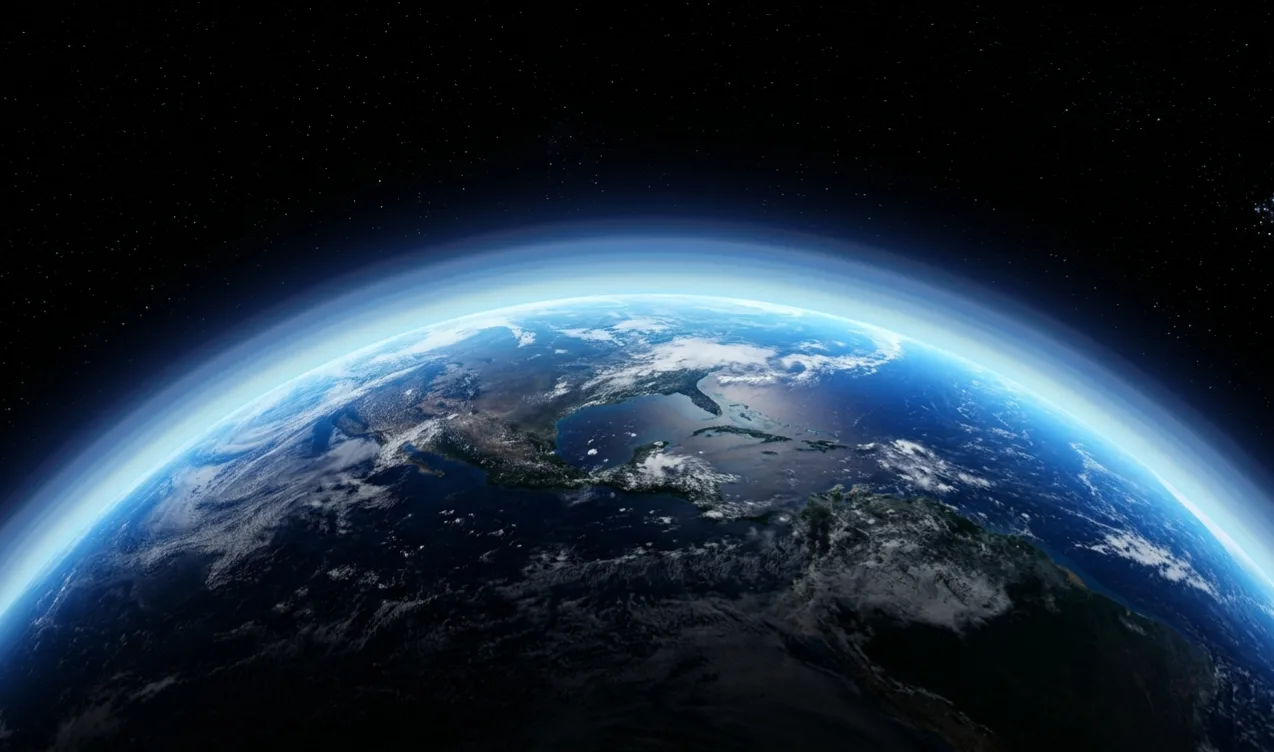
In This Article
- A Strange Split in the Sky
- How One Gas Does Two Opposite Jobs
- Why Is the Upper Atmosphere Cooling Instead of Warming?
- Why a Cold Sky Makes the Ground Warmer
- The Questions That Still Need Answering
Down here, the planet is heating up. But far above your head, the sky is doing the exact opposite, and it has been for decades. This puzzle, called upper atmosphere cooling, sounds impossible at first. It is also one of the clearest signs that humans are changing the climate, which is why one missing piece of the explanation mattered so much. A team has now filled that gap.
A Strange Split in the Sky
Picture Earth's air as a stack of layers. The bottom layer, where you breathe and where weather happens, is warming. We all know that as global warming.
But a layer far higher up, called the stratosphere, is cooling at the same time. Scientists call this split one of the clearest "fingerprints" of human-caused climate change. They could measure it for years. The strange part was that they could not fully explain the deep physics driving it.
So if one planet is warming low and cooling high, something clever must be going on in between.
How One Gas Does Two Opposite Jobs
The answer comes down to carbon dioxide, the gas we call CO2. Near the ground it works like a thick blanket, trapping heat that would otherwise escape and warming the surface.
High up in the thin stratosphere, the same gas flips its role. There it acts more like a radiator, soaking up heat from below and sending much of it straight out to space. Add more CO2, and that high layer gets even better at throwing heat away, so it cools.
This odd double behaviour was first predicted in the 1960s by Syukuro Manabe, whose early climate models later helped him win the Nobel Prize in Physics. Knowing it happens and knowing exactly how are two different things.
Why Is the Upper Atmosphere Cooling Instead of Warming?
Here is the short answer many readers would type straight into Google. The upper atmosphere is cooling because CO2 there releases heat to space faster than it traps it, and rising CO2 makes that release more efficient every year.
To pin down the details, lead researcher Sean Cohen and his colleagues built mathematical models of the cooling. They checked the models against real measurements and climate simulations, then refined the equations over months until the numbers matched reality. The work was published in Nature Geoscience in May 2026.
One factor stood out. It came down to a special band of infrared light, the invisible light that carries heat, which is extremely good at shedding warmth. The team nicknamed it the "Goldilocks zone." The detail surprised even the researchers behind the study: as CO2 builds up, that zone gets wider, and the sky gets steadily better at cooling itself.
"It explains a phenomenon that's a fingerprint of climate change, has been known to occur for decades, and has not been understood."
— Pincus, Columbia Climate School · Nature Geoscience, 2026Why a Cold Sky Makes the Ground Warmer
You might think a cooling sky is good news. It is not. The study uncovered a tricky twist that scientists call a feedback effect.
When the high stratosphere gets colder, the whole Earth ends up sending less heat out into space overall. Less heat leaving means more heat stays trapped down near the surface. So the cold sky high above is quietly helping to make the warming where you live even stronger.
So a small puzzle in Earth's temperature record has handed scientists a tool that reaches all the way to alien skies.
The Questions That Still Need Answering
The researchers are clear about what this study is and is not. It does not set out to prove climate change is real, since that is already well established. It fills in the missing "how" behind one important process.
Climate is also a vast web of linked effects. Clouds, oceans, and other gases all push and pull on temperature, and they stay hard to model perfectly. Long records help, including NASA satellite measurements of the upper atmosphere that have tracked this cooling for decades. The full picture is still being assembled.
- Two jobs, one gas — CO2 warms the surface like a blanket but cools the high stratosphere like a radiator.
- A widening Goldilocks zone — rising CO2 widens a band of heat-carrying light, making the sky better at shedding heat.
- A worrying feedback — the cooling high layer means Earth loses less heat to space, trapping more warmth near the ground.
"Here's this process that we've known about for 50-plus years. However, we didn't understand the details of what actually drove that process." — Sean Cohen, study lead author, Nature Geoscience, 2026.
For half a century, the cooling sky was a fact without a full story. Now it has one. It is a quiet reminder that even the things we think we already understand can still hold a deep surprise, waiting for someone patient enough to keep asking exactly how.
📄 Source & Citation
Primary Source: Cohen, S., Pincus, R. & Polvani, L.M. (2026). Stratospheric cooling and amplification of radiative forcing with rising carbon dioxide. Nature Geoscience, 19(5), 507. https://doi.org/10.1038/s41561-026-01965-8
Authors & Affiliations: Sean Cohen and Robert Pincus of the Lamont-Doherty Earth Observatory, Columbia Climate School, with Lorenzo M. Polvani of Columbia Engineering.
Data & Code: Model outputs and analysis details are provided with the paper and its supplementary materials via Nature Geoscience.
Key Themes: Upper atmosphere cooling · Stratospheric cooling · Carbon dioxide · Infrared radiation · Climate feedback
Supporting References:
[1] Manabe, S. & Wetherald, R.T. (1967). Thermal equilibrium of the atmosphere with a given distribution of relative humidity. Journal of the Atmospheric Sciences, 24(3):241–259.
[2] Bailey, S.M. et al. (2025). Long-term cooling and contraction of the mesosphere. Journal of Atmospheric and Solar-Terrestrial Physics.
[3] IPCC (2021). Climate Change 2021: The Physical Science Basis. Sixth Assessment Report.
No comments yet. Be the first to share your thoughts.
Leave a Comment