 Sanjay Verma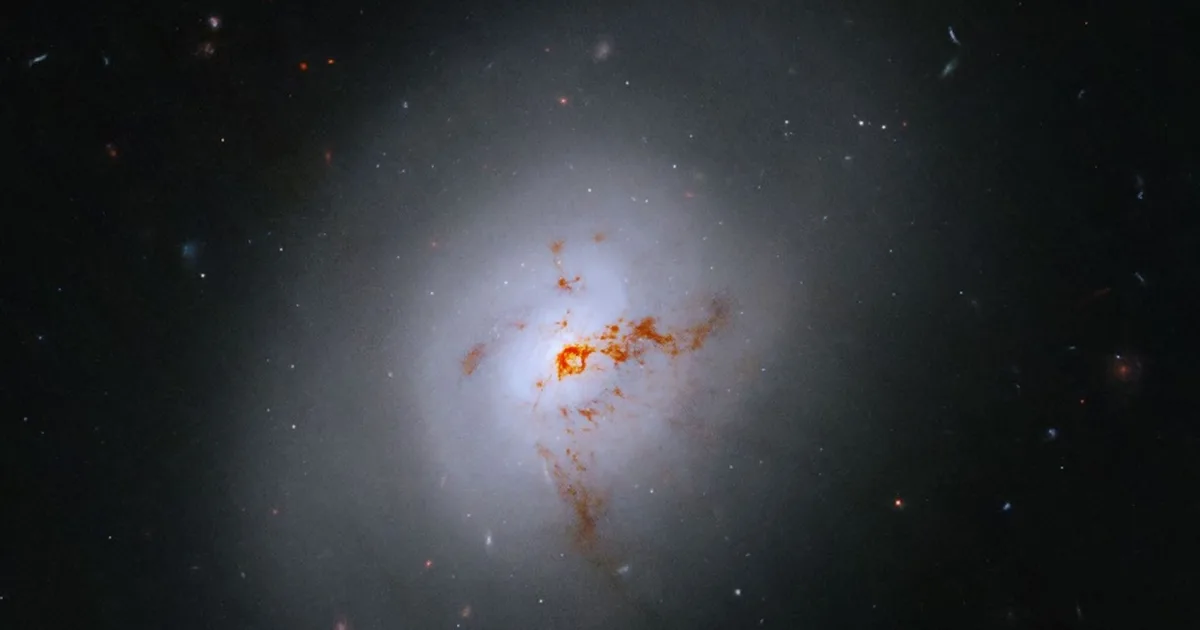
In This Article
- The Eye in the Dark Sky
- What Makes This Galaxy So Strange
- How Is a Black Hole Killing Off New Stars?
- A Galaxy in Transition, Caught Mid-Step
- Why This Tiny Dot in the Sky Matters
Picture a glowing eye floating in pitch-black space, with a soft brown veil drifting across its face. That is the new picture of NGC 1266, snapped by the Hubble Space Telescope and released by NASA this month. The galaxy sits about 100 million light-years from Earth. It is not quietly living its life. It is a galaxy in transition, slowly turning from one kind of galaxy into another while a hungry black hole inside it pulls the trigger.
The Eye in the Dark Sky
NGC 1266 lives in a part of the sky called Eridanus, which means "the Celestial River." From Earth we see it face-on, like looking down at a frisbee from above. Its centre glows brightly. The outer parts fade into a soft mist of light.
You can almost see swirling arms in the picture, the way spiral galaxies have. But look carefully and the arms vanish. They are only hints. Cutting across the face are rusty brown ribbons of dust, like coffee stains on a glowing dinner plate.
What Makes This Galaxy So Strange
Most galaxies fall into two big families. Spirals like our Milky Way are busy, full of swirling gas and new baby stars. Ellipticals are like retired old neighbourhoods, full of older stars and very little fresh gas. NGC 1266 is neither, which is why astronomers call it a galaxy in transition.
It belongs to a rare group called post-starburst galaxies. These galaxies just finished a giant baby boom of new stars. Then, suddenly, the baby boom ended. Now only about one in every hundred nearby galaxies looks like this.
How Is a Black Hole Killing Off New Stars?
About 500 million years ago, NGC 1266 bumped into a smaller galaxy and swallowed it. The crash poured fresh gas into the centre. New stars lit up by the thousands. The galaxy's central supermassive black hole, sitting like a giant drain at the middle, got a huge meal of gas too.
That is when things turned dark. A well-fed black hole does not just eat quietly. It spits. Powerful winds and jets shoot out from above and below it, like steam blasting from a pressure cooker. These jets push the leftover gas around so violently that it cannot calm down.
And here is the cruel twist. Stars are born when cold gas clumps together and squeezes itself into a glowing ball. If the gas is being thrashed about, it cannot squeeze. No squeeze, no star. So the black hole is choking off its own galaxy's future.
"The supermassive black hole in the galaxy's heart may be suppressing star birth by stripping or ejecting star-forming gas from the galaxy."
— NASA Hubble Mission Team · Goddard Space Flight Center, 2026A Galaxy in Transition, Caught Mid-Step
Hubble and other telescopes have watched gas streaming out of NGC 1266 in strong winds. The spaces between its stars look shaken and disturbed. The only nursery left where new stars can still form is a small zone right at the very centre. Beyond that core, the galaxy has gone almost still.
Astronomers think this is what a galaxy in transition looks like when a spiral slowly becomes an elliptical galaxy. The galaxy keeps its shape for a while, then loses its arms, then stops making new stars altogether. NGC 1266 is caught mid-step.
Why This Tiny Dot in the Sky Matters
NGC 1266 is a snapshot of something most galaxies hide. Galaxies usually take billions of years to change. Catching one in the middle of the act is rare. By studying NGC 1266 and the handful of others like it, astronomers can finally answer a stubborn question. How exactly do black holes shut down their host galaxies?
The lesson reaches all the way home. Our own Milky Way has a supermassive black hole at its centre too. Right now it is quiet. But one day, when our galaxy collides with Andromeda, things may not stay quiet for long.
- A galaxy mid-change: NGC 1266 is shifting from a spiral into a quiet elliptical, and Hubble caught it in the act.
- Black holes can kill star birth: Strong winds and jets stir up gas so violently that new stars cannot form from it.
- Rare but priceless: Only about 1% of nearby galaxies are post-starburst, which makes every one of them a precious window into galaxy evolution.
"Post-starburst galaxies like NGC 1266 are ideal subjects for astronomers to study the complex physical processes that suppress star formation." — NASA Hubble Mission Team, 2026.
📄 Source & Citation
Primary Source: NASA Hubble Mission Team (2026). Hubble Sights Galaxy in Transition. NASA Science / Goddard Space Flight Center, May 15, 2026. science.nasa.gov/missions/hubble/hubble-sights-galaxy-in-transition
Image Credit: NASA, ESA, K. Alatalo (Space Telescope Science Institute); Image Processing: G. Kober (NASA / Catholic University of America).
Target: NGC 1266, a lenticular post-starburst galaxy in the constellation Eridanus, roughly 100 million light-years from Earth.
Key Themes: Galaxy evolution · Active galactic nucleus · Lenticular galaxies · Star formation · Supermassive black holes
Supporting References:
[1] Alatalo K et al. (2015). Suppression of star formation in NGC 1266. The Astrophysical Journal, 798, 31.
[2] NASA Science (2026). Hubble's Galaxies. NASA Goddard Space Flight Center.
[3] French K D (2021). The Post-Starburst Galaxies: Rare Laboratories for Galaxy Evolution. Publications of the Astronomical Society of the Pacific.
No comments yet. Be the first to share your thoughts.
Leave a Comment