 Dr. Raj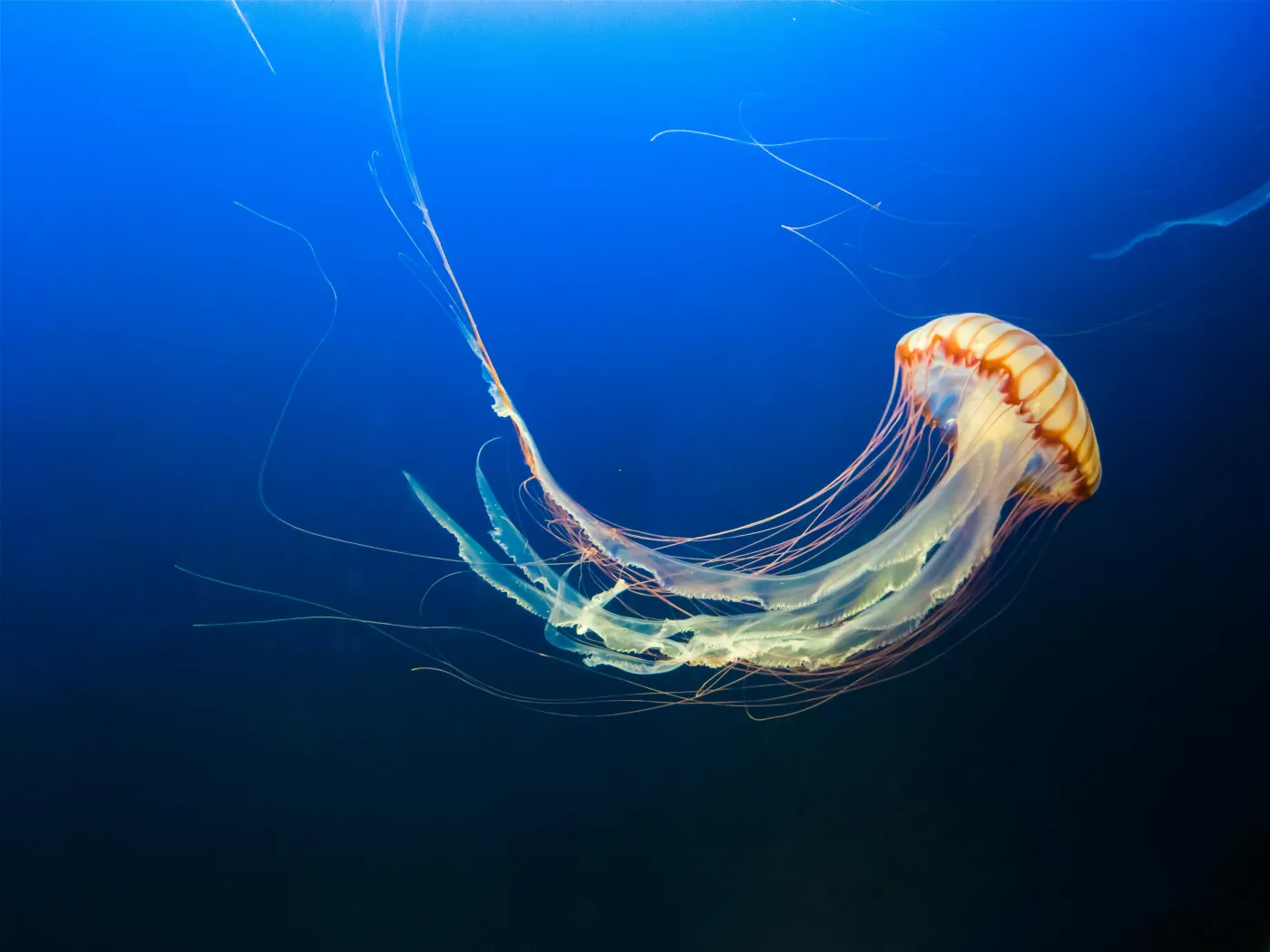
In This Article
- A Tiny Animal That Refuses To Die
- Why Aging Always Wins In Other Animals
- How Does The Immortal Jellyfish Grow Young Again?
- What This Could Mean For Human Bodies
- The Catch Scientists Cannot Ignore
Imagine an animal that, when it gets old or sick, simply melts into a blob and grows back as a baby. That is not a fairy tale. The immortal jellyfish, a small sea creature called Turritopsis dohrnii, really does this.
Found in the warm waters of the Mediterranean Sea, it can rewind its own life cycle when life becomes too hard. Scientists now study it closely, hoping it can teach us why human bodies break down with time, and whether we could one day slow that breakdown.
A Tiny Animal That Refuses To Die
Most jellyfish are born, grow up, lay eggs, and die. That is the rule of life in the ocean. But Turritopsis dohrnii breaks this rule.
When it is hurt, sick, or even just stressed by warm water, it shrinks into a small ball called a cyst. From that cyst, it grows back as a baby polyp, the earliest stage of jellyfish life. Then it grows up all over again, and in theory this can happen forever.
Why Aging Always Wins In Other Animals
In humans and most animals, time damages the body. Cells stop dividing, and DNA gets scratched up over the years.
Tiny caps at the ends of our chromosomes, called telomeres, also get shorter. Shorter telomeres mean weaker cells. Add in stress, pollution, and chronic disease, and the damage piles up faster.
Doctors call this the science of aging, and it explains why old age brings illness like heart disease, diabetes, and memory loss. So what makes this jellyfish so different? It seems to have found a way around the damage.
How Does The Immortal Jellyfish Grow Young Again?
The secret has a long name: transdifferentiation. In plain words, the jellyfish takes one type of grown-up cell, like a muscle cell, and turns it into a completely different cell, like a nerve or skin cell.
Most animals cannot do this. We are stuck with the cells we have. But the jellyfish breaks that limit.
A team led by Maria Pascual-Torner mapped the full genome of this animal in a 2022 paper in the Proceedings of the National Academy of Sciences. They compared it with a closely related cousin that ages and dies the normal way. They found extra copies of genes that fix DNA, protect telomeres, and switch cells into a younger state.
While the animal is in its cyst phase, the genes that build new DNA work overtime. Genes for normal cell division go quiet. The creature is, in a sense, choosing repair over reproduction.
"Comparative genomics of immortal cnidarians unveils novel keys behind rejuvenation, offering new directions for the study of human aging."
Pascual-Torner et al., PNAS, 2022What This Could Mean For Human Bodies
Here is where it gets exciting for us. Human cells can also change type, in a small way.
Doctors already use this trick to make stem cells from skin in labs, a method pioneered by Shinya Yamanaka, who won the Nobel Prize for it. Some teams are even trying to turn skin cells into nerve cells to repair spinal injuries.
The immortal jellyfish shows what is possible when this process is done safely and on a whole-body scale. Researchers at the National Institute on Aging believe that lessons from animals like this one could shape future treatments for dementia, weak bones, and tired immune systems in older adults.
The dream is not eternal youth. The real dream is staying healthy for longer.
The Catch Scientists Cannot Ignore
There is a hard truth. When human cells change identity without proper control, the result is often cancer.
The same kind of cell switching that rescues the jellyfish can, in our bodies, help tumours spread and resist treatment. Ovarian cancer is one painful example, where this process drives the disease through the belly and lowers the chance of survival.
So while the jellyfish gives hope, copying its trick in humans is risky business. The team behind the 2024 review in the Revista Española de Geriatría y Gerontología say the next step is finding ways to switch on safe repair without flipping the cancer switch. That work has only just started.
- Real rejuvenation exists. This animal proves that a complex creature can truly grow young again, not just heal.
- Genes hold the secret. Extra DNA repair genes and stronger telomere protection are at the heart of its trick.
- Cancer is the wall. In humans, the same cell switching often leads to tumours, which is why direct copying will not work.
"The model of the jellyfish Turritopsis dohrnii is an excellent principle and a research opportunity to ensure that people can have not only a longer life expectancy, but a better quality of life in old age." Velasco-Muñoz et al., Revista Española de Geriatría y Gerontología, 2025.
The immortal jellyfish will never make humans live forever. But it reminds us of something deeper. Nature has already solved problems that we are still struggling with today.
These answers hide inside animals so small you would never notice them in a glass of seawater. Sometimes the biggest answers to our oldest questions are floating quietly, right beneath the surface of the sea, waiting for us to look more closely.
📄 Source & Citation
Primary Source: Velasco-Muñoz V, Uribe-Gaviria M, Suárez-Gómez SA, Villamizar-Romero A, Ricaurte-Fajardo A, Vásquez-Vélez IC, Cano-Gutiérrez CA. (2025). Regenerative characteristics of the immortal jellyfish, Turritopsis dohrnii, and their potential implications for human aging. Revista Española de Geriatría y Gerontología, 60, 101607. https://doi.org/10.1016/j.regg.2024.101607
Authors & Affiliations: Valentina Velasco-Muñoz and colleagues, Pontificia Universidad Javeriana (Bogotá, Colombia), in collaboration with Weill Cornell Medical College (New York, USA).
Data & Code: Narrative review based on 21 studies drawn from PubMed, Scopus, and Google Scholar databases.
Key Themes: Transdifferentiation · Telomere biology · Cellular senescence · Anti-aging research · Cancer risk
Supporting References:
[1] Pascual-Torner M et al. (2022). Comparative genomics of mortal and immortal cnidarians unveils novel keys behind rejuvenation. PNAS, 119(36):e2118763119.
[2] Matsumoto Y, Piraino S, Miglietta MP. (2019). Transcriptome characterization of reverse development in Turritopsis dohrnii. G3 (Bethesda), 9(12):4127–4138.
[3] Petralia RS, Mattson MP, Yao PJ. (2014). Aging and longevity in the simplest animals and the quest for immortality. Ageing Research Reviews, 16:66–82.
No comments yet. Be the first to share your thoughts.
Leave a Comment