 Sanjay Verma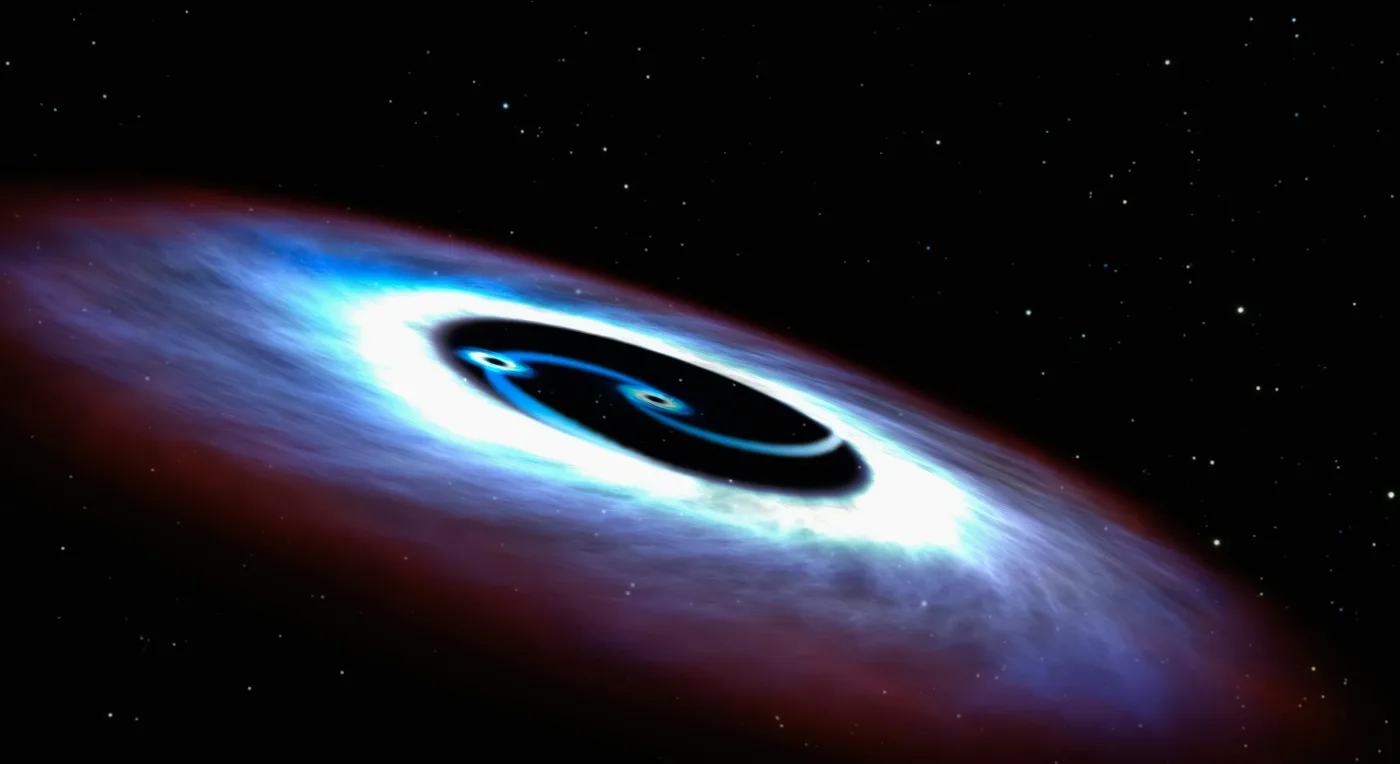
In This Article
- One Strange Ripple Among 28
- Why Dark Matter Has Stayed Hidden So Long
- How Can a Black Hole Crash Reveal Dark Matter?
- What This Means for the Hunt Ahead
- The Questions That Still Need Answers
Somewhere far out in space, two black holes crashed into each other and sent a ripple racing across the universe. When that ripple finally reached Earth, it looked a little odd. Scientists now think that odd shape may be a dark matter fingerprint, the first faint trace of the invisible stuff that makes up most of the universe. If they are right, a black hole crash just handed us a brand new way to catch something nobody has ever seen.
One Strange Ripple Among 28
A team of physicists looked closely at 28 black hole crashes recorded by giant detectors on Earth. For 27 of them, the ripples looked exactly as expected, like black holes crashing in empty space. But one signal, named GW190728, did not fit the usual pattern. Its shape looked like something had been tugging on it. That something, the team says, could be a thick cloud of dark matter.
Why Dark Matter Has Stayed Hidden So Long
For almost a hundred years, dark matter has played hide and seek with science. Normal matter, the stuff of stars, planets and people, bounces light around, so we can see it. Dark matter does none of that. The only way it ever shows itself is through gravity. Astronomers first noticed it because galaxies spin faster than their visible weight should allow, and because light bends around them more sharply than expected. Something heavy and unseen had to be there.
How Can a Black Hole Crash Reveal Dark Matter?
When two black holes spiral together and smash, they shake space itself and send out ripples called gravitational waves. Detectors known as LIGO first caught these ripples back in 2015. Here is the clever part: if a pair of black holes is wrapped in a thick cloud of dark matter, that cloud slightly bends and stretches the ripples as they form. The team at MIT built a computer model that predicts exactly what that bent ripple should look like. Then they checked real signals collected by the LIGO-Virgo-KAGRA observatory network. GW190728 was the one that matched.
"We know that dark matter is around us. It just has to be dense enough for us to see its effects. Black holes provide a mechanism to enhance this density."
— Aurrekoetxea, MIT Department of Physics · Physical Review Letters, 2026What This Means for the Hunt Ahead
For years, scientists have hunted dark matter with deep underground labs and huge particle machines, and found nothing solid. This new idea flips the search around. Instead of building a trap on Earth, it uses black holes far across space as natural detectors. One leading guess is that dark matter is made of super light particles that can act like waves. Near a fast spinning black hole, those waves can soak up the black hole's spinning energy and pile up into a dense cloud, a process scientists call superradiance. A cloud that thick is exactly what could leave a mark on a passing ripple.
The Questions That Still Need Answers
Before anyone gets too excited, the team is clear about one thing: this is a clue, not proof. The odd shape in GW190728 is not strong enough to count as a real discovery, and other scientists must check it with their own tests. The signal might still turn out to be something ordinary. But the team's bigger worry is sharper still. Without models like theirs, black holes merging inside dark matter could quietly be slipping past us, wrongly logged as ordinary crashes in empty space. The good news is that detectors are now catching new ripples faster than ever, and each one is a fresh chance to spot the fingerprint.
- One odd ripple — Out of 28 black hole crashes, only GW190728 looked like it carried a dark matter mark.
- A clue, not a discovery — The signal is too weak to be proof, so other teams must double check it.
- A new kind of detector — Black holes far in space can now be used to hunt for the universe's most wanted mystery.
"We now have the potential to discover dark matter around black holes as the detectors keep collecting data in the coming years. It is an exciting time to search for new physics using gravitational waves." — Soumen Roy, Physical Review Letters, 2026.
For a hundred years, dark matter has been the quiet weight holding the universe together, felt by everyone and seen by no one. Now a single strange ripple, born from two black holes crashing in the dark, may be its first whisper back. We have not caught it yet. But for the first time, we know where to listen.
📄 Source & Citation
Primary Source: Roy S, Vicente R, Aurrekoetxea JC, Clough K, Ferreira PG. (2026). Scalar fields around black hole binaries in LIGO-Virgo-KAGRA. Physical Review Letters, 136(19). https://doi.org/10.1103/fv9z-zkxx
Authors & Affiliations: Josu C. Aurrekoetxea (MIT Department of Physics), with collaborators from UCLouvain (Belgium), University of Amsterdam, Queen Mary University of London, and Oxford University.
Data & Code: Built on publicly available gravitational-wave data from the LIGO-Virgo-KAGRA collaboration's first three observing runs.
Key Themes: Dark Matter · Black Hole Mergers · Gravitational Waves · Superradiance · GW190728
Supporting References:
[1] Abbott BP et al. (2016). Observation of gravitational waves from a binary black hole merger. Physical Review Letters, 116(6):061102.
[2] LIGO Scientific Collaboration and Virgo Collaboration. (2021). GWTC-2: Compact binary coalescences observed by LIGO and Virgo. Physical Review X, 11(2):021053.
[3] Massachusetts Institute of Technology. (2026, May 19). A strange ripple in spacetime could be the first fingerprint of dark matter. MIT News.
No comments yet. Be the first to share your thoughts.
Leave a Comment