 Dr. Raj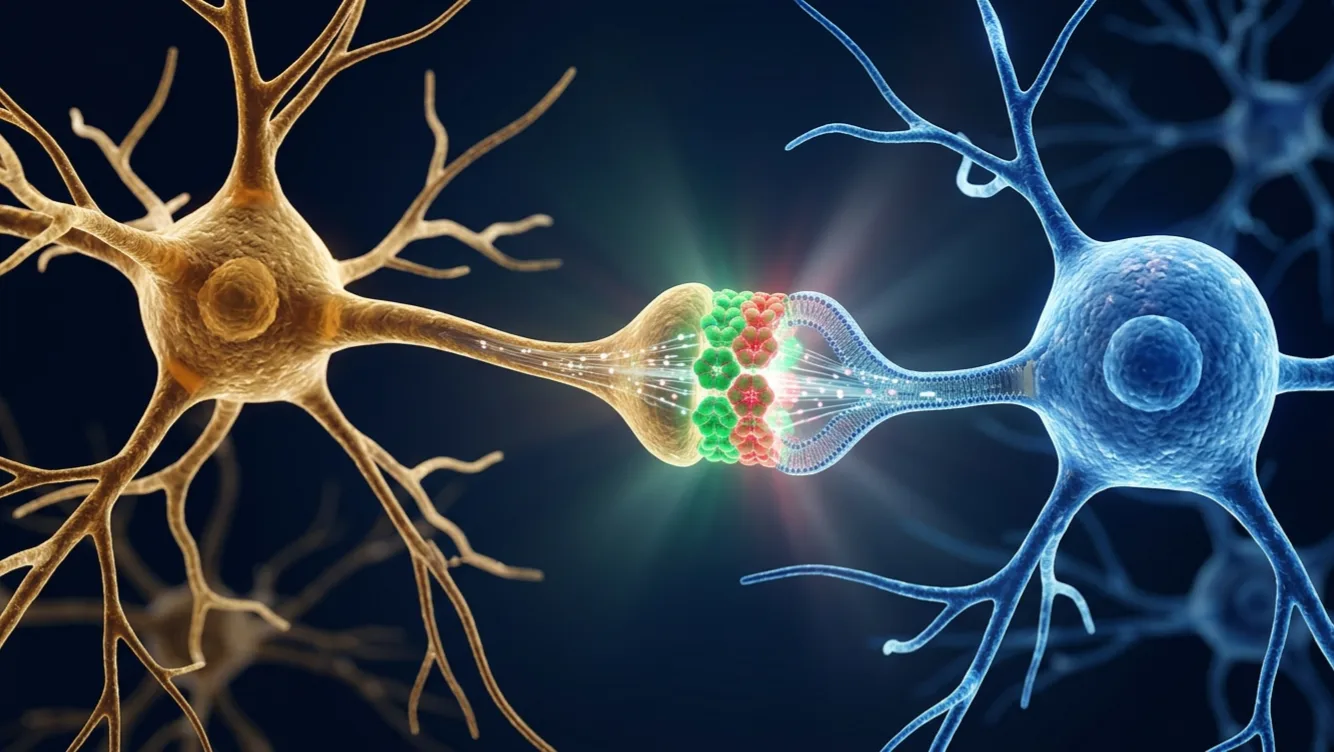
In This Article
- A Living Wire Built From Fish
- Why Old Brain Tools Always Missed the Target
- How Did Scientists Make Two Proteins Stick Only to Each Other?
- What Happened When They Tried It in Real Brains
- What This New Tool Still Cannot Do
Imagine if you could open up a brain and add a tiny wire between just two cells of your choice. Not a metal wire, but a living one made of protein. That is what a team at Duke University, Yale, and the Howard Hughes Medical Institute has done. Their new tool, called an engineered electrical synapse, lets two chosen brain cells share signals directly. In mice, this small change made the animals act braver under stress. The full paper was published this month in Nature.
A Living Wire Built From Fish
Inside every brain, cells talk to each other at tiny meeting points called synapses. Most of these use chemicals. But a small number use a direct electric link, like two batteries joined by a wire. These electric links are called gap junctions.
The team wanted to build new gap junctions on purpose, between specific cells. To do this, they did not invent something from scratch. They borrowed two proteins from Morone americana, the white perch, a common North American river fish. The proteins are named Cx34.7 and Cx35, and in the fish they naturally form a strong electric bridge.
Why Old Brain Tools Always Missed the Target
Scientists already have famous tools for poking the brain. Optogenetics uses light. DREADDs use drugs. Both can switch chosen cells on or off. But they share one weakness. They act on a single type of cell at a time. They do not connect two specific cells to each other.
That gap matters. A real brain circuit is not one cell shouting. It is a pair, or a chain, of different cells talking. Until now, there was no clean way to strengthen the link between, say, an excited cell and the quiet cell next to it without also affecting hundreds of unrelated neighbours.
How Did Scientists Make Two Proteins Stick Only to Each Other?
This was the hard part. The fish proteins worked, but they also stuck to many other proteins already inside a mouse brain. That would mess up the wiring. The team needed a key and lock that fit nothing else.
So they changed the proteins, letter by letter. They tried more than seventy small edits. They built a fast new test, called FETCH, that uses glowing colours to show which pairs lock together. They also ran computer simulations to predict which changes would push proteins apart and which would pull them close. After many rounds, two final winners emerged: Cx34.7(M1) and Cx35(M1). Together the pair is called LinCx, short for Long-term Integration of Circuits using Connexins.
The clever bit is the electric charge. One half of the bridge ended up with positive charges in key spots. The other half got negative charges in matching spots. Like fridge magnets, they grab each other. But neither half can stick to itself, and neither one likes the natural proteins around it. The match is private.
"This pair docks with each other to form an electrical synapse but not with other major connexins expressed in the mammalian central nervous system."
— Ransey et al., Duke University · Nature, 2026What Happened When They Tried It in Real Brains
The team first tested LinCx in tiny worms called Caenorhabditis elegans. Worms trained at cool temperatures normally avoid warm spots. But when LinCx was placed between a heat-sensing cell and the next cell in line, the worms switched. They started walking towards warmth. The new wire had rewritten a learned habit.
Then came mice. The researchers built LinCx between two cell types in the prefrontal cortex, the front part of the brain that handles planning and feelings. Brain recordings showed the two cells were now firing in tighter sync, like two drummers finally keeping the same beat. The mice also became more social with new partners and explored new spaces with more confidence.
What This New Tool Still Cannot Do
The team is careful not to oversell it. Their engineered electrical synapse only works between cells that already touch each other. It cannot reach across empty space. The proteins are also always on, so they can slowly change other natural synapses around them in ways that are not fully mapped. And one of the two proteins still showed a small reaction with one human protein, called Cx31.3, that future versions will need to fix.
There is also no plan, yet, to test LinCx in humans. The work is still basic science. But it gives Kafui Dzirasa and his team something new: a way to ask, for the first time, what happens when you choose exactly which two cells should talk a little louder, and then listen to what the rest of the brain does in reply.
- One bridge, two cells: LinCx is the first engineered electrical synapse that connects two chosen brain-cell types directly, not one at a time.
- Built from a fish: Tiny edits to a white perch protein turned a wild gap junction into a private lock and key.
- Behaviour follows wiring: Mice grew bolder around strangers and held up better under stress after their circuits were edited.
"We establish long-term integration of circuits using connexins for precision circuit editing in mammals." — Ransey, Thomas, Wisdom et al., Nature, 2026.
📄 Source & Citation
Primary Source: Ransey E, Thomas GE, Wisdom EM, et al. (2026). Long-term editing of brain circuits using an engineered electrical synapse. Nature. https://doi.org/10.1038/s41586-026-10501-y
Authors & Affiliations: Lead author Elizabeth Ransey and senior author Kafui Dzirasa, with collaborators from Duke University, Yale School of Medicine, the Howard Hughes Medical Institute, the University of Connecticut, the University of Iowa, and the Salk Institute.
Data & Code: Open code for the FETCH assay, molecular dynamics protocol, and optogenetic stimulation scripts is available at github.com/carlson-lab/FETCH and related repositories under DOI 10.7924/r4r486.
Key Themes: Engineered electrical synapse · Connexin proteins · Gap junctions · Neural circuit editing · Behaviour modulation
Supporting References:
[1] O'Brien J et al. (1998). Cloning and expression of two related connexins from the perch retina. Journal of Neuroscience, 18:7625–7637.
[2] Rabinowitch I et al. (2014). Rewiring neural circuits by ectopic electrical synapses in C. elegans. Nature Communications, 5:4442.
[3] Hawk JD et al. (2018). Integration of plasticity mechanisms within a single sensory neuron of C. elegans actuates a memory. Neuron, 97:356–367.
No comments yet. Be the first to share your thoughts.
Leave a Comment