 Sanjay Verma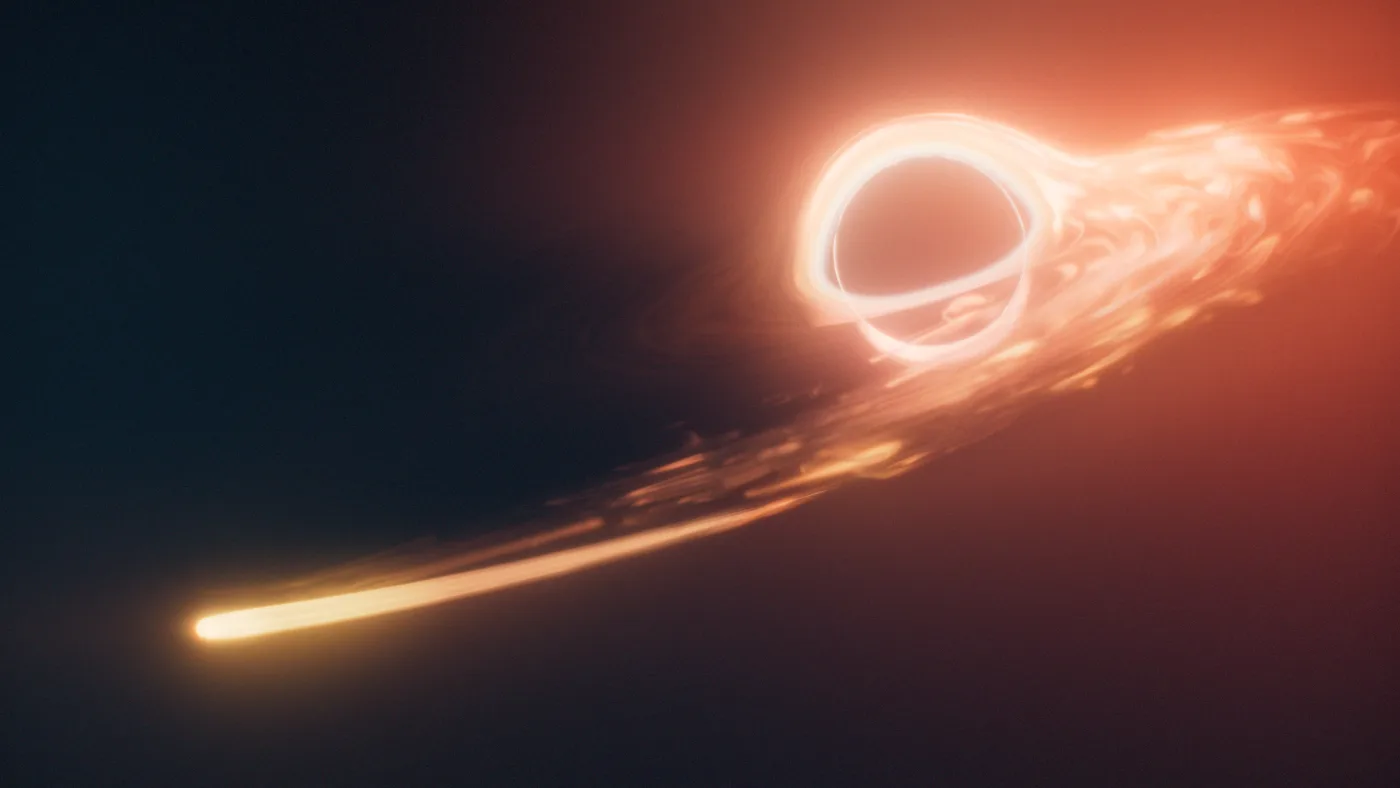
In This Article
- What Happens When a Black Hole Eats a Star?
- Why Some Black Holes Stay Hidden
- How Will Roman Spot These Ancient Star-Eaters?
- What This Tells Us About Where Black Holes Come From
- What Scientists Still Don't Know
Picture a star like our Sun. Now picture it being torn apart, piece by piece, by a black hole so strong that nothing nearby can escape. This is a real event, and for a few weeks it can outshine every other star in its galaxy combined. NASA's Roman Space Telescope, set to launch on August 30, 2026, is built to catch these rare flashes from as far back as 11 billion years ago. That reach gives scientists their best look yet at how giant black holes are born and how they grow.
What Happens When a Black Hole Eats a Star?
Black holes are usually invisible. Scientists find them by watching the glowing gas that swirls around them before falling in, much like water circling a drain before it disappears. But some black holes go further. Every so often, one pulls in an entire star, stretching and shredding it until the wreckage lights up brighter than the whole galaxy around it.
Why Some Black Holes Stay Hidden
Not every black hole can put on this kind of show. Truly massive ones, weighing more than a billion Suns, simply swallow an incoming star whole in one gulp. There is no tearing, no bright flare, nothing for telescopes to see. Lighter supermassive black holes behave differently, and that difference is exactly what makes them findable.
How Will Roman Spot These Ancient Star-Eaters?
Roman will run a project called the High-Latitude Time-Domain Survey. It will watch a patch of sky roughly as wide as 90 full moons, checking back on the same spot again and again to catch flickers of light that come and go. Because the universe is expanding, light from very distant events gets stretched out, a process called cosmological redshift. Roman is built to see that stretched, near-infrared light, so it is naturally tuned to spot tidal disruption events from 8 to 11 billion light-years away. The ground-based Vera C. Rubin Observatory will find thousands of closer, brighter events using visible light, while Roman hunts the far older, fainter ones that Rubin cannot reach.
"The Roman Space Telescope is going to be transformative for transient science."
— Mitchell Karmen, Johns Hopkins UniversityWhat This Tells Us About Where Black Holes Come From
Astronomers have spotted enormous black holes so early in cosmic history that current theories struggle to explain how they grew so big, so fast. One idea, called light seeds, says black holes start small, from the collapse of dying massive stars, then merge and feed over billions of years. A second idea, called heavy seeds, says a black hole can be born already massive, through the direct collapse of a giant gas cloud. Counting tidal disruption events at different distances helps scientists work out which story is closer to the truth.
What Scientists Still Don't Know
Everything described here comes from computer simulations, not yet real telescope data. The true number of tidal disruption events Roman finds could turn out higher or lower than predicted, and researchers still do not know which black hole seeding theory wins out. What is certain is that once Roman and Rubin start regular observations, astronomers will finally be able to check their forecasts against reality, and that comparison alone should reshape how the story of black holes gets told.
- Rare cosmic flares: Only lighter supermassive black holes shred stars visibly; heavier ones swallow them without a trace.
- A time machine of light: Roman's near-infrared vision lets it catch flares from up to 11 billion years ago.
- A clue to black hole origins: Counting these star-shredding events helps settle how the universe's biggest black holes got their start.
Just as the James Webb Space Telescope reshaped what astronomers know about distant galaxies, co-author Suvi Gezari of the University of Maryland expects Roman to do the same for short-lived cosmic flashes, saying it is "poised to transform our understanding of high-redshift transients." — Suvi Gezari, The Astrophysical Journal, 2026.
📄 Source & Citation
Primary Source: Karmen, M., Gezari, S., et al. (2026). Predicted tidal disruption event rates for the Nancy Grace Roman Space Telescope. The Astrophysical Journal. http://doi.org/10.3847/1538-4357/ae7a49
Authors & Affiliations: Mitchell Karmen (Johns Hopkins University) with Suvi Gezari (University of Maryland) and collaborators.
Original Reporting: Christine Pulliam, Space Telescope Science Institute, via NASA.
Key Themes: Tidal disruption events · Supermassive black holes · Roman Space Telescope · Black hole origins · Cosmic noon
No comments yet. Be the first to share your thoughts.
Leave a Comment