 Sanjay Verma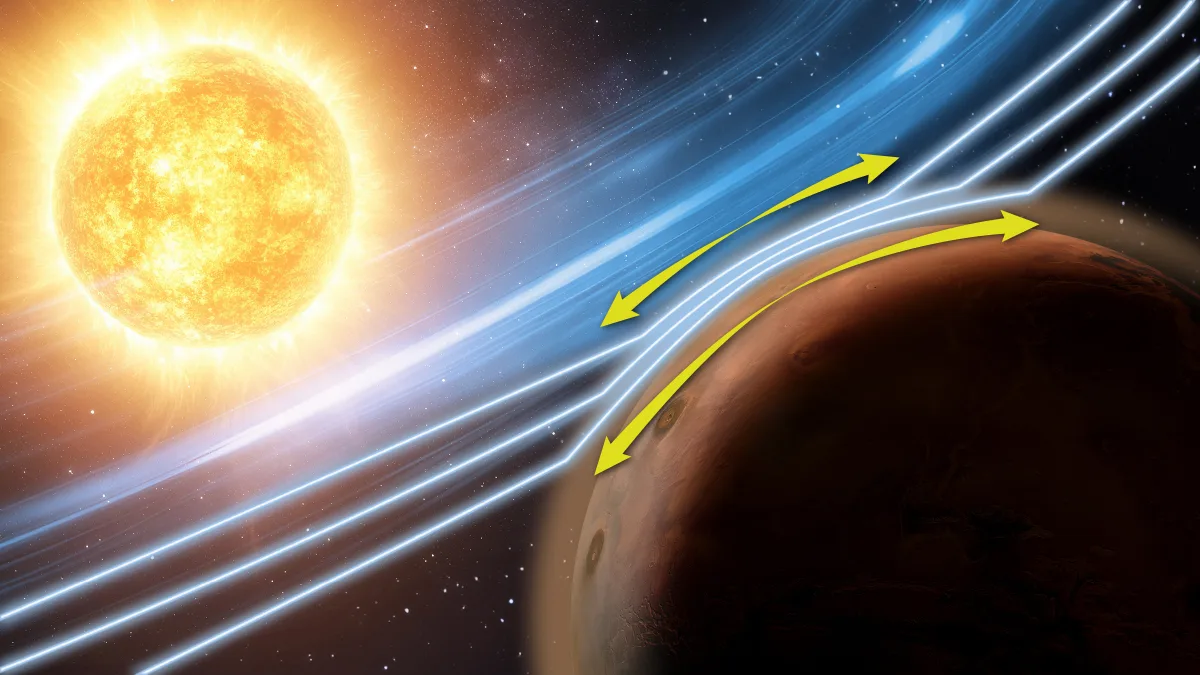
In This Article
- The Wiggles That Started a Hunt
- Why Mars Is an Easy Target for the Sun
- How Did Scientists Find a Squeeze Inside Mars' Air?
- What This Tells Us About Mars and Beyond
- The Questions Still Left to Answer
One scientist was quietly scrolling through old data from Mars when something odd caught his eye. Tiny wiggles. Little jiggles in the numbers that should not have been there. That small puzzle has now become the first sighting of the Zwan-Wolf effect at Mars, a kind of cosmic squeeze that no one had ever spotted inside the air of any planet, anywhere.
The Wiggles That Started a Hunt
In December 2023, scientists were studying readings from NASA's MAVEN spacecraft, a probe that has circled Mars since 2014 to study its thin air. The lead researcher noticed strange ripples in the magnetic field data as the spacecraft flew through the atmosphere.
At first, nobody knew what the ripples meant. So the team did what good detectives do. They dug deeper, checked other instruments, and slowly ruled out one cause after another until only one answer was left standing.
That answer turned a small data puzzle into a discovery no textbook had predicted.
Why Mars Is an Easy Target for the Sun
Earth has a built-in shield. Deep inside our planet, a giant magnetic field wraps around us and pushes most of the Sun's blast of particles, called the solar wind, safely away. Mars lost that global shield long ago.
Without it, Mars is far more exposed. The solar wind slams almost straight into the planet's upper air. Over billions of years, this is one big reason Mars slowly lost most of its atmosphere and became the cold, dry world we see today.
So if Mars has no real shield, how did an effect tied to magnetic fields show up so deep inside its atmosphere?
How Did Scientists Find a Squeeze Inside Mars' Air?
Mars does have a part-time, borrowed shield. When the solar wind hits the planet's charged upper air, it creates a weak magnetic bubble called an induced magnetosphere. This bubble is shaky. It can grow, shrink, and change shape when the Sun acts up.
That is exactly what happened. A large solar storm struck Mars, and the storm appears to have pumped up the Zwan-Wolf effect, making it strong enough for MAVEN to finally catch it. The team saw charged particles being squeezed and spread through the ionosphere, the electric layer of Mars' air below 200 kilometres.
The really surprising part is that the effect may be running all the time, just too quietly for the spacecraft to notice. It took a solar storm to turn up the volume so the wiggles became loud enough to read.
"No one expected that this effect could even occur in the atmosphere. That's what makes this even more exciting."
— Christopher Fowler, West Virginia University · Nature Communications, 2026What This Tells Us About Mars and Beyond
This discovery is more than a fun space fact. It shows a brand-new way the Sun can stir and reshape the air of Mars. Every clue like this helps scientists piece together the long story of how the Red Planet lost its water and its thick atmosphere.
It may also reach far past Mars. Other worlds without a strong shield, such as Venus and Saturn's big moon Titan, could feel the same squeeze. The find also matters for the future: knowing how space weather hits Mars helps protect rovers, orbiters, and one day astronauts working on the planet.
Yet even a discovery this neat leaves a long list of things scientists still cannot explain.
The Questions Still Left to Answer
This is a first look, not the full picture. Scientists still do not know exactly how often the effect runs, or how strong it gets when no solar storm is helping it show up. The quiet, everyday version remains hidden from MAVEN's instruments.
There is also a sad twist. MAVEN, the spacecraft that made this find, went silent on December 6, 2025. NASA opened a review board in February 2026 to check if the orbiter can ever be brought back. New discoveries may now have to come from its years of stored data.
- A first-ever sighting — the Zwan-Wolf effect had never before been seen inside any planet's atmosphere.
- The Sun reshapes Mars — a solar storm pumped up the effect, revealing a new way space weather stirs the Martian air.
- Clues hidden in old data — the find came from spotting tiny wiggles, proving years of saved measurements still hold surprises.
"The MAVEN team continues making new discoveries with our datasets and finding these links between our host star and the Red Planet." — Shannon Curry, MAVEN Principal Investigator, 2026.
It started with a few odd wiggles on a screen that someone chose not to ignore. That is how most big discoveries really begin: not with a loud answer, but with one curious person refusing to look away from a small, strange thing.
📄 Source & Citation
Primary Source: Fowler, C. et al. (2026). First comprehensive observations of the Zwan-Wolf effect in the Martian atmosphere. Nature Communications. https://www.nature.com/articles/s41467-026-72251-9
Authors & Affiliations: Led by Christopher Fowler (West Virginia University), with the NASA MAVEN team and the Laboratory for Atmospheric and Space Physics, University of Colorado Boulder.
Reported By: NASA Science — "NASA's MAVEN Makes 1st Discovery of Atmospheric Effect at Mars," May 18, 2026.
Key Themes: Zwan-Wolf effect · Mars atmosphere · Solar wind · Space weather · NASA MAVEN
Supporting References:
[1] NASA. MAVEN (Mars Atmosphere and Volatile EvolutioN) mission overview. NASA Science, science.nasa.gov/mission/maven.
[2] NASA Goddard Space Flight Center (2026). MAVEN spacecraft anomaly review board update, February 2026.
[3] Laboratory for Atmospheric and Space Physics, University of Colorado Boulder — MAVEN science operations and outreach.
No comments yet. Be the first to share your thoughts.
Leave a Comment