 Sanjay Verma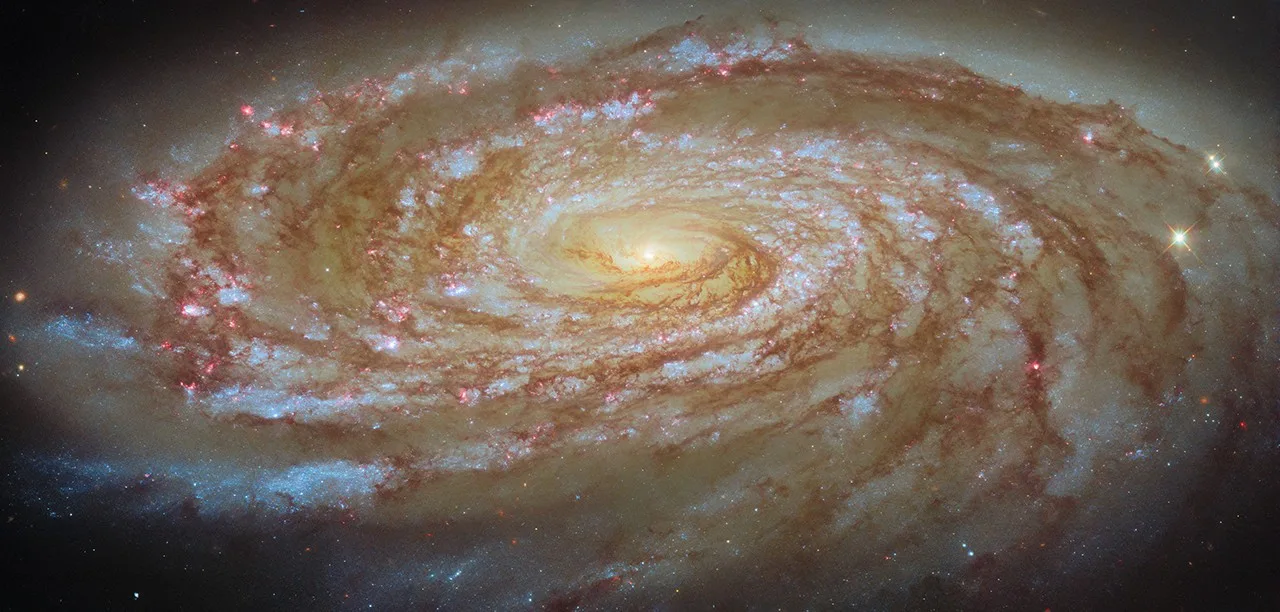
In This Article
- A Galaxy Caught Mid-Journey
- What Makes M88 Special to Astronomers
- How Does Ram Pressure Stripping Work?
- The Signs of Change Already Showing on M88
- What This Tells Us About All Galaxies in Clusters
Right now, a galaxy bigger than our entire Milky Way is speeding through space on a one-way trip that will slowly tear it apart. The Hubble Space Telescope has captured a stunning new image of Messier 88 (M88), a spiral galaxy 63 million light-years away that is already showing the first scars of its long cosmic journey toward the dangerous heart of the Virgo Cluster.
A Galaxy Caught Mid-Journey
Think of the Virgo Cluster as a giant city of galaxies. More than a thousand galaxies live there, all pulled together by gravity. M88 is one of them, and right now it is making a slow but dramatic move toward the city center.
This journey will take another 200 to 300 million years to complete. When M88 finally reaches the innermost part of the cluster, it will pass close to Messier 87, a colossal elliptical galaxy that acts like the anchor of the entire cluster. That encounter will change M88 permanently.
What makes this moment special is that Hubble has caught M88 at a crossroads. It is still a beautiful, active spiral. But the forces that will reshape it are already at work, quietly, at its edges. The universe does not always announce what it is doing.
What Makes M88 Special to Astronomers
M88 is what astronomers call an active galaxy. That simply means its very center is not quiet. Deep inside M88 sits a supermassive black hole that is actively eating gas and dust around it. Astronomers estimate this black hole is about 100 million times heavier than our Sun — and as it feeds, it pushes powerful streams of gas outward from the galaxy's core.
Around the black hole, a group of old, reddish stars give M88 its warm, glowing center. Spreading out from there are several tight, beautiful spiral arms, spotted with pink clouds where new stars are being born and outlined in brilliant blue by younger, hotter stars. Because we see M88 from an angle rather than directly face-on, it appears stretched and wide, almost like a lens. This angle actually helps astronomers study it more clearly, revealing the shape of its gas and the changes happening along its outer edges.
How Does Ram Pressure Stripping Work?
Picture riding a bicycle on a windy day. The faster you go, the harder the wind pushes against you. Now imagine that wind is invisible gas filling the space between galaxies inside a cluster, and you are a galaxy speeding toward the center. That pressure begins to tear your gas away from your outer edges. Astronomers call this ram pressure stripping, and it is one of the most powerful forces that shapes galaxy life inside clusters.
As M88 picks up speed heading inward, the surrounding cluster gas pushes back harder and harder. Slowly, the outer gas of M88 is swept away like snow blowing off a moving train. Once that gas is gone, M88 cannot use it to form new stars. The galaxy essentially stops growing and begins to age.
What surprised researchers is not that this will happen to M88 in the distant future. It is that it is already happening now.
"By studying galaxies on these scales, astronomers can understand how a journey through a cluster impacts a galaxy's evolution and ability to form new stars."
— NASA/ESA Hubble Mission Team · NASA Science, 2026The Signs of Change Already Showing on M88
The new Hubble image reveals something that researchers did not need to wait millions of years to find. The outer edge of M88's swirling gas disk looks compressed and pushed inward on one side, almost exactly like snow piling up on the front of a plough moving through fresh snow. That is the visible mark of ram pressure stripping already happening on M88's leading edge as it pushes through the cluster.
Even more telling, M88 has much less cold gas than expected for a galaxy of its size. Cold gas is the raw material that galaxies use to make new stars. Its absence, especially toward the outer edges of M88, is a clear sign that the cluster has already started quietly pulling its fuel away. The galaxy's ability to form new stars is being reduced even now, hundreds of millions of years before its closest and most violent pass through the cluster core.
What This Tells Us About All Galaxies in Clusters
M88 is not just one galaxy with an interesting story. It is a window into the lives of countless galaxies across the universe that have gone through the same journey in clusters just like this one. Astronomers included M88 in a dedicated Hubble observing program designed to understand how spiral galaxies change when they live in crowded environments filled with gas, gravity, and competing forces.
Most galaxies in the universe do not form or live in isolation. They belong to groups and clusters, and what happens to them inside those environments determines what kind of galaxy they become. Understanding M88's slow transformation helps explain why some galaxies today are still bursting with new star formation, while others appear old, quiet, and nearly empty of gas.
What remains open is the exact pace of change. Researchers know what will ultimately happen to M88. But tracking precisely how quickly its gas is being lost, and how fast star formation will drop, requires watching it carefully over many more years. The story is not finished.
- Already losing gas — M88 has noticeably less cold gas than a galaxy its size should have, a direct sign that ram pressure stripping is already removing its raw star-forming fuel at the edges.
- Compressed leading edge — The front edge of M88's gas disk is visibly pushed inward by cluster pressure, confirming that the stripping process is actively underway right now, not just in its future.
- Hubble catches the turning point — This new image finds M88 at a rare moment: still a vivid, active spiral galaxy, yet already carrying the early marks of the transformation that will define the rest of its life.
"M88 is on a long and somewhat perilous cosmic journey that will bring it to the innermost reaches of the cluster, and it will be fundamentally changed by its trek." — NASA/ESA Hubble Mission Team, NASA Science, 2026.
M88 will keep moving inward. Its gas will keep thinning. Its star-making will keep slowing. In a few hundred million years, what we see today as a vivid, swirling, star-forming galaxy may look more like a quiet, fading ember. What Hubble caught is not just a beautiful picture of a distant galaxy. It is the universe showing us, in real time, how the largest structures in existence can quietly reshape everything inside them, one galaxy, one journey, at a time.
Source & Citation
Primary Source: NASA Hubble Mission Team (2026). Hubble captures M88 on journey to center of Virgo Cluster. NASA Science, May 29, 2026. https://science.nasa.gov/missions/hubble/hubble-captures-m88-on-journey-to-center-of-virgo-cluster/
Authors & Affiliations: NASA Hubble Mission Team, Goddard Space Flight Center; Observing program PI: D. Thilker; Text credit: ESA/Hubble
Instrument: Hubble Wide Field Camera 3 (WFC3) · Hubble Observing Program #18103
Key Themes: Galaxy Evolution · Ram Pressure Stripping · Virgo Cluster · Star Formation · Active Galactic Nuclei
Supporting References:
[1] ESA/Hubble & NASA, D. Thilker (2026). Hubble image of Messier 88. NASA Science Missions.
[2] NASA Science (2026). Messier 87 — Hubble Messier Catalog. NASA Hubble Messier Catalog.
[3] NASA Science (2026). Galaxies — The Universe. NASA Science: Galaxies.
No comments yet. Be the first to share your thoughts.
Leave a Comment