 Sanjay Verma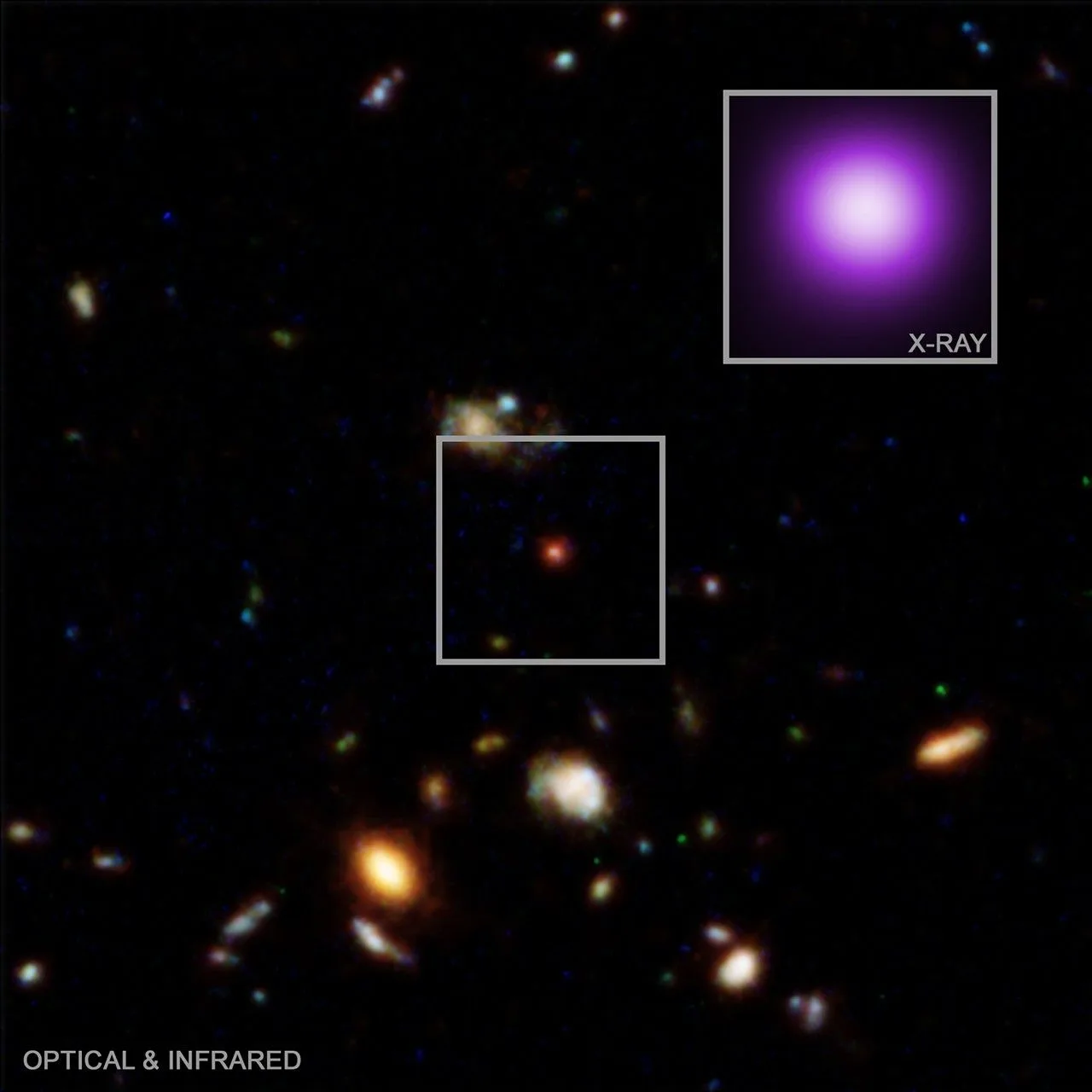
In This Article
- The Strange Objects Nobody Could Explain
- Why These Objects Stayed Hidden for So Long
- How Did NASA Finally Find One Glowing in X-rays?
- What the X-ray Dot Could Mean for Black Hole Science
- What Scientists Still Do Not Know
Somewhere near the very edge of the known universe, hundreds of tiny, faint red smudges of light have been sitting in plain sight, baffling astronomers for years. These little red dots, spotted by NASA's James Webb Space Telescope, look like nothing scientists have seen before. Now, one of them has done something completely unexpected: it lit up in X-ray light, and that single glowing dot may hold the answer to what all of them are.
The Strange Objects Nobody Could Explain
Picture looking up at the night sky and spotting a handful of tiny red sparks that should not exist. That is roughly what happened when Webb began sending back its first images of the deep universe. Almost immediately, astronomers noticed a new kind of object, small, very red, and impossibly far away, sitting about 12 billion light-years from Earth.
These objects became known as "little red dots," or LRDs. Hundreds of them turned up across different patches of sky. Scientists quickly suspected they were supermassive black holes, the kind that sit at the centres of galaxies and weigh billions of times more than our Sun. But these black holes seemed to be hiding.
Normally, a growing black hole is easy to spot. As it pulls in nearby gas and dust, that material heats up and blazes with bright ultraviolet light and X-rays, creating what astronomers call a quasar or active galactic nucleus. The little red dots showed none of that. No ultraviolet glow. No X-rays. Just that quiet, deep red colour. Something was covering them up, but exactly what remained a puzzle that left researchers guessing for years.
Why These Objects Stayed Hidden for So Long
Think of a campfire wrapped in a thick, wet blanket. The fire is burning, but all the light and heat get absorbed before they can escape. Scientists believe something similar is happening inside little red dots. The leading idea, called the "black hole star" scenario, holds that these black holes sit inside enormously dense clouds of gas, so thick that all the usual light signatures simply cannot get out.
That explains why they look so red: only certain longer wavelengths of red and infrared light can push through such a wall of gas, while shorter, higher-energy waves like X-rays and ultraviolet light are completely swallowed up. The problem is, without those X-ray signals, astronomers had no way to confirm these objects were black holes at all. They could have been something else entirely.
Without that X-ray fingerprint, astronomers were stuck. They had hundreds of candidates and no way to say for certain what any of them truly were. Then a single object changed everything.
How Did NASA Finally Find One Glowing in X-rays?
Researchers led by Raphael Hviding at the Max Planck Institute for Astronomy in Germany took a new approach. They compared fresh observations from Webb with a very long X-ray survey that NASA's Chandra X-ray Observatory had quietly been building for over a decade. Chandra had been staring at the same region of sky for years, collecting X-ray data so faint and distant that nothing had been done with most of it yet.
When the two datasets were laid on top of each other, one object jumped out. A little red dot located about 11.8 billion light-years from Earth, officially called 3DHST-AEGIS-12014, was producing a clear X-ray signal. Every other little red dot in the survey was silent. This one was not.
"Astronomers have been trying to figure out what little red dots are for several years. This single X-ray object may be, to use a phrase, what lets us connect all of the dots."
— Raphael Hviding, Max Planck Institute for Astronomy · The Astrophysical Journal Letters, 2026The X-ray data also showed something else: the brightness of the X-rays was not steady. It flickered. That flicker matters because it supports the idea that the black hole is only partially exposed. As the surrounding cloud of gas slowly rotates, thicker and thinner patches of it drift across the black hole's face, momentarily blocking or releasing X-rays, like clouds passing in front of a bright lamp.
What the X-ray Dot Could Mean for Black Hole Science
The team believes the X-ray dot is not just any little red dot. It may be one caught in the middle of a change. In their model, a black hole inside a dense gas cloud eventually starts eating through that cloud. Over time, small gaps and holes open up in the gas. X-rays begin to leak through those holes, which is exactly what Chandra seems to be detecting.
Eventually, the black hole consumes all the surrounding gas. The cloud disappears entirely. The black hole is fully exposed and becomes the kind of blazing, X-ray-bright object astronomers have studied for decades. If this model is right, little red dots are not a permanent, mysterious class of object. They are a phase, a chrysalis stage, between a newborn hidden black hole and a fully-grown active one.
Co-author Anna de Graaff of the Center for Astrophysics, Harvard and Smithsonian put the significance plainly: finding a little red dot that behaves differently from all the others gives researchers a new way to understand what powers them. The X-ray dot is not just a curiosity. It is a key.
What Scientists Still Do Not Know
Not everyone is ready to call this settled. There is an alternative explanation the team openly acknowledges: the X-ray dot could simply be a more ordinary growing black hole wrapped in an unusual and previously unknown type of dust. If that dust absorbs light in the same way that dense gas would, it might mimic all the properties of a little red dot without actually being one in transition.
Distinguishing between these two explanations will require more observations. The research team has follow-up studies planned that should help separate the two possibilities. Co-author Andy Goulding of Princeton University noted that the X-ray dot had been sitting, unnoticed, in Chandra survey data for over ten years before Webb made it remarkable, a reminder that the answers to some of astronomy's biggest questions are sometimes already in the data, waiting for the right question to be asked.
- One object, enormous implications — A single X-ray-bright little red dot is the first direct observational bridge between hidden black holes and the active ones astronomers know well.
- Two great telescopes, one discovery — Neither Webb nor Chandra could have made this find alone; only by combining infrared and X-ray surveys did the X-ray dot reveal itself.
- A hidden growth phase, now visible — If confirmed, little red dots represent a previously unobserved stage in the life of supermassive black holes, one that may explain how they grew so massive so early in cosmic history.
"If we confirm the X-ray dot as a little red dot in transition, not only would it be the first of its kind, but we may be seeing into the heart of a little red dot for the first time. We would also have the strongest piece of evidence yet that the growth of supermassive black holes is at the center of some, if not all, of the little red dot population." — Hanpu Liu, Princeton University, The Astrophysical Journal Letters, 2026.
For years, the little red dots sat at the edge of the universe like a locked box: clearly something was inside, but nobody had the right key. That one flickering X-ray signal may not just open the box. It may turn out that hundreds of boxes have the same lock, and now astronomers finally know where to look.
📄 Source & Citation
Primary Source: Hviding R., de Graaff A., Liu H., Goulding A., et al. (2026). An X-ray detection of a little red dot: evidence for a transition phase of growing supermassive black holes. The Astrophysical Journal Letters. NASA Chandra Mission Page
Authors & Affiliations: Raphael Hviding (Max Planck Institute for Astronomy, Germany); Anna de Graaff (Center for Astrophysics, Harvard & Smithsonian, Cambridge, MA); Hanpu Liu (Princeton University); Andy Goulding (Princeton University)
Observatories: NASA Chandra X-ray Observatory; NASA/ESA James Webb Space Telescope; NASA/ESA Hubble Space Telescope
Key Themes: Little Red Dots · Supermassive Black Holes · Early Universe · X-ray Astronomy · Black Hole Formation
Supporting References:
[1] NASA Chandra X-ray Observatory Mission Overview. NASA Science. science.nasa.gov/chandra
[2] James Webb Space Telescope Science Operations. NASA Science. science.nasa.gov/mission/webb
[3] Chandra X-ray Center extended press release. Chandra CFA Harvard. chandra.cfa.harvard.edu/photo/2026/xraydot
No comments yet. Be the first to share your thoughts.
Leave a Comment