 Sanjay Verma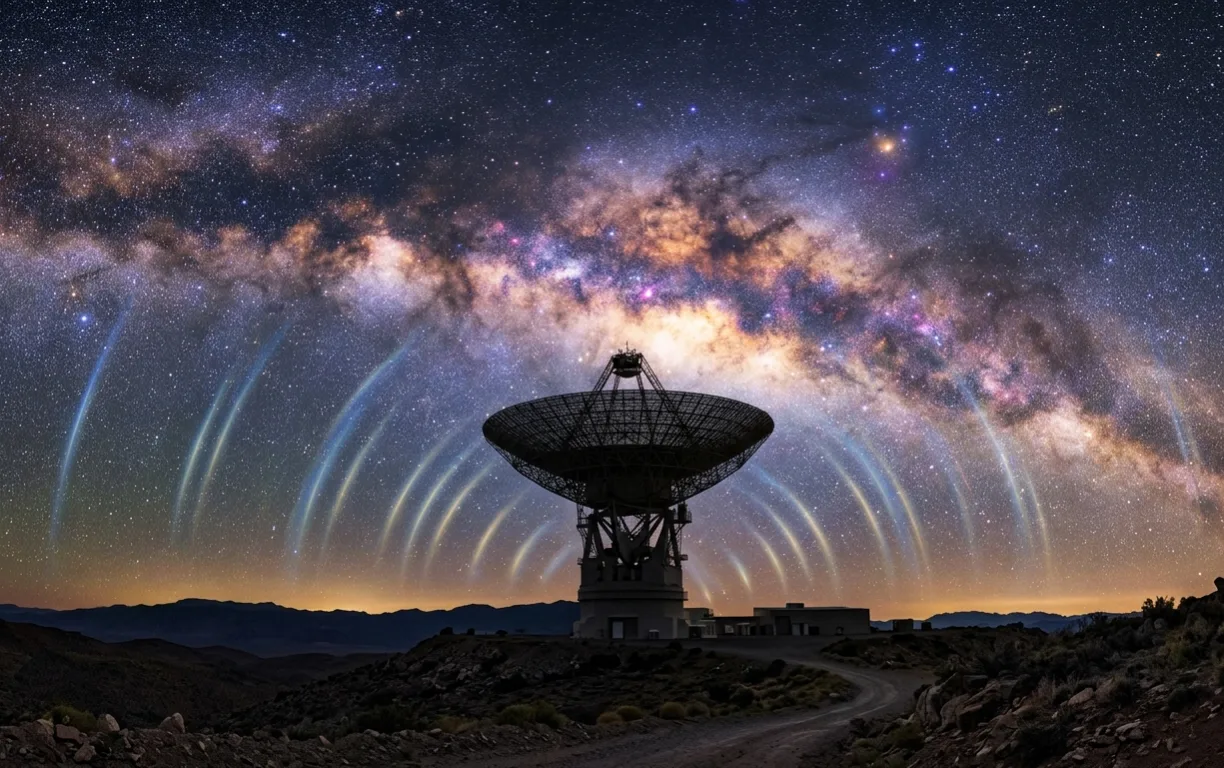
In This Article
- The Sky You Cannot See
- How Radio Waves Already Reach the Stars
- How Could We Actually Detect an Alien Signal?
- Why the Moon Is Our Best Listening Post
- What Happens the Day We Actually Hear Them?
Right now, radio waves from your city's TV channels are travelling through space at the speed of light. They left Earth decades ago and have already passed dozens of nearby stars. If any intelligent civilisation lives around those stars and owns a big enough antenna, they could be listening. Radio astronomer Emma Chapman of the University of Nottingham says the same thing works in reverse — alien worlds are almost certainly leaking radio waves right now, and with the right telescope in the right place, we could hear them.
The Sky You Cannot See
Close your eyes for a moment and imagine the night sky. You picture stars — bright pinpricks of light on a black background. But that image only shows you a tiny slice of what is actually out there. The universe is also full of radio waves: invisible ripples of energy that travel at the same speed as light but cannot be seen by any human eye.
Chapman describes what the sky would look like if we had "radio eyes." The sun would almost disappear. The moon would look permanently full. And in between every star you know, the sky would fill up with glowing gas clouds, magnetic field lines stretching across whole galaxies, and the expanding shells of exploded stars. Think of the normal night sky as a black sheet of paper with tiny holes punched in it, letting light through. The radio universe is the opposite: you see everything in between the holes.
This invisible universe is not just beautiful. It is useful. And the fact that radio waves travel across impossible distances, passing through walls, clouds, and even the vacuum of space without losing their basic shape, is exactly why they matter so much for finding alien life.
How Radio Waves Already Reach the Stars
Here is something most people have never stopped to think about. Every television broadcast, every radio station, every mobile phone signal that has ever been transmitted on Earth does not stop at the edge of our atmosphere. It keeps going. Those signals travel outward in every direction at the speed of light, forever.
The first strong radio signals left Earth roughly a hundred years ago. That means a bubble of human radio noise now stretches about 100 light-years into space in all directions. Any civilisation living within that bubble and pointing a powerful enough receiver at our sun could, in theory, detect that we are here — not from any deliberate message, but simply from our everyday noise.
Chapman's key argument is simple: physics is the same everywhere in the universe. Any intelligent species that develops technology will almost certainly discover radio waves. They will use them to communicate across long distances. And those waves will leak outward into space, just as ours do — with no intention of contacting anyone. We would not need to wait for aliens to send us a deliberate greeting. The clue would already be travelling toward us.
How Could We Actually Detect an Alien Signal?
This is where the search gets genuinely hard. Earth's own radio environment is getting noisier by the year. Thousands of satellites, including constellations like Starlink, are filling the sky with signals. A faint whisper from a planet 70 light-years away would be drowned out almost completely. Think of trying to hear someone speak from the other side of a stadium while a rock concert plays at full volume.
The SETI Institute, which has been running the Search for Extraterrestrial Intelligence for decades, uses large radio telescopes to scan millions of frequencies at once, looking for any signal that no natural object — no star, no gas cloud, no pulsar — could produce on its own. The search, as Chapman describes it, is brutally patient.
"They don't even have to want to contact us. They are leaking radio waves, just like we are leaking radio broadcasts. It would take an enormously powerful antenna to pick it up, but it is within the realm of possibility."
— Emma Chapman, University of Nottingham · Live Science, 2026More telescopes scanning more frequencies at once raises the odds dramatically. Chapman compares it to picking up a phone call: you can only answer if you happen to pick up at the exact moment the call comes in. The more receivers running simultaneously, the better the chance of catching that moment. It could happen this afternoon. It could happen in 200 years. Nobody knows.
Why the Moon Is Our Best Listening Post
Earth is simply too noisy for the most sensitive searches. The solution, Chapman argues, is to go somewhere that human-made radio interference cannot follow. The far side of the moon is the quietest place in the entire solar system. The moon's bulk blocks every single signal from Earth, leaving behind a silence that no location on our planet can match.
One plan already being discussed at NASA involves using a large natural crater on the moon's far side as a natural dish, the same way the now-collapsed Arecibo Observatory in Puerto Rico used a bowl-shaped valley. A few lightweight boxes would land at the crater's rim, unfurl copper wire to act as the antenna, and begin collecting radio signals from the deepest and oldest corners of the universe. Chapman believes this could realistically happen within a decade.
What Happens the Day We Actually Hear Them?
Suppose tomorrow morning a radio telescope picks up a signal that no natural source can explain. What happens next? Chapman is honest: the protocols exist within individual scientific teams, but no clear global plan does. Scientists would first check the signal over and over, making sure it repeats and that nothing on Earth caused it. Then they would work out exactly which part of the sky it came from and whether a known planet sits there.
Only after all of that would the wider world find out. And Chapman has thought hard about what happens after that. The distance alone would put an immediate limit on any panic. A signal from 70 light-years away was sent 70 years ago. The senders cannot arrive unannounced; the physics of the universe simply does not allow the energy required for faster-than-light travel. No respected SETI researcher believes alien visitation has ever occurred.
At that distance, any conversation would span human generations. Ask a question today, wait 70 years for the reply. It sounds absurd, but Chapman finds it wonderful.
- Radio waves cross any distance — they travel at the speed of light through empty space, making them the most practical way for any civilisation to communicate across the enormous gaps between stars.
- The leak is already happening — Earth has been broadcasting its presence for over a century without meaning to, and alien worlds with technology are almost certainly doing the same thing right now.
- The moon changes everything — a radio telescope on the far side of the moon, shielded from all Earth noise, would give humanity its most powerful ear for listening to the cosmos and, potentially, to others within it.
"It is not just a search for other life. It is a mirror held up at the cosmos, showing us what our own signals look like from the outside — and reminding us that, to someone out there, we are already the aliens." — Emma Chapman, University of Nottingham, 2026.
📄 Source & Citation
Primary Source: Specktor B. (2026). "The sun would all but disappear, and the moon would always look full": A radio astronomer shares her mind-bending view of the universe. Live Science. livescience.com
Authors & Affiliations: Dr Emma Chapman, Department of Physics and Astronomy, University of Nottingham, England. Interviewed by Brandon Specktor, Live Science.
Book: Chapman E. (2026). The Echoing Universe: How Radio Astronomy Helps Us See the Invisible Cosmos. Basic Books.
Key Themes: Radio Astronomy · SETI · Extraterrestrial Intelligence · Lunar Telescope · Technosignatures
Supporting References:
[1] SETI Institute. (2024). Overview of SETI research programmes. seti.org.
[2] NASA Jet Propulsion Laboratory. (2025). Lunar Crater Radio Telescope (LCRT) concept study. nasa.gov.
[3] Isaacson H. et al. (2023). Radio technosignature searches with the MeerKAT telescope. Astrophysical Journal, 945(2).
No comments yet. Be the first to share your thoughts.
Leave a Comment