 Sanjay Verma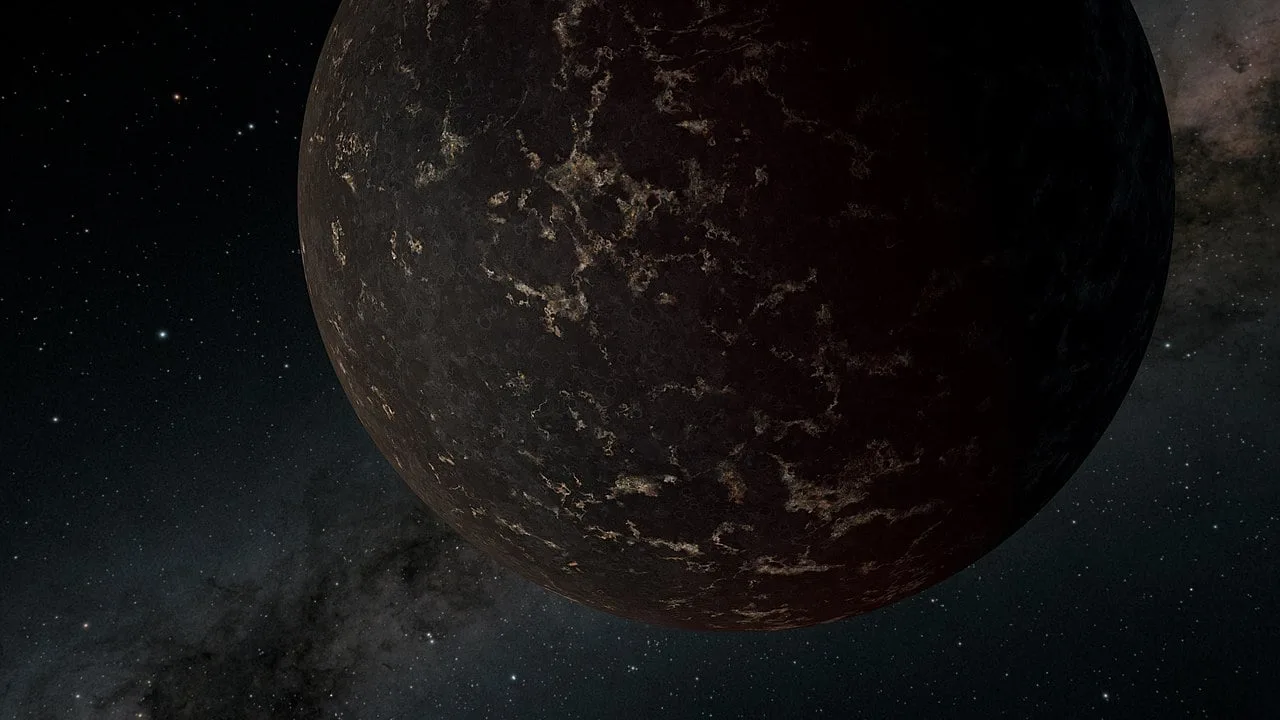
In This Article
- Meet Kua'kua — The Planet With a Beautiful Name and a Brutal Surface
- How JWST Read a Planet's Surface From 48 Light-Years Away
- Why Does LHS 3844 b Have No Atmosphere?
- What Would It Actually Feel Like to Stand on Kua'kua?
- What Comes Next — and Why This Still Matters
Picture a world 30% bigger than Earth, baking under a sun so close it completes an entire orbit in just 11 hours — hotter than a furnace, darker than coal, and wrapped in absolutely nothing. No air. No breeze. No clouds. Just ancient scorched rock under a sky that has been silent for billions of years. That world is real. It sits 48 light-years from Earth, and the James Webb Space Telescope just gave us our most detailed look at its surface — a result published in Nature Astronomy in 2026 by a team led by Sebastian Zieba of Harvard and Laura Kreidberg of the Max Planck Institute for Astronomy in Heidelberg.
Meet Kua'kua — The Planet With a Beautiful Name and a Brutal Surface
The planet's official name is LHS 3844 b. Scientists informally call it Kua'kua, a word from the Bribri language of Central America meaning "butterfly." The name sounds gentle. The planet is anything but.
Kua'kua is what astronomers call a super-Earth — a rocky planet bigger than Earth but smaller than Neptune. It orbits a red dwarf star (a small, dim star much cooler than our sun) called Batsu, completing one full orbit every 11 hours. To understand how close that is: Earth takes 365 days to go around our sun. Kua'kua takes less than half a day.
Because Kua'kua orbits so close to its star, it is tidally locked. That means one side always faces the star and one side always faces away — just as the same face of our Moon always looks toward Earth. The dayside of Kua'kua never gets a break. It bakes at around 1,000 Kelvin (about 727°C) every single second. That heat, combined with the complete absence of any atmosphere, makes it one of the most extreme environments yet studied by any telescope. And the surprising discoveries do not stop there.
How JWST Read a Planet's Surface From 48 Light-Years Away
This is where the science becomes genuinely astonishing. Kua'kua is 48 light-years from Earth — roughly 450 trillion kilometres. Yet JWST's Mid-Infrared Instrument (MIRI) collected infrared light directly from its surface and built a detailed picture of what the rocks there are made of. Think of it like reading the label on a jar from across a city using only the heat it gives off.
Infrared light — sometimes called heat radiation — carries a chemical fingerprint. Different rocks and minerals glow in slightly different patterns of infrared. The team compared Kua'kua's infrared fingerprint to known rock types from Earth, the Moon, and Mars, running hundreds of computer models to find the best match.
The result was clear and unexpected. Kua'kua's surface does not match the granite-rich crust that covers much of Earth's continents. Instead it matches darker, denser material — volcanic mantle rock, the kind of rock that sits deep beneath Earth's surface and only reaches the top during massive eruptions. That one finding quietly rewrote everything the team thought they knew about the planet's history.
Why Does LHS 3844 b Have No Atmosphere?
On Earth, the air surrounding us is not just there by accident. It built up slowly over billions of years, largely thanks to volcanoes. Every eruption releases gases — water vapour, carbon dioxide, sulphur dioxide — that gradually accumulated into the blanket of atmosphere that keeps us warm, lets us breathe, and shields us from harmful radiation.
Kua'kua appears to have none of that. And the surface data now explains why. The rock type JWST detected is not the kind that forms through repeated cycles of melting, tectonic shifting, and resolidification. On Earth, plate tectonics — the slow movement of giant slabs of crust — constantly recycles rock and helps build a geologically active, gas-releasing planet. Kua'kua shows no evidence of that process.
"Thanks to the amazing sensitivity of JWST, we can detect light coming directly from the surface of this distant rocky planet. We see a dark, hot, barren rock, devoid of any atmosphere."
— Laura Kreidberg, Max Planck Institute for Astronomy, Heidelberg · Nature Astronomy, 2026Without tectonic activity, there is no gas release. Without gas release, there is no atmosphere to build. And without an atmosphere, there is nothing to shield the surface from the star's radiation — which strips away any remaining gas even faster. Zieba's team also concluded that Kua'kua likely contains very little water, another ingredient Earth relies on to drive plate tectonics in the first place. It is a chain of geological failures, each one making the next more certain.
What Would It Actually Feel Like to Stand on Kua'kua?
Close your eyes and try to imagine it. You are standing on a world larger than Earth. The sky above is black — not the dark-blue black of a clear night, but completely, permanently black, because there is no air to scatter any light. The star hangs massive and red in the sky, motionless, because this planet never rotates relative to it. The ground beneath your feet is dark volcanic rock — the same dense, iron-rich basalt that pours from volcanoes on Earth and forms the floors of our oceans.
There may also be a layer of what scientists call regolith on top — a fine dark dust created over billions of years by tiny meteorites constantly pounding the surface. This is exactly what coats the Moon. Each impact is too small to see, but over vast stretches of time, the cumulative effect grinds hard rock into powder and darkens it by adding iron and carbon. That darkening is actually what the JWST data may be capturing.
What Comes Next — and Why This Still Matters
Zieba, Kreidberg, and their team are not done with Kua'kua. More JWST time is already approved, and the next observations will study how the surface looks from different angles and at different times. The roughness of a surface affects how it radiates heat. Smooth fresh lava and ancient powdery regolith radiate differently. By comparing multiple observations over time, the team can separate one from the other.
This is the same technique planetary scientists already use to study asteroids in our solar system — and it works. Kreidberg says she is confident it will do the same for rocky exoplanets. That matters far beyond just one planet.
Every rocky planet JWST studies adds a data point to a larger map of how worlds form, evolve, and die. Kua'kua may be barren, but it is telling us exactly what happens to a rocky planet that loses — or never had — the ingredients Earth was lucky enough to keep: water, tectonic movement, and a volcano-built sky.
- No crust means no plate tectonics — Kua'kua lacks the granite-rich surface crust that forms through tectonic cycling on Earth, suggesting its geology stopped evolving long ago.
- No volcanism means no atmosphere — Without volcanic gas releases over geological time, there was nothing to build or replenish an atmosphere against the star's radiation.
- JWST can read rock types from light-years away — The MIRI instrument's infrared sensitivity is now precise enough to identify surface minerals on planets beyond our solar system, opening a new era of exoplanet geology.
"We are confident the same technique will allow us to clarify the nature of LHS 3844 b's crust and, in the future, other rocky exoplanets." — Laura Kreidberg, Max Planck Institute for Astronomy, Nature Astronomy, 2026.
Kua'kua will never have oceans, forests, or cities. But it is giving us something almost as precious: a window into the processes that decide whether a world lives or dies. And the more of those windows we open, the better we understand why, out of all the barren rocks scattered across the galaxy, our own pale blue dot turned out the way it did.
📄 Source & Citation
Primary Source: Zieba S., Kreidberg L., et al. (2026). The dark and featureless surface of rocky exoplanet LHS 3844 b from JWST mid-infrared spectroscopy. Nature Astronomy. https://doi.org/10.1038/s41550-026-02860-3
Authors & Affiliations: Sebastian Zieba (Harvard Center for Astrophysics); Laura Kreidberg (Max Planck Institute for Astronomy, Heidelberg).
Instruments Used: JWST MIRI (Mid-Infrared Instrument); Spitzer Space Telescope (archival data).
Planet Discovery: LHS 3844 b first discovered by the Transiting Exoplanet Survey Satellite (TESS) in 2018.
Key Themes: Rocky Exoplanets · Super-Earths · Planetary Atmospheres · Exoplanet Geology · JWST Science
Supporting References:
[1] Vanderspek R. et al. (2019). TESS observation of the rocky super-Earth LHS 3844 b. Astrophysical Journal Letters, 871(2).
[2] Kreidberg L. et al. (2019). Absence of a thick atmosphere on the terrestrial exoplanet LHS 3844 b. Nature, 573:87–90.
[3] Max Planck Institute for Astronomy. (2026). Astronomers explore the surface composition of a nearby super-Earth. mpia.de.
No comments yet. Be the first to share your thoughts.
Leave a Comment