 Sanjay Verma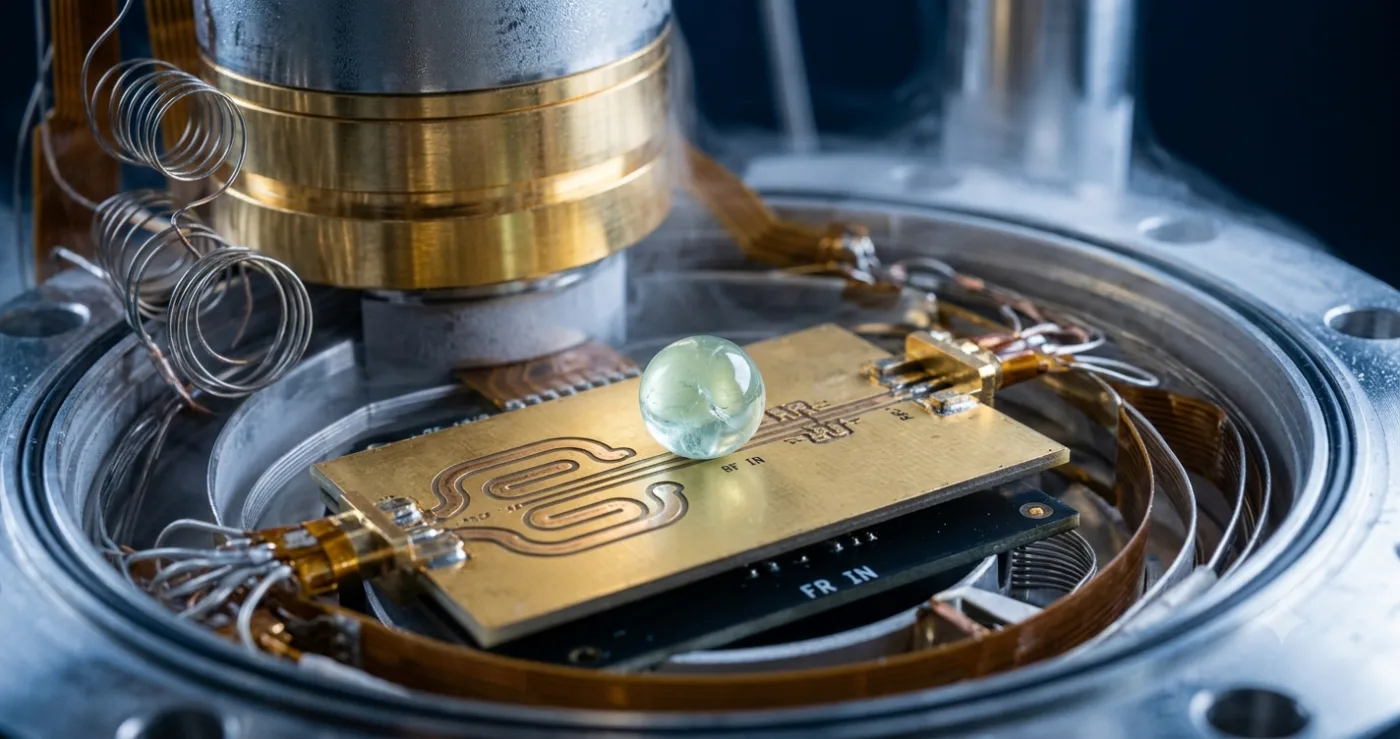
In This Article
- The Magnon Lifetime Problem That Blocked Quantum Computers
- Why Earlier Magnon Experiments Kept Failing
- How Did Scientists Stretch Magnon Lifetime to 18 Microseconds?
- What Longer Magnon Lifetimes Mean for Quantum Computing
- What Scientists Still Need to Figure Out
Imagine a whisper that used to fade before you finished saying hello, now lasting long enough to hold an entire conversation. That is roughly what just happened inside a physics lab, where a magnetic signal called a magnon held onto its energy for 18 microseconds, nearly a hundred times longer than any earlier measurement. The magnon lifetime breakthrough, reported by physicists at the University of Vienna and partner institutions, could remove one of the biggest roadblocks standing between today's computers and tomorrow's quantum machines.
The Magnon Lifetime Problem That Blocked Quantum Computers
For years, magnons looked like promising building blocks for quantum computers, but they had one fatal flaw. A magnon is a tiny ripple of magnetism that moves through a crystal, similar to a wave crossing a pond after a stone drops in. The trouble was that this ripple died out in a few hundred nanoseconds, faster than a heartbeat, before anyone could use it to carry quantum information.
That short window meant a single magnon could only stay in touch with about two qubits, the basic switches inside a quantum computer, before it vanished. Scientists studying superconducting circuits, the same technology behind machines built for IBM's quantum computing program, needed a signal that could last far longer without losing its quantum state.
Why Earlier Magnon Experiments Kept Failing
Most past experiments studied a magnon mode that oscillates the same way across the whole crystal, known as the Kittel mode. It is easy to trigger, but it sits right at the crystal's surface, where scratches and rough edges scatter its energy away almost instantly. Surface defects act like potholes on a smooth road, slowing and breaking up the wave before it can travel far.
Researchers already suspected that magnons traveling deeper inside a crystal, away from those surface potholes, might survive longer. What nobody had shown was exactly how much longer, or whether cold alone would be enough to prove it.
How Did Scientists Stretch Magnon Lifetime to 18 Microseconds?
The team swapped the surface-hugging Kittel mode for short-wavelength magnons called dipole-exchange magnons, ripples so tiny their wavelength is close to one micrometer, traveling deep inside the crystal instead of skimming its surface. They grew three pea-sized spheres of yttrium iron garnet, a magnetic crystal prized for how quietly it lets magnons travel, then chilled each sphere inside a dilution refrigerator down to 30 millikelvin, colder than the empty vacuum of deep space.
At that temperature, they fired a precise microwave pulse at each sphere and watched one large magnon split into two smaller ones, timing exactly how long that secondary pair survived before fading away. The room-temperature result matched older studies almost exactly, about one microsecond, which told the team their new method was measuring the real thing rather than an experimental fluke.
"...positioning magnons as viable, long-lived information carriers for solid-state quantum computing."
— Serha et al., University of Vienna · Science Advances, 2026What Longer Magnon Lifetimes Mean for Quantum Computing
Eighteen microseconds might sound tiny, but in the quantum world it counts as a lifetime. That duration now roughly matches the coherence time of typical superconducting transmon qubits, the circuits at the heart of many working quantum processors. Long-lived magnons could act as a quantum bus, a shared microwave highway letting hundreds of distant qubits talk to each other instead of only whispering to their nearest neighbor.
That distance matters because most current quantum chips can only link qubits sitting right next to one another, which caps how large and useful a single machine can grow. A magnon that survives 18 microseconds could, in principle, carry a quantum signal across an entire chip before it fades.
What Scientists Still Need to Figure Out
The magnon lifetime stopped growing below about 100 millikelvin, even though colder conditions should, in theory, keep helping rather than leveling off. Leftover rare-earth atoms trapped in the crystal lattice keep flickering their own tiny magnetic fields, and the researchers believe those flickers are now the last major speed bump. The team never tested temperatures below 30 millikelvin, where that flickering might finally calm down enough to push the lifetime even higher.
Turning this lab result into a working quantum bus will also require tiny transducers that can couple magnons to microwave circuits without losing the signal, a separate engineering challenge the paper flags as unfinished business. The path forward looks less like a redesign and more like a purity contest: cleaner crystals, longer-lived magnons, and the same lesson every patient experimenter eventually learns, that sometimes the biggest breakthrough is simply refusing to accept how something is supposed to fall apart.
- 100 times longer — Magnon lifetime jumped from a few hundred nanoseconds to 18 microseconds by using deep, short-wavelength ripples instead of surface waves.
- Crystal purity matters most — The cleanest yttrium iron garnet sphere held its magnon signal four times longer than the least pure one.
- Quantum bus potential — Long-lived magnons could link hundreds of qubits together, a scale current quantum chips still struggle to reach.
The coherence of these short-wavelength magnons no longer depends on the fragile surface effects that doomed earlier attempts. It depends, instead, on how clean the crystal can be made, a materials problem the field can now chase directly. Serha et al., Science Advances, 2026.
📄 Source & Citation
Primary Source: Serha RO, McAllister KH, Majcen F, Knauer S, Reimann T, Dubs C, Melkov GA, Serga AA, Tyberkevych VS, Chumak AV, Bozhko DA. (2026). Ultralong-living magnons in the quantum limit. Science Advances, 12(18), eaee2344. https://doi.org/10.1126/sciadv.aee2344
Authors & Affiliations: Lead author Rostyslav O. Serha (University of Vienna), with collaborators at the University of Colorado Colorado Springs, INNOVENT e.V. Technologieentwicklung Jena, Taras Shevchenko National University of Kyiv, RPTU Kaiserslautern-Landau, and Oakland University.
Data & Code: Extended raw dataset and materials deposited in the OSF database at doi.org/10.17605/OSF.IO/JPSM2.
Key Themes: Quantum magnonics · Yttrium iron garnet · Spin waves · Quantum coherence · Superconducting qubits
Supporting References:
[1] Tabuchi Y, Ishino S, Noguchi A, Ishikawa T, Yamazaki R, Usami K, Nakamura Y. (2015). Coherent coupling between a ferromagnetic magnon and a superconducting qubit. Science, 349(6246):405-408.
[2] Lachance-Quirion D, Wolski SP, Tabuchi Y, Kono S, Usami K, Nakamura Y. (2020). Entanglement-based single-shot detection of a single magnon with a superconducting qubit. Science, 367(6476):425-428.
[3] Kosen S, van Loo AF, Bozhko DA, Mihalceanu L, Karenowska AD. (2019). Microwave magnon damping in YIG films at millikelvin temperatures. APL Materials, 7:101120.
No comments yet. Be the first to share your thoughts.
Leave a Comment