 Sanjay Verma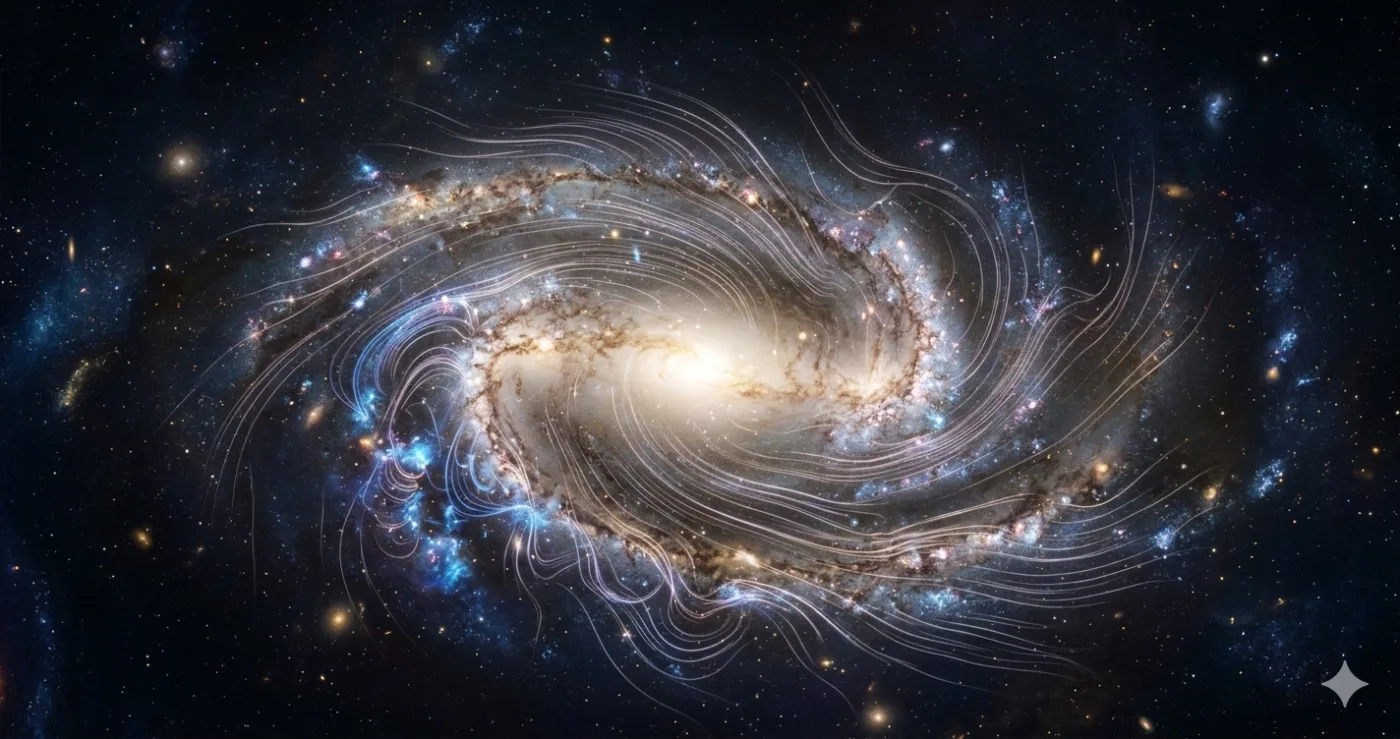
In This Article
- An Invisible Force Holding the Galaxy Together
- The Trick for Seeing Something Invisible
- How Did Scientists Spot a Twist No One Expected?
- What the Diagonal Twist Tells Us
- The Questions That Still Need Answering
Our galaxy is wrapped in something you can never see, yet it holds everything in place. It is the Milky Way magnetic field, a vast and invisible web of force. Astronomers have just drawn one of the clearest maps of it ever made, and the map held a shock: deep in one spiral arm, the field suddenly flips and runs the wrong way, cutting a giant diagonal twist across space.
An Invisible Force Holding the Galaxy Together
Think of a giant spinning plate of stars, gas, and dust. That is our galaxy. Gravity is always trying to pull all of it inward, so something has to push back and keep it steady.
One of those quiet helpers is the galaxy's magnetic field. It is far too weak to feel, but it stretches across the entire Milky Way. Scientists have long known it is there. What they lacked was a clear picture of its real shape.
To map something invisible, the team needed a clever trick. And they had one.
The Trick for Seeing Something Invisible
You cannot photograph a magnetic field. So scientists watch what it does to radio waves passing through it. As those waves travel across space, electrons and magnetic fields gently twist them. That twist is called Faraday rotation.
One researcher compared it to a familiar sight: a straw in a glass of water looks bent because light changes as it passes through. By measuring how much the radio waves get twisted, the team could trace the hidden magnetic shapes behind them.
The work used a new telescope in British Columbia and fed into a global project called the Global Magneto-Ionic Medium Survey, or GMIMS. Then the data showed something strange.
How Did Scientists Spot a Twist No One Expected?
Looked at from above, the Milky Way's magnetic field mostly runs in one direction, like a clock turning clockwise. The whole galaxy seems to follow that simple rule.
But in one region, the Sagittarius Arm, the field does the opposite. It runs counterclockwise. Scientists had seen hints of this reversal before, yet they could not work out how the field switched from one direction to the other.
The breakthrough came from the fresh, detailed data. The reversal was not a sharp wall. It was diagonal, slanting across space. The lead professor described the moment a colleague brought in the new data and the diagonal shape suddenly jumped out, an answer the team had been missing for years.
"We need to know what the magnetic field of the galaxy looks like now, so we can create accurate models that predict how it will evolve."
— Brown, University of Calgary · The Astrophysical Journal, 2026What the Diagonal Twist Tells Us
A reversal is a place where the magnetic field points one way on one side and the opposite way on the other. Finding that the switch happens along a slanted, three-dimensional line is a real clue about how the galaxy is built.
One team member turned the discovery into a new 3D model. From our spot on Earth, that slanted structure is exactly what shows up as the diagonal seen in the data. It explains a puzzle that had no good answer before.
Still, a single new map cannot answer everything about a galaxy this big.
The Questions That Still Need Answering
This work maps the field as it looks today, but it does not fully explain why the reversal formed in the first place. How a galaxy grows a diagonal magnetic twist is still an open question.
The survey also covered the northern sky, so a matching look at the southern sky would complete the picture. Scientists want to know how this reversal fits into the long story of how galaxies form and slowly change over billions of years.
- An invisible scaffold — the galaxy's magnetic field helps hold the Milky Way against the inward pull of gravity.
- A diagonal flip — in the Sagittarius Arm the field reverses direction along a slanted, three-dimensional line.
- A tool for everyone — the survey leaves behind a detailed magnetic map that astronomers worldwide can keep using.
"The discovery provides an important new clue about the hidden magnetic architecture of the Milky Way and could help scientists better understand how galaxies evolve." — University of Calgary, 2026.
We live inside this galaxy, yet we are still drawing its true shape for the first time. That is the quiet wonder of this work. The biggest things around us can stay hidden in plain sight, waiting for someone with the right tool and the patience to look closer.
📄 Source & Citation
Primary Source: Booth, R.A., Ordog, A., Brown, J.-A. et al. (2026). A three-dimensional model for the reversal in the local large-scale interstellar magnetic field. The Astrophysical Journal, 997(2), 304. https://doi.org/10.3847/1538-4357/ae28d1
Authors & Affiliations: Led by Rebecca A. Booth, Anna Ordog, and Jo-Anne Brown of the Department of Physics and Astronomy, University of Calgary, with international GMIMS collaborators.
Data & Code: The Faraday depth survey dataset is published openly as part of the Global Magneto-Ionic Medium Survey (GMIMS-DRAGONS).
Key Themes: Milky Way magnetic field · Magnetic reversal · Sagittarius Arm · Faraday rotation · Galaxy structure
Supporting References:
[1] Ordog, A., Booth, R.A., Landecker, T.L. et al. (2026). GMIMS-DRAGONS: a Faraday depth survey of the northern sky covering 350–1030 MHz. The Astrophysical Journal Supplement Series, 282(2):53.
[2] Dominion Radio Astrophysical Observatory, National Research Council Canada — radio survey facility.
[3] Global Magneto-Ionic Medium Survey (GMIMS) — international galactic magnetic field mapping project.
No comments yet. Be the first to share your thoughts.
Leave a Comment