 Krishan Gopal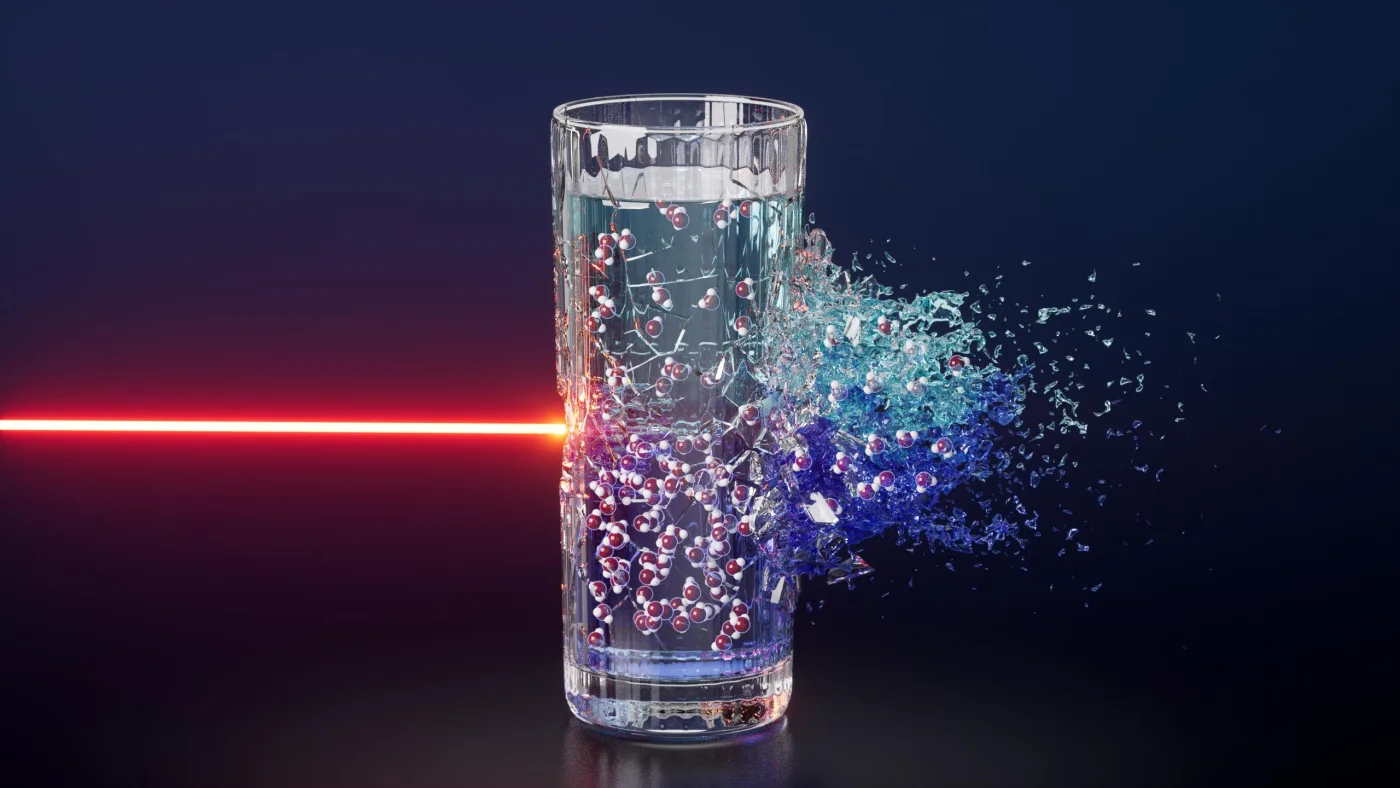
In This Article
- The Paradox That Has Puzzled Science for 150 Years
- Why Water Refuses to Play by the Rules
- How Did Scientists Finally Find the Hidden Critical Point?
- What a "Black Hole" Inside Water Actually Means
- Why This Discovery Could Reshape Our Understanding of Life Itself
Think about the last time you dropped an ice cube into a glass of water. The ice floated. You barely noticed. But that simple, mundane moment represents one of the biggest unsolved puzzles in all of science — and for over 150 years, physicists have had no satisfying explanation for it. Now, a team at Stockholm University, using some of the most powerful X-ray lasers on Earth, has finally found the answer buried inside supercooled water: a hidden critical point where water briefly exists as two separate liquids at once.
The Paradox That Has Puzzled Science for 150 Years
Water is the most familiar substance in our lives. We drink it, cook with it, bathe in it — India alone depends on it for agriculture feeding 1.4 billion people and a monsoon system that shapes the entire subcontinent's climate. Yet for all its familiarity, water is deeply, stubbornly weird.
Most liquids get denser as they cool. They compress, their molecules slow and pack tighter, and when they freeze, the solid sinks because it is denser than the liquid. Water does the exact opposite. Ice floats. Liquid water is densest not at 0°C but at 4°C — and below that, it starts expanding again as you cool it further. It is as if water is trying to defy the rules everyone else agreed to follow.
The great German physicist Wilhelm Röntgen — the same man who discovered X-rays — was among the first to propose, back in 1892, that water might secretly consist of two different structural forms. The idea was radical then. A century later, it is finally confirmed.
Why Water Refuses to Play by the Rules
Under normal conditions, liquid water is a single phase — one consistent substance. But scientists had long suspected that deep inside the supercooled regime (when water is chilled well below freezing without being allowed to crystallise), water might split into two distinct liquid forms. One form has a denser, more disordered molecular structure. The other is less dense and more tetrahedral, with water molecules arranged in an open, ice-like lattice.
The theory said these two forms should coexist under extreme cold and pressure, and that somewhere in that frozen, high-pressure region, there should be a critical point — a precise spot where the line separating the two liquids vanishes entirely. At and around that critical point, the two liquid forms would constantly fluctuate back and forth, unable to settle. And those fluctuations, rippling outward, would explain water's bizarre behaviour even at room temperature.
The problem? Nobody could get there to check. Water insists on freezing before you can chill it far enough, and the predicted critical point sits at roughly −63°C and 1,000 atmospheres of pressure. Reaching it experimentally was, for most of the last century, essentially impossible.
How Did Scientists Finally Find the Hidden Critical Point?
The answer was speed. Extraordinary, almost unimaginable speed. Researchers from Stockholm University travelled to the PAL-XFEL facility in South Korea — one of the world's most powerful X-ray free-electron laser labs — to fire ultra-fast X-ray pulses at droplets of deeply supercooled water. The key insight: if you can hit the water with X-rays fast enough, you can capture a snapshot of its molecular structure before the sample has any chance to freeze.
The team used amorphous ice — a glassy, non-crystalline form of frozen water — as their starting point. When this ice is rapidly warmed, it briefly passes through the deeply supercooled liquid state before crystallising. That fleeting window, lasting just millionths of a second, was their target.
What they saw in that window confirmed the theory. The X-ray data revealed the liquid-liquid transition — the boundary between the two liquid forms — and then showed exactly where it vanishes: the critical point. The findings were published in the journal Science in March 2026.
"For decades, there have been speculations and different theories to explain these remarkable properties, and one theory has been the existence of a critical point. Now we have found that such a point exists."
— Anders Nilsson, Stockholm University · Science, 2026What a "Black Hole" Inside Water Actually Means
Here is where the story gets genuinely strange. As the researchers observed water approaching the critical point, they noticed something unexpected: the system's internal dynamics slowed dramatically. The molecular fluctuations — normally rapid and chaotic — began to grind down, as though the water were being pulled into a region it could not escape from.
Robin Tyburski, a researcher in Chemical Physics at Stockholm University, put it vividly: the behaviour near the critical point resembles falling toward a black hole. Once you enter that regime, the physics bends around you in ways that feel inescapable. The analogy is not literal, of course — but the mathematical parallels in how both systems behave near a point of no return are striking enough that even physicists reached for the same metaphor.
Beyond the critical point, water enters what scientists call a supercritical state — a phase where the distinction between liquid and gas dissolves entirely. And here is the remarkable part: this supercritical water is the condition water exists in under normal, everyday, ambient conditions. The water in your glass right now is technically supercritical with respect to that hidden phase boundary. It exists on the far side of the transition, which is why those fluctuations — the two liquid forms trading places — can ripple all the way up to room temperature and affect properties like viscosity, compressibility, and heat capacity in ways no other liquid shares.
Why This Discovery Could Reshape Our Understanding of Life Itself
Perhaps the most tantalising question raised by this research is not about physics at all — it is about biology. Fivos Perakis, an associate professor in Chemical Physics at Stockholm University, put it plainly: water is the only substance that exists in a supercritical state under the ambient conditions where life thrives on Earth. Every other supercritical fluid requires extreme industrial conditions to reach that state. Water gets there naturally, at sea level, at body temperature.
Is that a coincidence? Or is there something about water's unique supercritical nature — the constant flickering between two liquid structures — that makes it uniquely suited as the solvent of life? Could the anomalous properties we have been puzzling over for centuries actually be features, not bugs? Features that evolution discovered and learned to exploit, from the way proteins fold to the way DNA is hydrated inside every cell in your body?
These are the questions the field now gets to chase. According to lead researcher Anders Nilsson, the next stage of this work is to trace the implications of this confirmed critical point across physical, chemical, biological, geological, and climate-related processes. That is an enormous mandate — essentially, understanding water from scratch with a corrected model.
- A century-long debate is settled — Scientists can now agree on a single model for water's anomalous behaviour, ending decades of competing theories and allowing research to move forward on a unified foundation.
- Climate and hydrology models may improve — Water's unusual density and compressibility underpin everything from ocean circulation patterns to monsoon dynamics; a corrected molecular model could sharpen long-range climate predictions.
- Biology may be the biggest frontier — If water's supercritical nature is essential to life's chemistry, this discovery opens a new line of inquiry into why life as we know it depends so specifically on H₂O and not any other solvent.
"I find it very exciting that water is the only supercritical liquid at ambient conditions where life exists and we also know there is no life without water. Is this a pure coincidence or is there some essential knowledge for us to gain in the future?" — Fivos Perakis, Stockholm University, Science, 2026.
📄 Source & Citation
Primary Source: You S, Ladd-Parada M, Nam K, Karina A, et al. (2026). Experimental evidence of a liquid-liquid critical point in supercooled water. Science. https://doi.org/10.1126/science.aec0018
Authors & Affiliations: Anders Nilsson, Fivos Perakis, Aigerim Karina, Robin Tyburski, Iason Andronis (Stockholm University); Kyung Hwan Kim, Seonju You (POSTECH University, South Korea); collaborators from Max Planck Society, Johannes Gutenberg University (Germany), and St. Francis Xavier University (Canada).
Original News Coverage: SciTechDaily — "Scientists Finally Solved One of Water's Biggest Mysteries" (April 29, 2026). Published by Stockholm University.
Data & Code: Available via the Science journal's online supplementary portal at the DOI link above.
Key Themes: Supercooled Water · Liquid-Liquid Phase Transition · Critical Point Physics · X-Ray Free-Electron Laser · Origin of Life Chemistry
Supporting References:
[1] Debenedetti PG. (2003). Supercooled and glassy water. Journal of Physics: Condensed Matter, 15(45):R1669. — IOP Science
[2] Poole PH, Sciortino F, Essmann U, Stanley HE. (1992). Phase behaviour of metastable water. Nature, 360:324–328. — Nature
[3] Nilsson A, Pettersson LGM. (2015). The structural origin of anomalous properties of liquid water. Nature Communications, 6:8998. — Nature Communications
No comments yet. Be the first to share your thoughts.
Leave a Comment